Continuum GRC’s Holistic Operational Risk-Readiness Security Evaluation (HORSE) is a proprietary, policy-driven framework designed to help organizations systematically identify, assess, treat, and continuously monitor enterprise and operational risks.
Unlike traditional point-in-time risk assessments, HORSE takes a holistic view of people, process, technology, and mission. When powered by A.ITAM and AITAMBot, organizations move from reactive risk management to continuous, intelligent risk reduction—delivering a true Roadmap to Risk Reduction.

Introducing the HORSE Framework
Table of Contents
ToggleHORSE (Holistic Operational Risk-Readiness Security Evaluation) is Continuum GRC’s proprietary framework for enterprise and operational risk management. Developed by the founders of Lazarus Alliance and Continuum GRC, HORSE provides a structured, continuous, and policy-driven approach to risk readiness.
HORSE emphasizes:
- Holistic coverage of people, process, technology, and mission
- Policy-driven evaluation rather than pure technical checklists
- Operational readiness as the primary goal
- Continuous monitoring and improvement
- Clear linkage between risk, controls, and business objectives
HORSE is designed to complement and enhance established standards such as NIST RMF, ISO 31000, COSO ERM, and NIST CSF while remaining practical and actionable for real-world organizations.
Why Enterprise & Operational Risk Management Matters
Enterprise and operational risks threaten an organization’s ability to achieve its mission, protect assets, and maintain stakeholder trust. Common risk sources include:
- Cyber threats and technology failures
- Process breakdowns and human error
- Third-party and supply chain exposures
- Regulatory and compliance gaps
- Strategic and financial risks
Without a structured, continuous approach, organizations face blind spots, delayed responses, and increased likelihood of material incidents.
Modules include:
- Holistic Operational Risk-Readiness Security Evaluation (HORSE)
Key Challenges in Enterprise & Operational Risk Management
| Challenge | Description | Business Impact |
|---|---|---|
| Fragmented Risk Visibility | Risks are tracked in departmental silos with inconsistent tools and methodologies across the enterprise. | Incomplete enterprise risk picture, blind spots, and inability to prioritize effectively. |
| Point-in-Time Assessments | Risk evaluations occur periodically rather than continuously, creating gaps between assessments. | Emerging risks go undetected, leading to surprise incidents and compliance failures. |
| Inconsistent Risk Methodology | Different teams apply varying criteria for identifying, scoring, and treating risks. | Unreliable prioritization, poor decision-making, and difficulty aggregating enterprise risk. |
| Manual Evidence Collection | Heavy reliance on manual processes to gather evidence and produce risk reports. | High operational costs, delays, human error, and resource drain on teams. |
| Weak Link Between Risk & Controls | Risk findings are not effectively mapped to controls or remediation actions. | Persistent residual risk and inefficient remediation efforts. |
| Lack of Real-Time Visibility | Leadership receives outdated or infrequent risk reporting. | Delayed response to emerging threats and missed opportunities to reduce risk proactively. |
How A.ITAM and AITAMBot Supercharge HORSE
When HORSE is delivered through Continuum GRC’s A.ITAM platform and powered by AITAMBot, organizations gain powerful automation and intelligence:
- Automated evidence collection and validation across systems
- Intelligent risk scoring and prioritization
- Continuous monitoring of risk indicators and control effectiveness
- Auto-mapping of risks and controls across multiple frameworks
- Real-time dashboards and executive reporting
- Reduced manual effort and faster time-to-insight
A.ITAM turns the HORSE methodology into a living, continuous risk management system rather than a static assessment.
The HORSE Risk Management Lifecycle
HORSE follows a clear, iterative lifecycle that aligns with modern risk management best practices:
- Prepare: Define scope, establish context, risk appetite, and governance.
- Identify & Categorize: Systematically identify enterprise and operational risks.
- Assess: Evaluate likelihood, impact, and existing controls using consistent criteria.
- Select & Implement Treatments: Choose risk treatment strategies (avoid, mitigate, transfer, accept) and implement controls.
- Authorize: Document residual risk and obtain formal acceptance from leadership.
- Monitor: Continuously track risk indicators, control performance, and emerging threats.
- Improve: Use insights from monitoring and incidents to refine the risk program.
This lifecycle is fully supported and automated within A.ITAM.
Key Benefits of HORSE + A.ITAM
- Holistic Risk Visibility: Gain a unified view of enterprise and operational risks across the organization.
- Continuous Risk Readiness: Move from periodic assessments to ongoing monitoring and response.
- Reduced Manual Effort: AITAMBot automates evidence collection, scoring, and reporting.
- Consistent Methodology: Apply a single, proven framework across all business units and risk types.
- Stronger Audit & Regulatory Support: Produce clear, defensible documentation that supports multiple frameworks.
- Better Decision Making: Provide leadership with timely, accurate risk intelligence.
- Improved Operational Resilience: Identify and address risks before they impact operations or reputation.
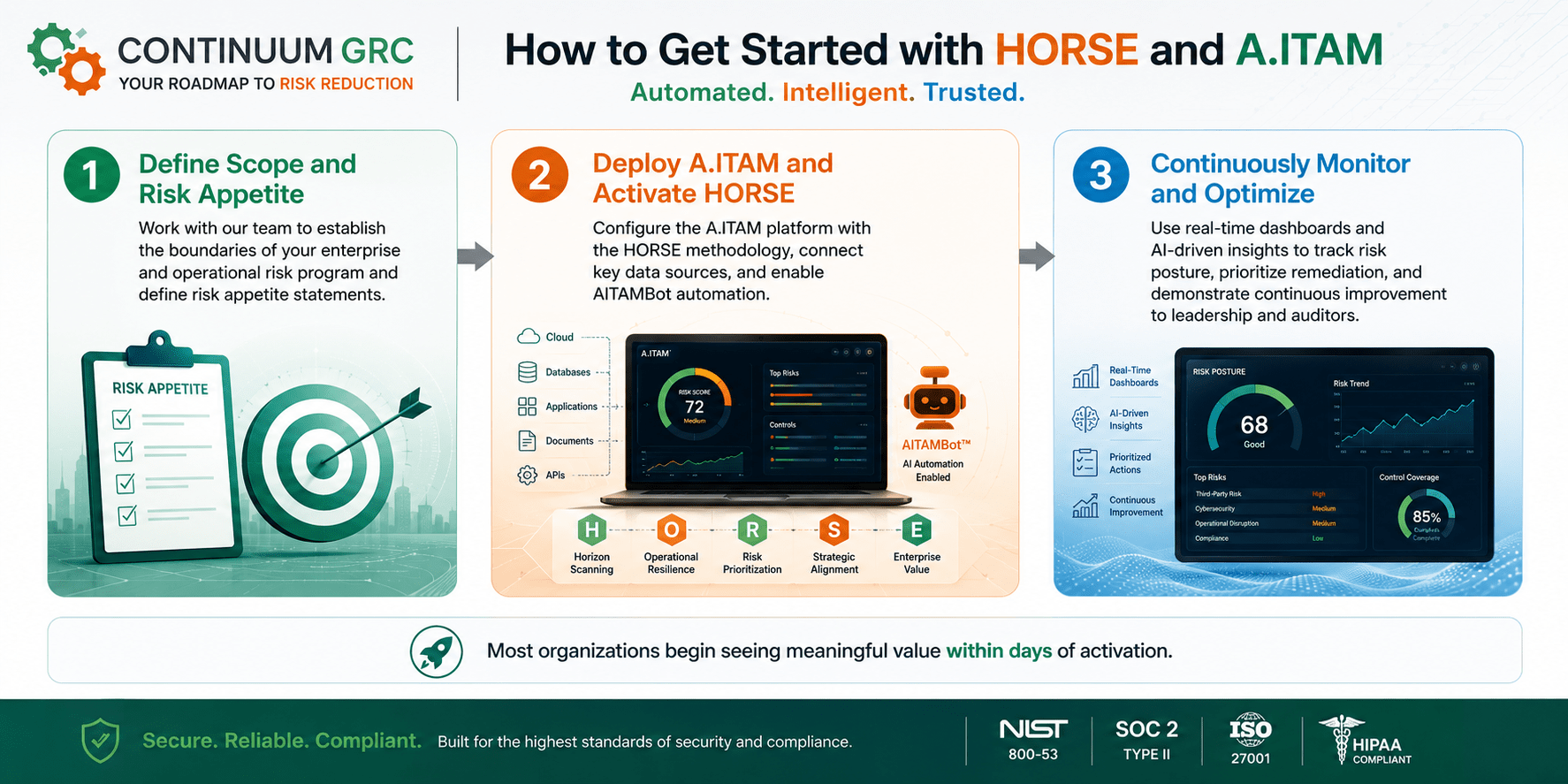
How to Get Started with HORSE and A.ITAM
Step 1: Define Scope and Risk Appetite
Work with our team to establish the boundaries of your enterprise and operational risk program and define risk appetite statements.
Step 2: Deploy A.ITAM and Activate HORSE
Configure the A.ITAM platform with the HORSE methodology, connect key data sources, and enable AITAMBot automation.
Step 3: Continuously Monitor and Optimize
Use real-time dashboards and AI-driven insights to track risk posture, prioritize remediation, and demonstrate continuous improvement to leadership and auditors.
Most organizations begin seeing meaningful value within days of activation.
Why Leading Organizations Choose Continuum GRC for Enterprise Risk
Organizations choose Continuum GRC because we combine the following:
- A proprietary, battle-tested framework (HORSE) developed by experienced practitioners
- The only FedRAMP-authorized AI-powered GRC platform (A.ITAM)
- Deep expertise in regulated industries (defense, government, healthcare, finance)
- A proven Roadmap to Risk Reduction approach
- Seamless multi-framework support and automation
HORSE is not just another framework — it is a practical operating model for continuous enterprise and operational risk management.
FAQ
How does NIST 800-30 ensure comprehensive risk management?
This publication outlines the steps for assessing current risk management practices and implementing better strategies. It has the benefit of using common language to describe and prioritize risks and remediation. It also helps in automating essential processes so that systems have all the appropriate security controls.
How does NIST 800-30 help with business continuity?
Having a robust cybersecurity posture is a proactive approach to maintaining business continuity. Being able to identify potential vulnerabilities and threats, prioritize their impact, and address them beforehand, goes a long way to ensure that business is not interrupted. The steps of NIST 800-30 also help in faster recovery in case of a data breach.
How does NIST 800-30 help organizations develop a risk management culture?
NIST 800-30 makes the steps of a risk management program more concise and systematic. The goal is to embed a risk management mindset throughout a system life cycle. The steps touch every aspect of risk management: planning, processes, controls, access and responsibilities. Active understanding creates a culture around risk management.
What is the role of documentation in NIST 800-30 risk assessments?
Documentation is essential as a record of threats, mitigation efforts, and the thinking behind key decisions. These documents provide transparency and accountability. Moving forward, these records also help an organization track their progress and serve as a resource for future assessments in implementing security controls.
How can organizations implement the Risk Management Framework NIST 800-37?
There are seven steps to implementation:
- Prepare: establish priorities
- Categorize: classify systems and potential impacts on the organization
- Select: security controls that are appropriate for the system and risk level
- Implement: selected controls with appropriate documentation
- Assess: ensure controls are functioning correctly
- Authorize: approve the system for use
- Monitor: continuously monitor to ensure controls are in compliance
What are risk acceptance and risk transfer in NIST 800-30
Risk Acceptance and Risk Transfer are two common response strategies. Risk Acceptance means acknowledging the risk but deciding that it’s within an acceptable risk level. It doesn’t warrant the costs of any mitigation measures.
Risk Transfer acknowledges a risk and assigns the responsibility for handling it to a third party, such as an insurer. You’ll find this in certain industries like construction or finance.
What are you waiting for?
You are just a conversation away from putting the power of Continuum GRC to work for you.
Contact us using the form below or calling us at 1-888-896-6207 for immediate assistance.
About the Standard
HORSE provides a structured process for managing security and privacy risks for federal information systems and organizations. It outlines a seven-step process to ensure systems are secure and compliant with federal standards. Below is a concise summary of the compliance requirements for HORSE, tailored to provide a clear understanding of what organizations must do to comply.
Overview of HORSE Compliance Requirements
Compliance involves implementing the following steps and requirements:
1. Prepare
- Objective: Establish a risk management strategy and prepare the organization for HORSE implementation.
- Requirements:
- Identify organizational and system-level risk management roles and responsibilities.
- Develop a risk management strategy, including risk tolerance and assessment approaches.
- Conduct organization- and system-level risk assessments to identify threats, vulnerabilities, and impacts.
- Establish a system-level security and privacy strategy, including categorization processes.
- Ensure integration of security and privacy requirements into enterprise architecture and acquisition processes.
- Maintain an inventory of information systems and their connections.
- Communicate RMF activities to stakeholders and establish governance structures.
2. Categorize
- Objective: Categorize the system based on the potential impact of a security or privacy breach.
- Requirements:
- Categorize the system based on confidentiality, integrity, and availability.
- Document the categorization in a security categorization report.
- Review and approve the categorization by the system owner
3. Select
- Objective: Select appropriate security and privacy controls based on the system’s categorization.
- Requirements:
- Tailor controls to address specific system risks, mission needs, or operational environments.
- Consider overlays (predefined control sets for specific technologies or environments, e.g., cloud systems).
- Document the selected controls in a Security and Privacy Plan (e.g., System Security Plan, SSP).
- Include continuous monitoring strategies in the plan.
4. Implement
- Objective: Implement the selected controls within the system and its environment.
- Requirements:
- Deploy technical, administrative, and physical controls as specified in the SSP.
- Document the implementation details, including how controls are applied (e.g., configurations, policies).
- Ensure controls address both security (e.g., access control, encryption) and privacy (e.g., data minimization, consent).
- Integrate controls into the system development lifecycle and operational processes.
5. Assess
- Objective: Assess the effectiveness of implemented controls.
- Requirements:
- Develop an assessment plan
- Conduct independent assessments by qualified assessors to verify control implementation and effectiveness.
- Test controls using appropriate methods (e.g., interviews, document reviews, technical testing).
- Document findings in a Security Assessment Report (SAR) and, if applicable, a Privacy Assessment Report.
- Identify deficiencies and develop a Plan of Action and Milestones (POA&M) to address gaps.
6. Authorize
- Objective: Obtain authorization to operate (ATO) the system based on risk acceptance.
- Requirements:
- Compile a security and privacy authorization package, including:
- System Security Plan (SSP)
- Security Assessment Report (SAR)
- Plan of Action and Milestones (POA&M)
- Submit the package for review.
- The AO evaluates residual risks and determines if they are acceptable.
- Ensure authorization decisions are documented and communicated to stakeholders.
- Compile a security and privacy authorization package, including:
7. Monitor
- Objective: Continuously monitor the system to ensure ongoing compliance and risk management.
- Requirements:
- Implement a continuous monitoring strategy as outlined in the SSP.
- Monitor security and privacy controls regularly (e.g., through automated tools, audits, or scans).
- Report changes in system status, new risks, or incidents to stakeholders.
- Update the SSP, SAR, and POA&M as needed to reflect changes in the system or environment.
- Conduct periodic reassessments
Additional Compliance Considerations
- Documentation: Maintain comprehensive documentation for all HORSE steps, including risk assessments, control selections, and authorization decisions.
- Training: Ensure personnel involved in RMF processes are trained in security and privacy practices.
- Privacy Integration: Incorporate privacy requirements (e.g., NIST SP 800-53B) to address data protection and compliance with laws like FISMA and the Privacy Act.
- Supply Chain Risk Management: Address risks in third-party components or services.
- Continuous Monitoring: Use tools like Security Information and Event Management (SIEM) systems to track compliance in real time.
Key Deliverables for Compliance
- System Security Plan (SSP): Details the system, its categorization, and selected controls.
- Security Assessment Report (SAR): Documents control assessment results.
- Plan of Action and Milestones (POA&M): Outlines remediation plans for control deficiencies.
- Authorization Package: Combines SSP, SAR, and POA&M for approval.
- Continuous Monitoring Reports: Provide ongoing evidence of compliance.