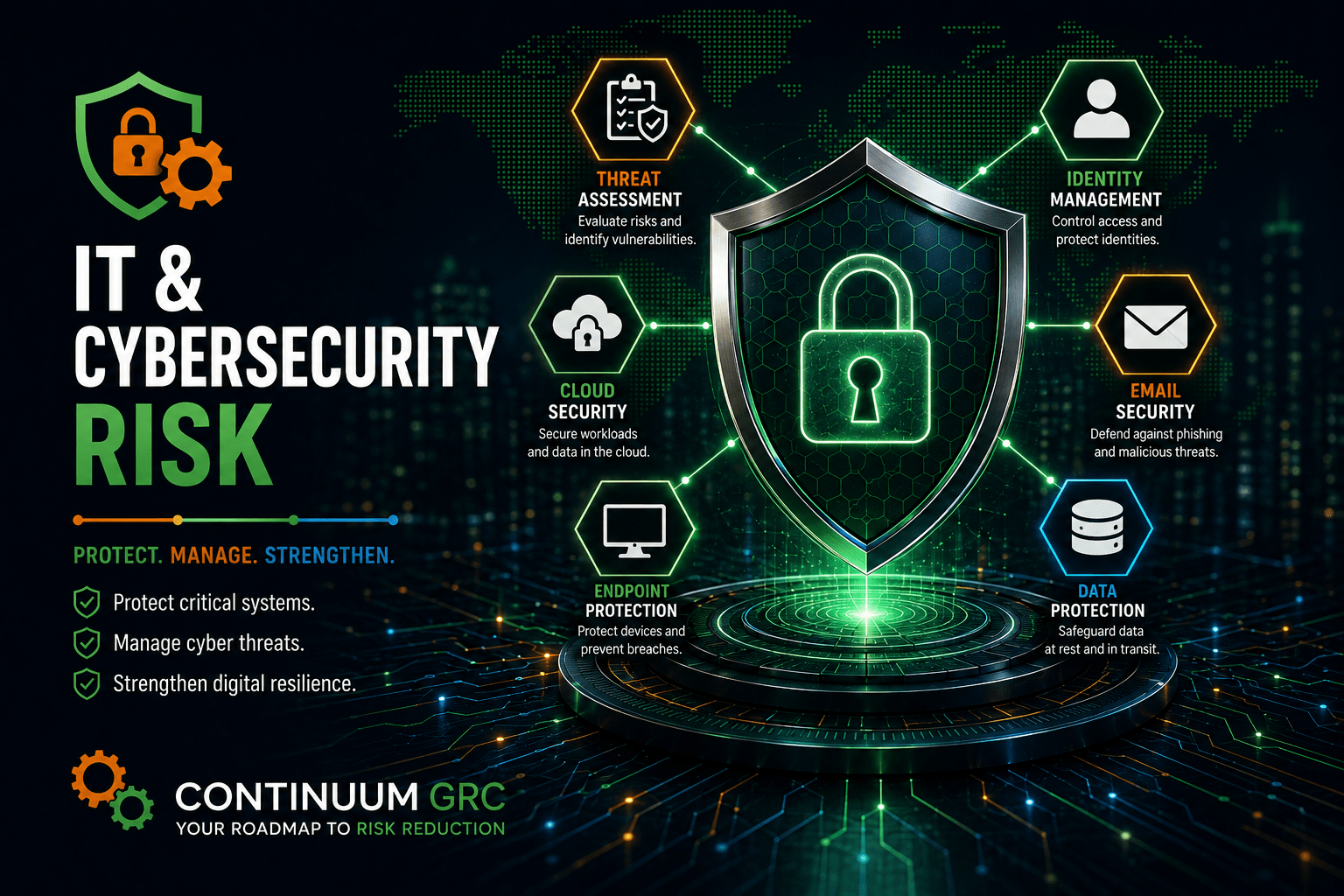
Identify, assess, and mitigate IT and cybersecurity risks with structured processes, continuous monitoring, and intelligent automation powered by AITAMBot.
While IT and cybersecurity risks represent a significant and growing portion of organizational risk, they must be understood and managed within the broader context of Enterprise Risk Management (ERM). Effective organizations no longer treat cybersecurity risk in isolation. Instead, they integrate it into enterprise-wide risk frameworks so that technical risks are evaluated alongside strategic, operational, financial, compliance, and reputational risks.
A.ITAM supports this enterprise perspective by providing structured, auditable risk data that can be aggregated and reported at both the operational and executive levels. This enables organizations to maintain alignment between cybersecurity decisions and overall business objectives and risk appetite.
Why IT & Cybersecurity Risk Matters
Table of Contents
ToggleOrganizations today operate in an environment where cyber threats are more frequent, sophisticated, and damaging than ever before. Ransomware attacks, supply chain compromises, data breaches, and advanced persistent threats have made cybersecurity risk management a top priority for boards, executives, and regulators alike. Frameworks such as the NIST Risk Management Framework (RMF) and the NIST Cybersecurity Framework emphasize the importance of structured, ongoing risk management to protect organizational assets and maintain resilience.
IT & Cybersecurity Risk Management is the disciplined process of identifying, assessing, prioritizing, and mitigating risks that could negatively impact an organization’s information technology systems, data assets, and overall security posture. It goes beyond traditional vulnerability scanning or compliance checklists by focusing on understanding the likelihood and potential business impact of various threat scenarios.
Effective cybersecurity risk management helps organizations:
- Protect sensitive data and critical systems from evolving threats
- Meet regulatory and contractual requirements (e.g., NIST, CMMC, ISO 27001, SOC 2)
- Make informed, risk-based decisions about security investments
- Reduce the likelihood and impact of security incidents
- Make informed decisions about security investments and priorities
- Demonstrate due diligence to regulators, customers, and boards
Without a structured approach to cybersecurity risk, organizations often operate with blind spots, struggle to prioritize limited security resources, and find it difficult to demonstrate effective risk management during audits or after an incident occurs.
Key Challenges in IT & Cybersecurity Risk Management
These challenges are widely recognized across the industry. Standards such as ISO/IEC 27005 highlight the difficulties organizations face in maintaining consistent risk assessment practices, managing third-party risk, and aligning technical findings with business priorities.
| Challenge | Description | Potential Impact |
|---|---|---|
| Lack of Asset Visibility | Difficulty maintaining an accurate and up-to-date inventory of IT assets, systems, and data. | Unknown exposures and incomplete risk assessments. |
| Inconsistent Risk Assessment | Varying methodologies and subjective risk evaluations across teams and departments. | Inconsistent prioritization and poor risk-based decision-making. |
| Third-Party and Supply Chain Risk | Managing cybersecurity risks introduced by vendors, partners, and service providers. | Extended attack surface and hidden vulnerabilities outside direct control. |
| Vulnerability Management Overload | High volume of vulnerabilities with limited resources to assess and remediate them. | Critical risks left unaddressed due to prioritization challenges. |
| Aligning Risk with Business Context | Difficulty translating technical cybersecurity risks into clear business impact. | Misaligned security investments and disconnect with executive leadership. |
| Maintaining Continuous Monitoring | Challenges in continuously monitoring risk posture across dynamic and complex environments. | Delayed detection of emerging or changing risks. |
| Documentation and Audit Readiness | Maintaining clear, auditable evidence of risk decisions, treatments, and residual risk levels. | Weak audit findings and increased regulatory scrutiny. |
These challenges are interconnected. For example, poor asset visibility makes risk assessment more difficult, while inconsistent methodologies hinder the ability to prioritize remediation efforts effectively. A structured, repeatable, and technology-supported approach is essential for managing cybersecurity risk at scale.
How A.ITAM and AITAMBot Support IT & Cybersecurity Risk Management
Managing cybersecurity risk effectively requires more than periodic assessments or spreadsheets. A.ITAM and AITAMBot help organizations build and maintain a more continuous, structured, and auditable approach to identifying and managing IT and cybersecurity risks.
The platform supports IT and cybersecurity risk management in the following ways:
- Centralized Risk Register: Maintain a single, auditable source of truth for identified IT and cybersecurity risks, including clear ownership, risk scores, treatment plans Status tracking.
- Control Mapping and Gap Analysis: Map cybersecurity risks to relevant controls across frameworks (e.g., NIST 800-53, ISO 27001, CMMC) and identify gaps.
- Risk Assessment and Scoring: Support consistent risk assessment methodologies with defined scoring criteria, helping reduce subjectivity and improve prioritization across teams.
- Third-Party Risk Management: Track and assess cybersecurity risks associated with vendors, service providers, and supply chain partners within the same platform used for internal risk management.
- Risk Treatment and Remediation Tracking: Assign, monitor, and document risk treatment decisions, including mitigation activities, risk acceptance, or transfer decisions.
- Integration with Security and GRC Processes: Connect risk data with vulnerability management, policy management, compliance activities, and audit workflows for a more unified view of organizational risk.
- Reporting and Evidence Collection: Generate risk reports and maintain documentation of risk decisions and treatments to support audits, regulatory reviews, and internal governance requirements.
By combining structured risk processes with automation and cross-framework visibility, A.ITAM helps organizations manage cybersecurity risk more consistently while reducing the manual effort typically associated with risk tracking and reporting.
Integrating IT & Cybersecurity Risk into Enterprise Risk Management
Modern organizations increasingly recognize that IT and cybersecurity risks cannot be managed effectively in a silo. Leading risk management practices, including those outlined in the COSO Enterprise Risk Management Framework and ISO 31000, emphasize the need to integrate cybersecurity risk into the organization’s overall enterprise risk profile.
A.ITAM supports this integration in several important ways:
- Risk Aggregation and Roll-up: Cybersecurity and IT risks identified at the system, application, or business unit level can be aggregated to provide an enterprise view of risk exposure.
- Alignment with Risk Appetite: Organizations can define and apply risk appetite statements that include cybersecurity considerations, helping ensure that risk-taking decisions are consistent with strategic objectives.
- Executive and Board Reporting: Structured risk data and reporting capabilities help translate technical cybersecurity risks into business impact language that is meaningful to executive leadership and board members.
- Cross-Functional Risk Visibility: By maintaining risks in a centralized platform, A.ITAM reduces fragmentation between information security, operational risk, compliance, and enterprise risk management functions.
- Support for Enterprise Risk Frameworks: The platform’s control mapping and risk assessment capabilities can be aligned with broader enterprise risk taxonomies and frameworks used by the organization.
This integrated approach helps organizations avoid both underestimating the business impact of cybersecurity risks and overreacting to technical issues without proper business context.
Key Capabilities for IT & Cybersecurity Risk Management
A.ITAM supports the following core capabilities to help organizations manage IT and cybersecurity risk more effectively:
- Centralized IT and cybersecurity risk register with ownership and status tracking
- Structured risk identification, assessment, and scoring
- Control mapping across multiple cybersecurity and compliance frameworks
- Third-party and vendor cybersecurity risk tracking
- Risk treatment planning and remediation workflow management
- Integration with vulnerability management and security monitoring tools
- Risk reporting, dashboards, and trend analysis
- Evidence collection and documentation for audits and regulatory reviews
These capabilities enable organizations to move from reactive or ad-hoc risk management toward a more proactive, repeatable, and defensible cybersecurity risk program.
Benefits of Strong IT & Cybersecurity Risk Management
Organizations that implement structured IT and cybersecurity risk management programs typically experience several important benefits:
- Improved Security Posture: Systematic identification and prioritization of risks helps organizations focus limited security resources on the most significant threats and vulnerabilities rather than reacting to issues as they arise.
- Better-Informed Decision-Making: Clear visibility into cybersecurity risks enables more confident decisions about security investments, risk acceptance, resource allocation, and strategic priorities.
- Regulatory and Audit Readiness: Structured risk documentation and evidence of treatment decisions help organizations demonstrate effective risk management during audits, assessments, and regulatory reviews.
- Reduced Likelihood and Impact of Incidents: Proactive identification and treatment of risks can significantly lower the probability and potential consequences of security breaches and operational disruptions.
- Stronger Third-Party Oversight: Improved visibility into vendor and supply chain cybersecurity risks helps organizations better manage their extended attack surface and reduce concentration risk.
- Alignment Between Security and Business Objectives: Translating technical risks into business impact language helps bridge the gap between security teams and executive leadership, leading to more effective risk discussions at the board level.
- Continuous Improvement Culture: Ongoing risk monitoring, review, and reporting processes support a culture of continuous improvement in cybersecurity posture over time.
- Competitive and Contractual Advantage: Demonstrating mature cybersecurity risk management practices can strengthen an organization’s position when pursuing contracts, partnerships, or certifications in regulated industries.
- Stronger Enterprise Risk Oversight: By incorporating IT and cybersecurity risks into the broader enterprise risk framework, organizations gain a more complete picture of their overall risk landscape, improving strategic decision-making.
- Improved Risk Culture and Accountability: When cybersecurity risks are managed using consistent enterprise risk processes, it reinforces a culture of risk awareness across both technical and business teams.
- Better Capital and Resource Allocation: Enterprise-level visibility into cybersecurity risk helps organizations prioritize investments more effectively across competing risk domains (cyber, operational, compliance, strategic).
- Enhanced Regulatory and Stakeholder Confidence: Demonstrating that cybersecurity risk is managed as part of a formal enterprise risk program strengthens credibility with regulators, investors, and business partners.
How to Get Started with IT & Cybersecurity Risk Management
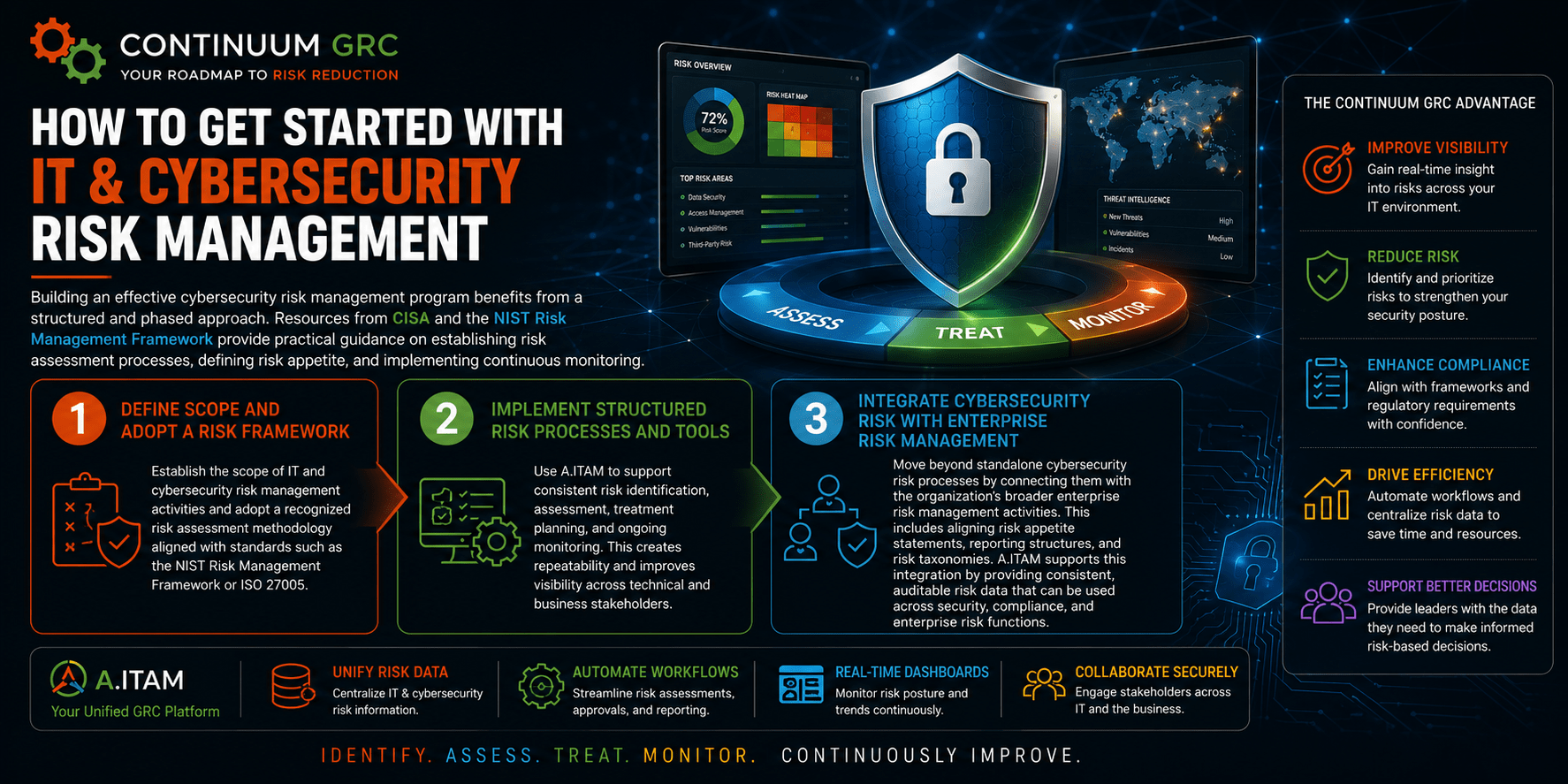
Building an effective cybersecurity risk management program benefits from a structured and phased approach. Resources from CISA and the NIST Risk Management Framework provide practical guidance on establishing risk assessment processes, defining risk appetite, and implementing continuous monitoring.
Step 1: Define Scope and Adopt a Risk Framework
Establish the scope of IT and cybersecurity risk management activities and adopt a recognized risk assessment methodology aligned with standards such as the NIST Risk Management Framework or ISO 27005.
Step 2: Implement Structured Risk Processes and Tools
Use A.ITAM to support consistent risk identification, assessment, treatment planning, and ongoing monitoring. This creates repeatability and improves visibility across technical and business stakeholders.
Step 3: Integrate Cybersecurity Risk with Enterprise Risk Management
Move beyond standalone cybersecurity risk processes by connecting them with the organization’s broader enterprise risk management activities. This includes aligning risk appetite statements, reporting structures, and risk taxonomies. A.ITAM supports this integration by providing consistent, auditable risk data that can be used across security, compliance, and enterprise risk functions.
Why Choose Continuum GRC for IT & Cybersecurity Risk Management
Continuum GRC supports IT and cybersecurity risk management as part of an integrated governance, risk, and compliance platform. Rather than treating cybersecurity risk as a standalone function, A.ITAM allows organizations to align risk activities with compliance, policy management, and audit readiness across multiple frameworks.
Key advantages include the following:
- A unified platform for cybersecurity risk, compliance, and broader GRC activities
- Structured workflows, risk scoring, and documentation capabilities
- Support for mapping risks and controls across multiple cybersecurity frameworks
- Experience supporting regulated and security-conscious organizations
Frequently Asked Questions
IT & Cybersecurity Risk Management is the process of identifying, assessing, prioritizing, and mitigating risks that could affect an organization’s information technology systems, data, and overall security posture. Effective cybersecurity risk management helps organizations protect against evolving threats, meet regulatory requirements, make better security investment decisions, and reduce the likelihood and impact of security incidents. A.ITAM supports centralized risk tracking, control mapping, risk assessment, third-party risk management, treatment workflows, and reporting within a single platform. Not necessarily. A.ITAM allows organizations to manage cybersecurity risk alongside compliance, policy, and broader GRC activities, reducing the need for disconnected systems. Many organizations begin improving risk visibility and processes within days or weeks. Full implementation with custom workflows and integrations typically takes several weeks depending on organizational complexity. IT and cybersecurity risks are a major category within enterprise risk. Leading ERM frameworks require organizations to identify, assess, and manage these risks alongside other enterprise risks so that leadership has a complete view of the organization’s risk profile. Yes. While A.ITAM is particularly strong in IT and cybersecurity risk, its centralized risk register, aggregation capabilities, and reporting features also support enterprise risk management by providing visibility across multiple risk domains and facilitating consistent risk practices organization-wide.
What is IT & Cybersecurity Risk Management?
Why is cybersecurity risk management important?
How can A.ITAM help with cybersecurity risk management?
Do I need a separate tool for cybersecurity risk management?
How long does it take to implement cybersecurity risk management with A.ITAM?
How does IT and cybersecurity risk fit into Enterprise Risk Management?
Can A.ITAM support both cybersecurity risk and broader enterprise risk management?
Ready to Strengthen Your IT & Cybersecurity Risk Management Program?
Improve your ability to identify, assess, and mitigate IT and cybersecurity risks with greater structure and visibility.
Start your free 14-day trial today and experience intelligent GRC automation powered by A.ITAM.