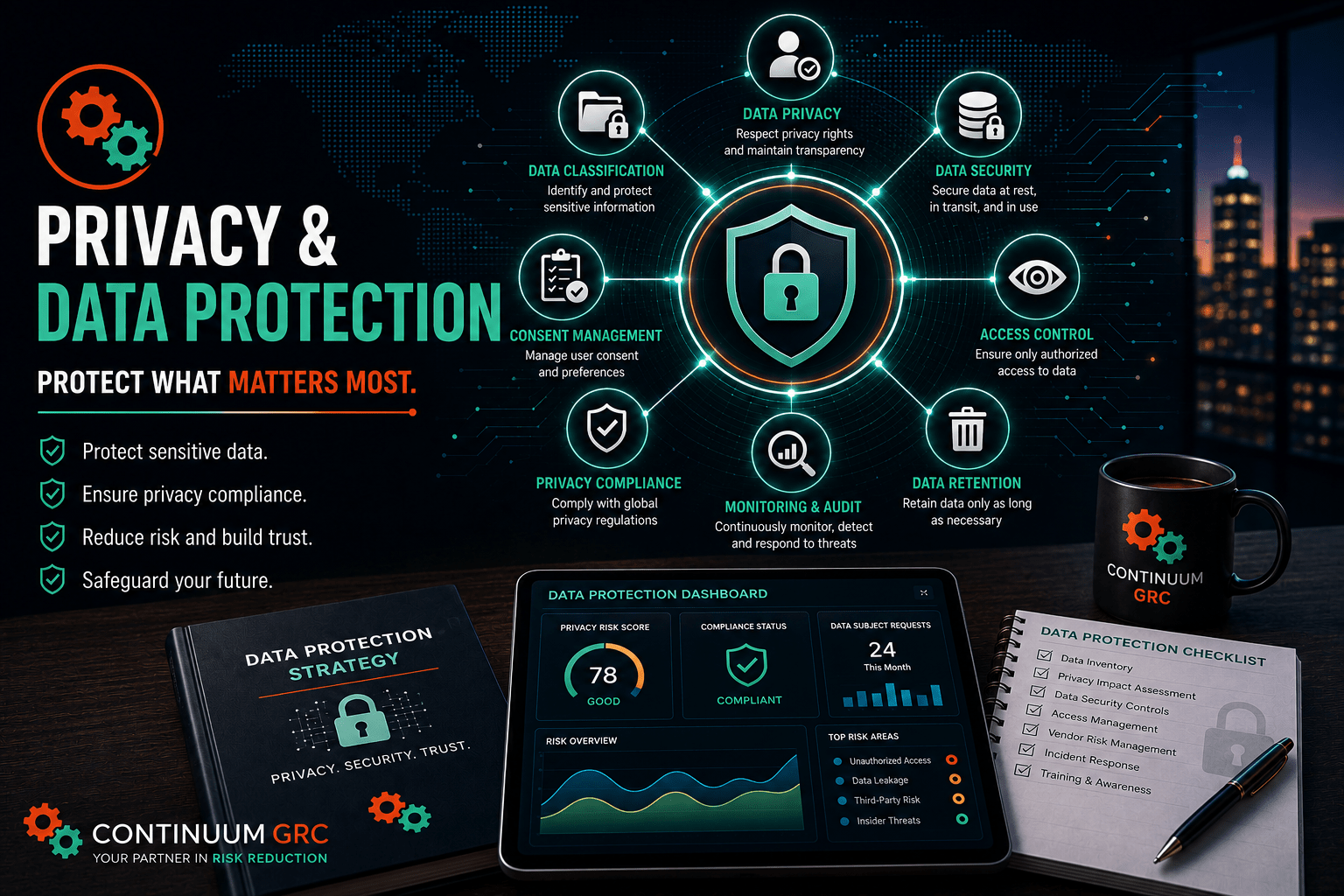
Manage privacy obligations and protect personal data across global regulations with automated data mapping, impact assessments, and intelligent compliance monitoring.
Why Privacy & Data Protection Matters
Table of Contents
ToggleOrganizations today collect, process, and store vast amounts of personal data as part of their daily operations. With this comes increasing responsibility — and regulatory pressure — to protect that data and respect individual privacy rights.
Laws such as the General Data Protection Regulation (GDPR), California Consumer Privacy Act (CCPA/CPRA), Personal Information Protection and Electronic Documents Act (PIPEDA), Lei Geral de Proteção de Dados (LGPD), and others have significantly raised the standards for how organizations must handle personal information. These regulations require transparency, accountability, and the ability to demonstrate compliance. Failure to meet these obligations can result in substantial fines, regulatory investigations, and lasting reputational damage.
Beyond legal requirements, customers, business partners, and employees increasingly expect organizations to handle personal data responsibly. A privacy failure or data breach can quickly erode trust and damage relationships that took years to build. At the same time, individuals are becoming more aware of their data rights and are more likely to exercise them.
Effective Privacy & Data Protection goes beyond policy documents. It requires organizations to understand what personal data they hold, why they hold it, how it flows through their systems, and how to respond to individual rights requests in a timely and accurate manner. Achieving this level of visibility and control is difficult to maintain through manual processes alone, especially for organizations operating across multiple jurisdictions.
A strong privacy program helps organizations reduce risk, demonstrate accountability, and build trust with customers, regulators, and partners.
Key Challenges in Privacy & Data Protection
Managing privacy effectively involves navigating several complex and interconnected challenges.
| Challenge | Description | Potential Impact |
|---|---|---|
| Data Discovery & Mapping | Difficulty identifying where personal data resides across systems and processes. | Incomplete compliance and increased risk of data breaches. |
| Data Subject Rights Requests | Handling access, deletion, and correction requests in a timely and accurate manner. | Regulatory penalties and reputational harm. |
| Cross-Border Data Transfers | Ensuring lawful transfer of personal data across different jurisdictions. | Legal exposure and potential operational disruption. |
| Privacy Impact Assessments (DPIA) | Conducting and maintaining DPIAs for high-risk processing activities. | Non-compliance with regulatory requirements. |
| Consent & Lawful Basis Management | Tracking and documenting valid consent or other lawful bases for processing. | Regulatory findings and loss of stakeholder trust. |
| Third-Party & Vendor Risk | Managing privacy risks introduced by service providers and data processors. | Data breaches and compliance failures. |
| Regulatory Change Management | Keeping up with evolving privacy laws across multiple jurisdictions. | Gaps in compliance and increased legal risk. |
These challenges often overlap. For example, poor data discovery makes it harder to respond to data subject rights requests or conduct meaningful Privacy Impact Assessments. A structured, technology-enabled approach is essential for managing these issues at scale.
How A.ITAM and AITAMBot Support Privacy & Data Protection
Manual privacy management is becoming increasingly difficult as data volumes grow and regulations evolve. A.ITAM and AITAMBot help organizations automate and organize key privacy activities.
The platform supports privacy and data protection in the following ways:
- Automated Data Discovery and Mapping: Helps identify where personal data is stored and processed across systems, reducing the manual effort needed to maintain accurate data inventories.
- Privacy Impact Assessment (DPIA) Workflows: Provides structured tools to document, assess, and manage Data Protection Impact Assessments for high-risk processing activities.
- Data Subject Rights Management: Supports the intake, tracking, and response to individual rights requests (access, deletion, correction, etc.) with clear audit trails.
- Consent and Lawful Basis Documentation: Helps organizations record and monitor the legal basis for processing personal data, including consent where required.
- Cross-Border Data Transfer Records: Maintains documentation of data transfer mechanisms and safeguards in line with regulatory expectations.
- Third-Party Privacy Risk Management: Assesses and monitors privacy risks associated with vendors and service providers.
- Regulatory Change Monitoring: Tracks updates to privacy laws and helps assess their potential impact on existing processes and controls.
By combining automation with structured workflows, A.ITAM enables organizations to manage privacy more efficiently while maintaining strong documentation for audits and regulatory inquiries.
Key Capabilities for Privacy & Data Protection
A.ITAM supports the following core capabilities to help organizations manage privacy and data protection effectively:
- Centralized data inventory and records of processing activities
- Privacy Impact Assessment (DPIA) creation, tracking, and management
- Data subject rights request workflows and response tracking
- Consent and lawful basis documentation and monitoring
- Cross-border data transfer documentation and safeguards
- Vendor and third-party privacy risk assessments
- Integration with broader risk and compliance programs
- Automated evidence collection for privacy audits and regulatory reviews
These capabilities help organizations maintain accountability and respond more effectively to both regulatory requirements and internal governance needs.
Benefits of Strong Privacy & Data Protection Management
Organizations that implement structured and proactive privacy and data protection programs typically realize several important benefits:
- Reduced Regulatory and Legal Risk: Proactive management of privacy obligations significantly lowers the likelihood of regulatory investigations, fines, enforcement actions, and litigation. Demonstrating accountability through proper documentation and processes helps organizations defend their practices when scrutinized.
- Improved Data Governance and Decision-Making: Better visibility into what personal data is collected, where it resides, and how it is used enables more responsible and informed data-handling decisions across the organization. This supports both compliance and strategic data use.
- Faster and More Reliable Response to Data Subject Rights Requests: Structured workflows and tracking capabilities help organizations respond to individual rights requests (access, deletion, correction, etc.) within required timeframes. This reduces the risk of complaints and regulatory penalties while improving the individual experience.
- Stronger Third-Party and Vendor Oversight: Clear processes for assessing and monitoring the privacy practices of service providers and data processors help reduce the risk of data breaches or compliance failures originating from third parties.
- Enhanced Trust, Reputation, and Customer Confidence: Organizations that demonstrate responsible data handling and respect for privacy rights are better positioned to build and maintain trust with customers, partners, and stakeholders. In many industries, strong privacy practices are becoming a competitive differentiator.
- Greater Operational Efficiency: Automation of data mapping, documentation, consent tracking, and request management reduces the manual workload on privacy, legal, and compliance teams. This allows resources to be redirected toward higher-value activities.
- Better Audit and Regulatory Readiness: Centralized records, evidence collection, and structured documentation make it significantly easier and faster to respond to privacy audits, regulatory inquiries, and due diligence requests from customers or partners.
- Improved Incident Response and Breach Preparedness: Organizations with strong privacy programs are generally better equipped to detect, respond to, and recover from privacy incidents or data breaches. Clear data inventories and processing records support faster investigation and notification when required.
Together, these benefits help organizations not only meet regulatory requirements but also operate more responsibly and efficiently in an environment where data privacy is increasingly important to stakeholders.
How to Get Started with Privacy & Data Protection
Many organizations benefit from taking a phased approach to strengthening their privacy program.
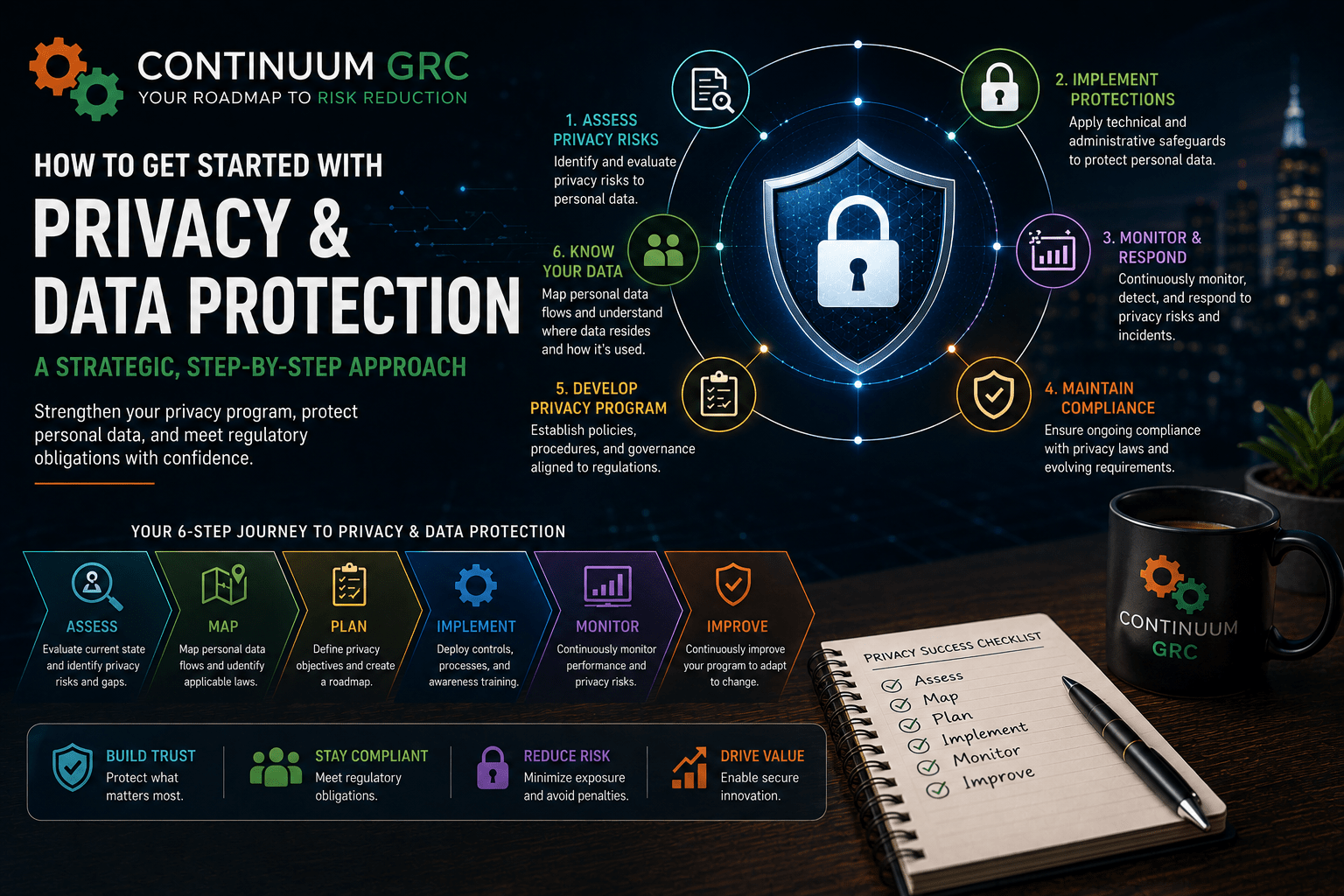
Step 1: Build Visibility into Personal Data: Start by identifying what personal data is collected and processed, and document the purposes and legal bases. A.ITAM helps structure and maintain these records in a centralized system.
Step 2: Automate Key Privacy Processes: Use AITAMBot to support data mapping, DPIA creation, and data subject rights management. Automation improves consistency and reduces manual effort.
Step 3: Integrate Privacy into Broader Governance: Connect privacy activities with existing risk, compliance, and security programs. This creates a more unified view of organizational risk and accountability.
Most organizations begin seeing meaningful improvements in privacy visibility and documentation within the first few weeks.
Why Choose Continuum GRC for Privacy & Data Protection
Continuum GRC supports privacy and data protection as part of an integrated governance, risk, and compliance platform. Rather than managing privacy in isolation, A.ITAM allows organizations to align privacy activities with other compliance and risk management efforts.
Key advantages include the following:
- A unified platform for privacy, risk, and compliance
- Automation of key privacy activities through AITAMBot
- Support for multiple global privacy regulations
- Strong documentation and evidence capabilities
- Experience working with regulated and complex organizations
Frequently Asked Questions
Privacy & Data Protection refers to the policies, processes, and controls organizations implement to handle personal data responsibly and in compliance with applicable laws and regulations. A.ITAM supports major privacy frameworks, including GDPR, CCPA/CPRA, PIPEDA, LGPD, and others. The platform can be configured to manage requirements across multiple jurisdictions. A DPIA is a structured assessment used to identify and minimize privacy risks associated with high-risk data processing activities. It is required under certain regulations, such as the GDPR. A.ITAM provides workflows and tracking capabilities to help organizations receive, document, and respond to requests from individuals regarding their personal data. Not necessarily. A.ITAM allows organizations to manage privacy activities within the same platform used for risk management and other compliance programs, reducing the need for disconnected tools. Many organizations begin improving data visibility and documentation within days or weeks. Full implementation with custom workflows typically takes a few weeks depending on organizational complexity.
What is Privacy & Data Protection?
Which privacy regulations does A.ITAM support?
What is a Data Protection Impact Assessment (DPIA)?
How can A.ITAM help with data subject rights requests?
Do I need a separate tool for privacy management?
How long does it take to implement privacy management with A.ITAM?
Ready to Strengthen Your Privacy & Data Protection Program?
Manage privacy obligations with greater visibility, automation, and control.
Start your free 14-day trial today and experience intelligent GRC automation powered by A.ITAM.