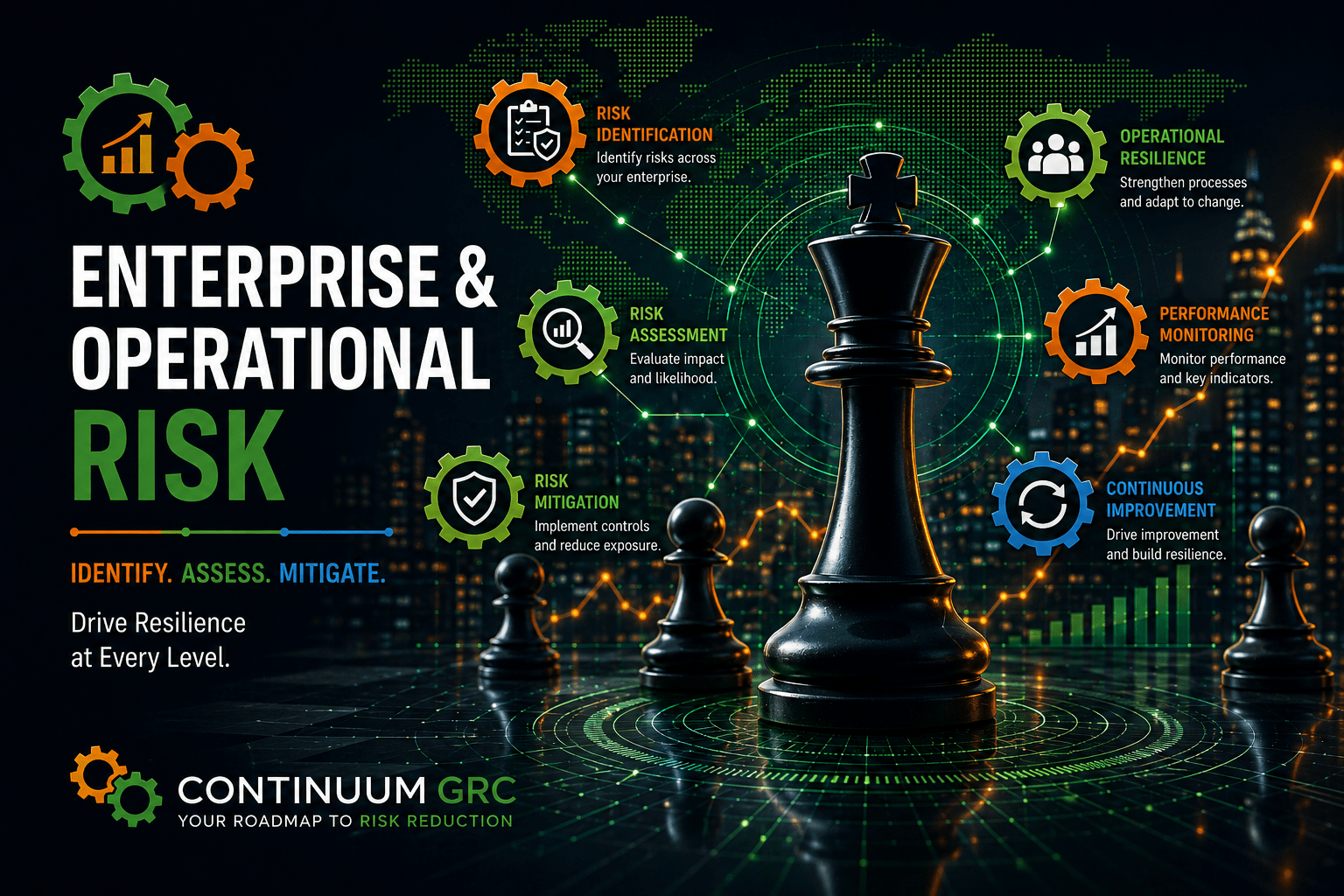
Why Enterprise & Operational Risk Management Matters
Table of Contents
ToggleIn today’s environment, risks are more interconnected than ever. A supply chain disruption can quickly create operational, financial, and reputational consequences. Similarly, a technology failure or regulatory change can affect multiple areas of the business simultaneously. This interconnected nature makes it essential to manage risk at an enterprise level rather than in isolated pockets.
Every organization faces a wide range of risks that can impact its ability to achieve strategic objectives. These risks go beyond cybersecurity or compliance — they include operational disruptions, financial exposure, supply chain issues, regulatory changes, reputational threats, and more.
Enterprise Risk Management (ERM) provides a structured, organization-wide approach to identifying and managing these risks. It helps leadership understand the full risk landscape, prioritize resources, and make informed decisions that protect and create value.
Operational Risk Management focuses specifically on risks arising from internal processes, people, systems, and external events. This includes everything from process failures and human error to third-party dependencies and business continuity threats.
As organizations grow more complex and interconnected, the need for integrated, proactive risk management becomes critical. Without a clear view of enterprise and operational risks, companies can face unexpected losses, regulatory penalties, damaged reputations, and missed opportunities.
Key Areas of Enterprise & Operational Risk
Effective risk management requires visibility across multiple interconnected areas. Below are the primary categories organizations must actively manage:
| Risk Category | Description | Potential Impact |
|---|---|---|
| Strategic Risk | Risks related to business strategy, market changes, and competitive positioning. | Missed growth targets, loss of market share, and strategic misalignment. |
| Operational Risk | Risks arising from internal processes, people, systems, and external events. | Process failures, financial loss, service disruptions, and regulatory issues. |
| Financial Risk | Risks related to financial management, liquidity, credit, and market volatility. | Cash flow problems, increased costs, and regulatory scrutiny. |
| Compliance & Regulatory Risk | Risks of failing to meet legal, regulatory, or contractual obligations. | Fines, sanctions, loss of licenses, and reputational damage. |
| Reputational Risk | Risks that can damage brand perception and stakeholder trust. | Loss of customers, difficulty attracting talent, and brand damage. |
| Third-Party & Vendor Risk | Risks introduced through suppliers, partners, and service providers. | Supply chain disruption, data breaches, and compliance failures. |
| Business Continuity & Resilience | Risks that threaten an organization’s ability to operate during disruptions. | Extended downtime, revenue loss, and regulatory penalties. |
Managing these risks in isolation often leads to gaps. A strong enterprise risk program connects these areas and provides leadership with a holistic view of organizational exposure.
How A.ITAM and AITAMBot Support Enterprise & Operational Risk
Traditional risk management often relies on manual processes, static risk registers, and periodic assessments. These approaches struggle to keep pace with today’s dynamic business environment. A.ITAM and AITAMBot help organizations shift from reactive, spreadsheet-driven risk management to a more proactive and continuously monitored approach.
Here’s how the platform supports enterprise and operational risk management:
- Automated Risk Identification: AITAMBot continuously scans processes, systems, and data to identify emerging risks across the enterprise.
- Real-Time Risk Scoring & Dashboards: Dynamic risk scoring provides leadership with an up-to-date view of the organization’s overall risk posture.
- Integrated Risk Registers: Maintain a centralized, living risk register that connects strategic, operational, financial, and compliance risks.
- Control Mapping & Monitoring: Map risks to controls and monitor control effectiveness in real time.
- Third-Party Risk Oversight: Gain visibility into vendor and supplier risks through automated assessments and ongoing monitoring.
- Business Continuity Integration: Align risk data with business continuity and disaster recovery planning.
By automating much of the detection and monitoring work, A.ITAM allows risk and compliance teams to focus on analysis, mitigation planning, and strategic decision support.
This shift from periodic, manual risk assessments to continuous, automated oversight represents a significant advancement in how organizations can manage enterprise and operational risk at scale.
Key Capabilities for Enterprise & Operational Risk Management
A mature enterprise and operational risk program requires more than just identifying risks — it needs the right capabilities to assess, monitor, and respond to them effectively. Continuum GRC’s platform supports the following core capabilities:
- Centralized Risk Identification and Assessment: Capture and evaluate risks across the organization in one unified system instead of relying on disconnected spreadsheets or departmental silos.
- Dynamic Risk Scoring and Maturity Tracking: Automatically calculate risk levels and track how risk maturity evolves over time, giving leadership a clear picture of progress and remaining gaps.
- Automated Control Testing and Effectiveness Monitoring: Continuously test the performance of controls linked to key risks, reducing reliance on manual testing and improving assurance quality.
- Third-Party and Vendor Risk Management: Assess and monitor risks introduced by suppliers, partners, and service providers through structured questionnaires, ongoing monitoring, and risk scoring.
- Integration with Business Continuity and Resilience Planning: Align operational risk data with business continuity plans so that critical risks are directly connected to recovery strategies and resilience efforts.
- Regulatory Change Impact Assessment: Monitor regulatory developments and automatically assess how changes may affect existing risks and controls across the enterprise.
- Customizable Risk Frameworks and Reporting: Adapt risk frameworks to your organization’s specific needs and generate tailored reports for executives, risk committees, and auditors.
- Cross-Functional Visibility for Leadership: Provide real-time dashboards and reports that give senior leaders and risk committees a consolidated view of enterprise exposure.
These capabilities work together to create a more proactive, data-driven approach to risk management while significantly reducing the manual effort traditionally required.
Benefits of Strong Enterprise & Operational Risk Management
Organizations that implement structured enterprise and operational risk programs typically experience several important benefits:
- Improved Strategic Decision-Making: A clear, real-time view of enterprise risks enables leadership to make better-informed decisions about growth, investments, and resource allocation while avoiding strategies that carry unacceptable risk.
- Reduced Unexpected Losses and Disruptions: Early identification of operational risks — such as process failures, third-party issues, or technology dependencies — allows organizations to address problems before they escalate into major incidents or financial losses.
- Stronger Regulatory Posture: An integrated view of risks and controls helps organizations demonstrate effective risk oversight during regulatory examinations and audits. This is especially valuable for organizations subject to multiple overlapping compliance requirements.
- Enhanced Business Resilience: By connecting risk management with business continuity and resilience planning, organizations can better prepare for and recover from disruptive events, whether they are caused by technology failures, supply chain issues, or external events.
- Increased Stakeholder Confidence: Boards, regulators, investors, and customers increasingly expect organizations to demonstrate proactive risk management. A mature enterprise risk program helps build trust and can become a competitive differentiator.
- Greater Operational Efficiency: By automating risk identification, monitoring, and reporting, teams spend less time on manual data collection and spreadsheets. This frees them to focus on higher-value work such as risk analysis and mitigation planning.
- Better Alignment Across the Organization: Enterprise risk management breaks down silos between departments. It creates a shared understanding of risk and encourages more consistent risk-based decision-making across business units.
In short, effective enterprise and operational risk management helps organizations protect value while enabling them to pursue opportunities with greater confidence.
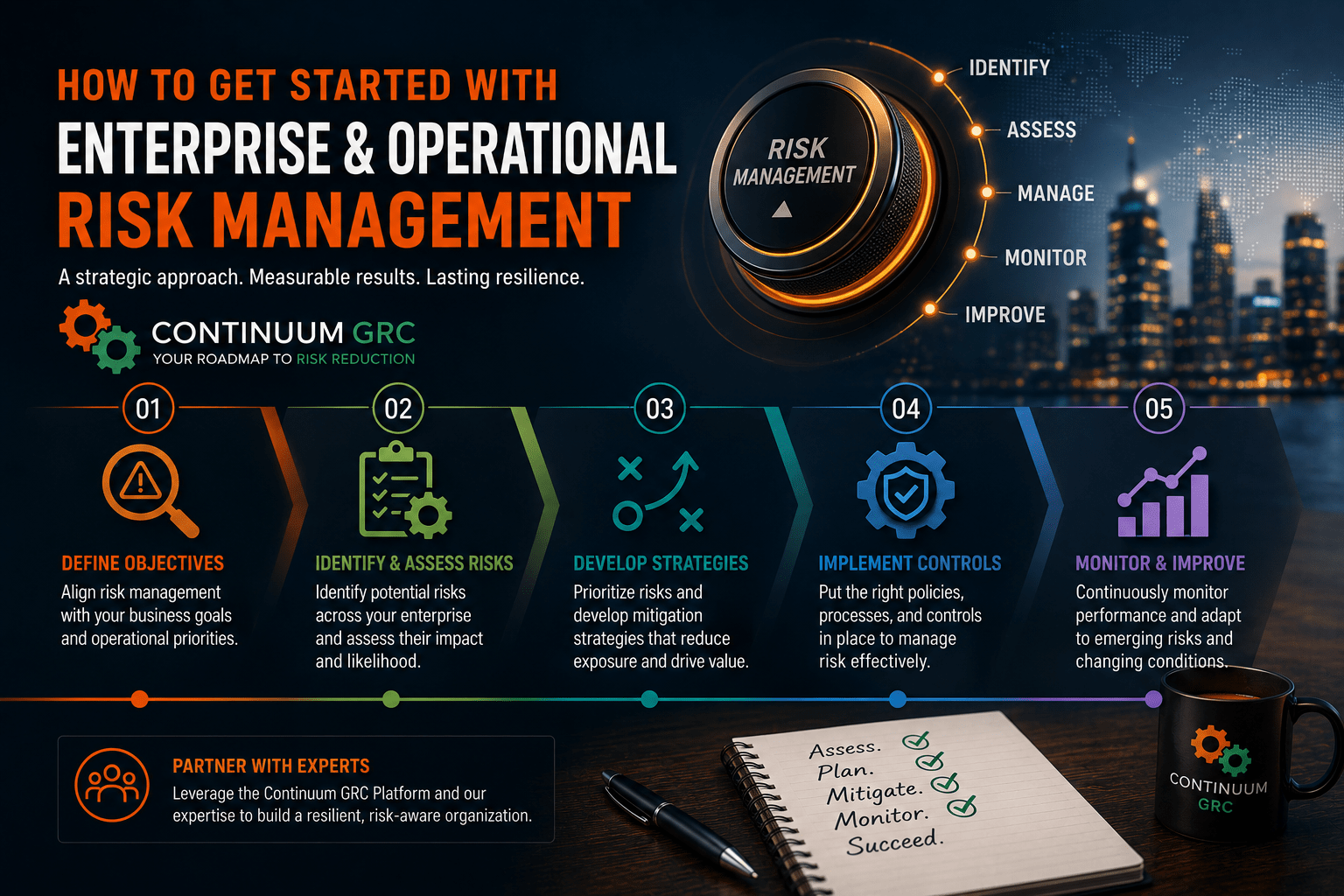
How to Get Started with Enterprise & Operational Risk Management
Implementing effective enterprise risk management doesn’t require overhauling everything at once. Many organizations begin by focusing on visibility and structure.
Step 1: Establish a Clear Risk Framework: Define your risk appetite, risk categories, and governance structure. This creates a consistent foundation for identifying and evaluating risks across the organization.
Step 2: Connect Systems and Data Sources: Integrate relevant systems, processes, and data into A.ITAM. This allows AITAMBot to begin identifying risks, mapping controls, and building a living risk profile.
Step 3: Automate Monitoring and Reporting: Move from periodic risk assessments to continuous monitoring. Use real-time dashboards and automated reporting to keep leadership informed and enable faster response to emerging risks.
Most organizations begin seeing meaningful improvements within the first few weeks of implementation.
Why Choose Continuum GRC for Enterprise & Operational Risk
Continuum GRC combines deep expertise in governance, risk, and compliance with powerful automation through A.ITAM and AITAMBot. The platform is designed to support both enterprise-wide risk programs and detailed operational risk management.
Key advantages include the following:
- A unified platform for enterprise risk, operational risk, and compliance
- Real-time visibility and intelligent automation
- Strong multi-framework support
- Proven experience working with regulated and complex organizations
- FedRAMP-authorized infrastructure for high-security environments
Frequently Asked Questions
Enterprise Risk Management is a structured, organization-wide approach to identifying, assessing, and managing risks that could impact an organization’s ability to achieve its objectives. Operational risk refers to the risk of loss resulting from inadequate or failed internal processes, people, systems, or external events. It includes risks related to execution, fraud, technology failures, and third-party dependencies. Operational risk is one important component of enterprise risk. Enterprise risk management takes a broader view, incorporating strategic, financial, compliance, and reputational risks alongside operational risks. A.ITAM and AITAMBot automate risk identification, provide real-time risk scoring, maintain living risk registers, and integrate risk data with compliance and business continuity programs. Not necessarily. A well-designed platform like A.ITAM can support both enterprise-level oversight and detailed operational risk management within a single system. Many organizations begin gaining visibility within days of connecting their systems. Full implementation with custom frameworks and reporting typically takes a few weeks.
What is Enterprise Risk Management (ERM)?
What is Operational Risk?
How is operational risk different from enterprise risk?
How can A.ITAM help with enterprise and operational risk management?
Do I need separate tools for enterprise risk and operational risk?
How long does it take to implement enterprise risk management with A.ITAM?
Ready to Strengthen Your Enterprise & Operational Risk Management?
Gain real-time visibility into enterprise and operational risks with intelligent automation and structured risk management.
Start your free 14-day trial today and experience intelligent GRC automation powered by A.ITAM.