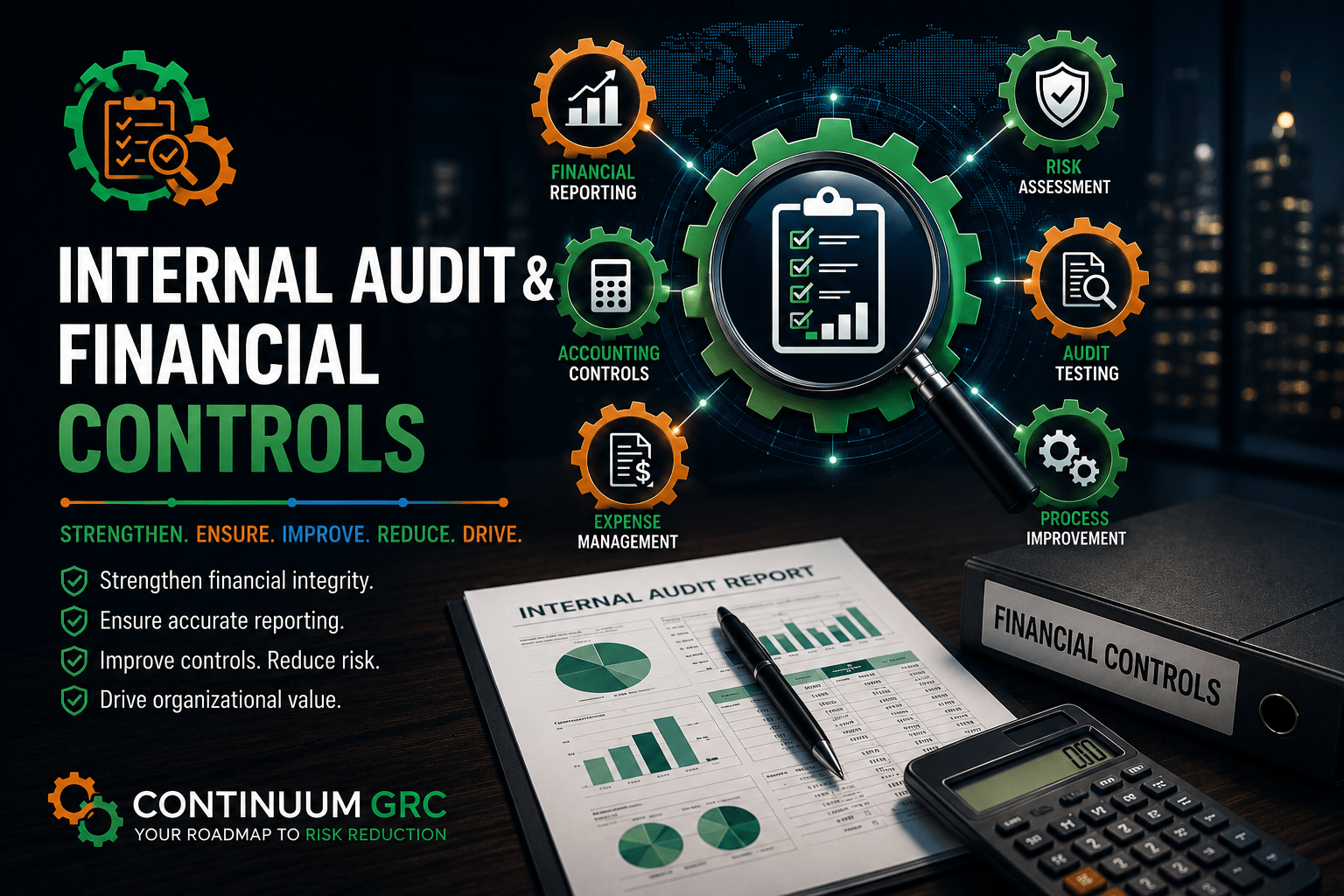
Effective internal audit and financial controls are essential for maintaining financial integrity, regulatory compliance, and stakeholder confidence. Organizations must not only design and implement strong controls but also continuously test, monitor, and document their effectiveness.
Many organizations still manage internal audit and financial controls through manual processes, spreadsheets, and disconnected systems. These traditional approaches often lead to incomplete control documentation, inconsistent testing, difficulty tracking remediation, and challenges in demonstrating control effectiveness to external auditors, boards, and regulators.
A.ITAM provides a modern, integrated approach to Internal Audit & Financial Controls. The platform helps organizations move from reactive, manual audit processes to a more continuous and automated model. By combining structured control frameworks, automated evidence collection, continuous monitoring, and intelligent support through AITAMBot, organizations can strengthen their internal audit function and maintain stronger financial controls with greater efficiency and confidence.
Key Challenges in Internal Audit & Financial Controls
Table of Contents
ToggleOrganizations commonly encounter the following challenges when managing internal audit and financial controls:
| Challenge | Description | Business Impact |
|---|---|---|
| Manual and Time-Consuming Control Testing | Control testing is often performed manually using spreadsheets and email, making the process slow and prone to human error. | High effort required for testing with limited assurance over control effectiveness. |
| Difficulty Maintaining Control Documentation and Evidence | Control documentation and supporting evidence are often scattered across multiple systems and file shares. | Incomplete audit trails and difficulty demonstrating control operation during audits. |
| Siloed Internal Audit and Risk Management Processes | Internal audit activities operate separately from enterprise risk management and compliance functions. | Inconsistent risk coverage and duplicated effort across assurance functions. |
| Inconsistent Control Mapping Across Frameworks | Financial controls are often mapped separately from IT, security, and operational controls, creating fragmented views. | Difficulty achieving a unified view of control effectiveness across the organization. |
| Limited Visibility into Control Effectiveness Over Time | Organizations lack real-time insight into whether key financial controls are operating effectively on an ongoing basis. | Increased risk of control failures going undetected until external audits or incidents occur. |
| Challenges Demonstrating Audit Readiness to External Auditors | Preparing for external audits requires significant manual effort to compile evidence and control documentation. | Higher audit costs, longer audit cycles, and increased risk of audit findings. |
These challenges are addressed in leading internal control frameworks. The COSO Internal Control – Integrated Framework provides a widely recognized structure for designing, implementing, and evaluating internal controls over financial reporting. In the United States, the Public Company Accounting Oversight Board (PCAOB) Auditing Standard No. 2201 establishes requirements for audits of internal control over financial reporting, while the U.S. Securities and Exchange Commission provides guidance on management’s assessment responsibilities under the Sarbanes-Oxley Act.
How A.ITAM and AITAMBot Support Internal Audit & Financial Controls
A.ITAM enables organizations to take a more integrated and continuous approach to internal audit and financial controls. Instead of relying on periodic manual testing and disconnected documentation, the platform supports structured control management, automated evidence collection, and ongoing monitoring of control effectiveness.
Key capabilities include:
- Centralized Control Repository: A.ITAM provides a single location to document, organize, and maintain financial and operational controls with clear ownership and linkage to risks and processes.
- Automated Evidence Collection and Testing Support: The platform helps streamline the collection and organization of control evidence, reducing the manual effort required for testing and audit preparation.
- Continuous Control Monitoring: A.ITAM supports ongoing visibility into control performance rather than relying solely on point-in-time testing.
- Integrated Audit and Risk Management: Internal audit activities can be connected with enterprise risk management, compliance, and IT controls for better coordination and coverage.
- Control Mapping Across Frameworks: Organizations can map financial controls to multiple frameworks (such as COSO, SOX, and others) within a single system, reducing duplication and improving consistency.
- AITAMBot Intelligence: AITAMBot can assist with identifying control gaps, suggesting improvements to control design, and helping prioritize testing and remediation activities based on risk.
This approach helps internal audit and finance teams work more efficiently while providing stronger assurance over financial controls.
Key Capabilities for Internal Audit & Financial Controls
A.ITAM delivers the following core capabilities to support internal audit and financial controls programs:
- Centralized documentation and management of financial and operational controls
- Structured workflows for control self-assessments and testing
- Automated evidence collection and centralized evidence repository
- Continuous monitoring of key control performance indicators
- Integration between internal audit, risk management, and compliance activities
- Control mapping and harmonization across multiple frameworks (COSO, SOX, and others)
- Real-time dashboards showing control status, testing progress, and open issues
- AI-assisted gap analysis and audit planning support via AITAMBot
These capabilities support alignment with the COSO Internal Control – Integrated Framework and can be further harmonized with IT control frameworks such as COBIT when organizations need to integrate financial and technology controls.
Benefits of Implementing Internal Audit & Financial Controls with A.ITAM
Organizations that adopt a more integrated and automated approach to internal audit and financial controls typically experience several important benefits:
- Improved Control Effectiveness: Better documentation, more consistent testing, and ongoing monitoring help identify and address control weaknesses earlier.
- Reduced Audit Preparation Effort: Centralized evidence and structured control documentation significantly reduce the time and effort required to prepare for internal and external audits.
- Stronger Coordination Across Assurance Functions: Integration between internal audit, risk management, and compliance reduces duplication and improves overall assurance coverage.
- Better Visibility for Leadership and the Board: Real-time dashboards provide clearer insight into the status of key financial controls and audit progress.
- More Efficient Use of Internal Audit Resources: Automation of evidence gathering and routine tasks allows internal audit teams to focus on higher-risk areas and advisory work.
- Enhanced Regulatory Confidence: Stronger documentation and continuous monitoring help demonstrate control effectiveness to external auditors and regulators.
Organizations that maintain well-documented and continuously monitored control environments aligned with the COSO Internal Control – Integrated Framework are generally better positioned to support reliable financial reporting and meet regulatory expectations from auditors and oversight bodies.
How to Get Started with Internal Audit & Financial Controls
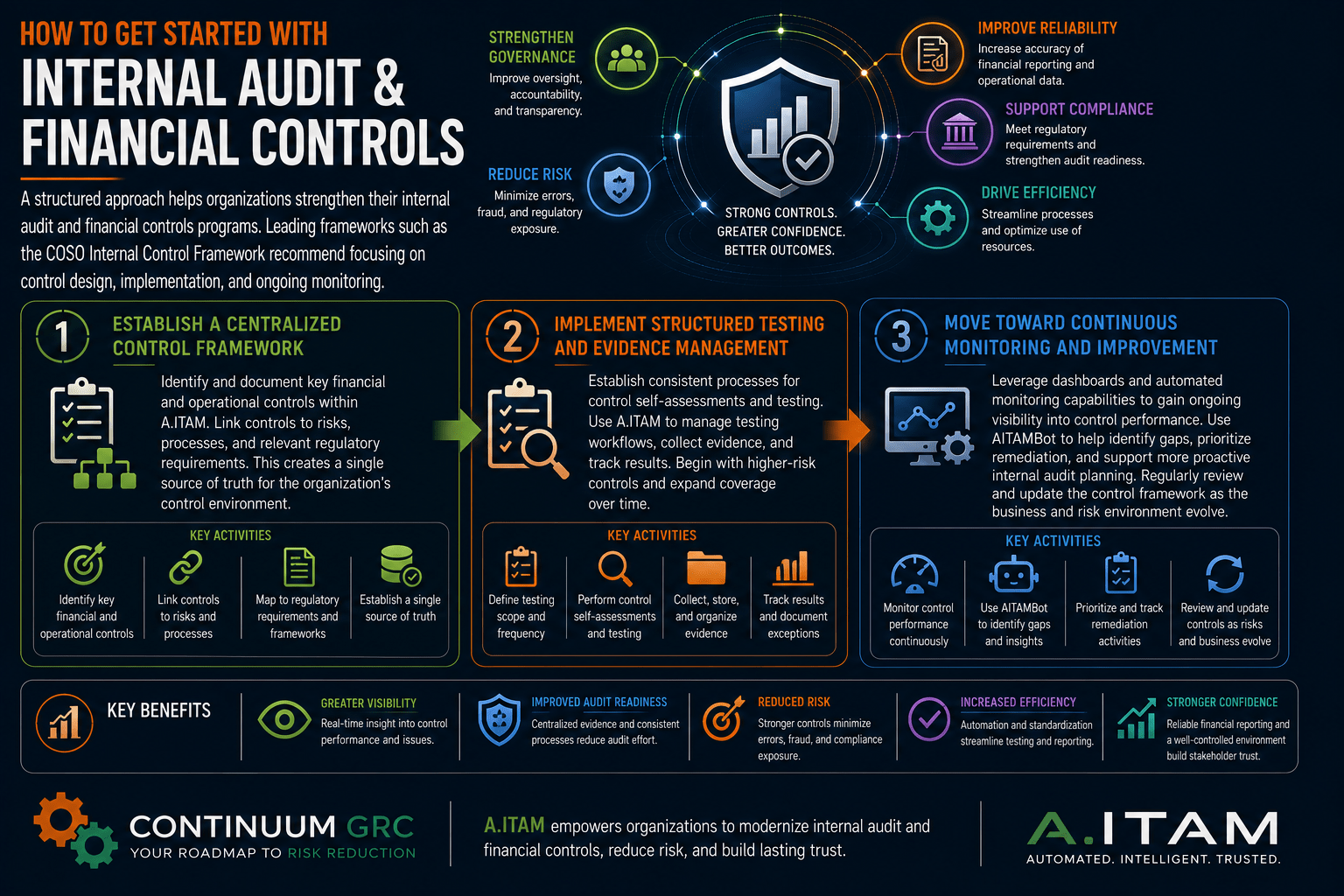
A structured approach helps organizations strengthen their internal audit and financial controls programs. Leading frameworks such as the COSO Internal Control – Integrated Framework recommend focusing on control design, implementation, and ongoing monitoring.
Step 1: Establish a Centralized Control Framework: Identify and document key financial and operational controls within A.ITAM. Link controls to risks, processes, and relevant regulatory requirements. This creates a single source of truth for the organization’s control environment and supports alignment with the COSO Internal Control – Integrated Framework.
Step 2: Implement Structured Testing and Evidence Management: Establish consistent processes for control self-assessments and testing. Use A.ITAM to manage testing workflows, collect evidence, and track results. Begin with higher-risk controls and expand coverage over time. This approach helps organizations meet expectations for control evaluation under frameworks such as COSO and the requirements outlined in PCAOB Auditing Standard No. 2201.
Step 3: Move Toward Continuous Monitoring and Improvement: Leverage dashboards and automated monitoring capabilities to gain ongoing visibility into control performance. Use AITAMBot to help identify gaps, prioritize remediation, and support more proactive internal audit planning. Regularly review and update the control framework as the business and risk environment evolve.
Why Choose Continuum GRC for Internal Audit & Financial Controls
Continuum GRC helps organizations build practical, integrated internal audit and financial controls programs. A.ITAM was designed to address the operational challenges of managing controls, evidence, and audit activities in complex environments.
Key advantages include the following:
- Strong integration between internal audit, risk management, and compliance
- Support for both periodic testing and continuous control monitoring
- Intelligent assistance through AITAMBot to improve efficiency and focus
- Proven support for organizations with financial reporting and audit requirements
Frequently Asked Questions
Financial controls are the specific policies, procedures, and activities designed to ensure the accuracy and reliability of financial reporting. Internal audit is the independent function that evaluates the effectiveness of those controls and the overall control environment. A.ITAM can be used to document SOX controls, manage control testing and evidence collection, track remediation of deficiencies, and provide reporting to support management’s assessment of internal control over financial reporting. Yes. A.ITAM allows organizations to connect internal audit activities with risk assessments and compliance programs, helping create a more coordinated assurance approach. AITAMBot can help identify control gaps, suggest improvements to control design or testing approaches, and assist with prioritizing audit activities based on risk. Yes. The platform supports organizations with large numbers of controls across multiple business units, locations, and regulatory requirements. By maintaining centralized, well-organized control documentation and evidence, A.ITAM significantly reduces the time internal teams spend compiling materials for external auditors. A.ITAM supports the COSO Internal Control Framework and can be used alongside other relevant frameworks such as COBIT and NIST standards for integrated control management and mapping.
What is the difference between internal audit and financial controls?
How can A.ITAM help with SOX compliance?
Can A.ITAM integrate internal audit with enterprise risk management?
How does AITAMBot assist with internal audit activities?
Is A.ITAM suitable for organizations with complex control environments?
How does A.ITAM help reduce the effort required for external audits?
What frameworks does A.ITAM support for internal audit and financial controls?
Ready to Strengthen Your Internal Audit & Financial Controls Program?
Build more efficient, transparent, and defensible internal audit and financial control capabilities with A.ITAM.
Start your free 14-day trial today and experience intelligent GRC automation powered by A.ITAM.