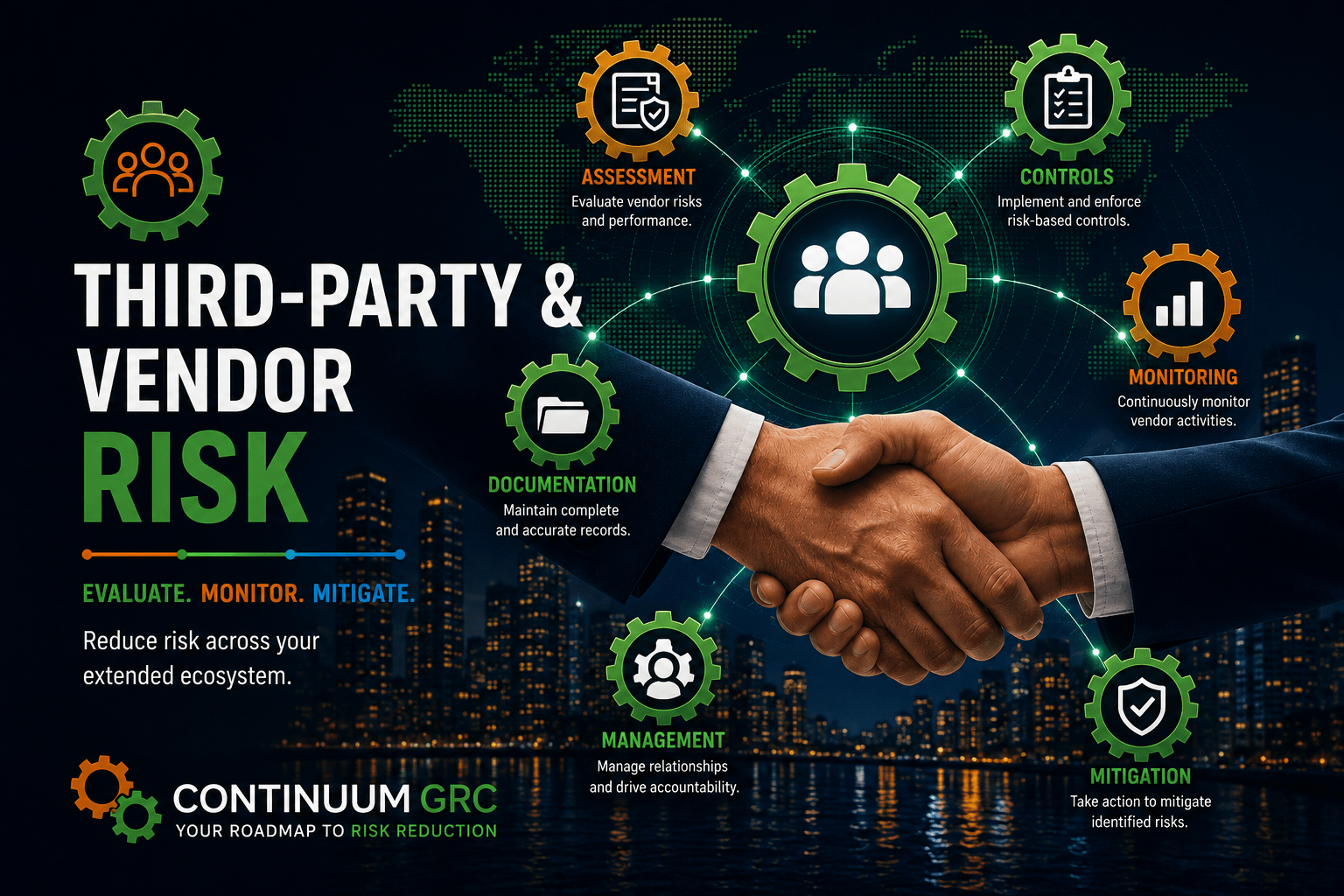
Manage third-party and vendor cybersecurity risks with structured assessment, continuous monitoring, and intelligent automation powered by AITAMBot.
Why Third-Party & Vendor Risk Matters
Table of Contents
ToggleOrganizations today rely heavily on third parties — including vendors, suppliers, service providers, and partners — to deliver critical services and technology. While this creates operational efficiency, it also significantly expands the organization’s attack surface. High-profile supply chain attacks have demonstrated how a single compromised vendor can have widespread consequences. Frameworks such as NIST SP 800-161 provide structured guidance for managing cybersecurity risks throughout the supply chain.
High-profile supply chain attacks in recent years have demonstrated how a single compromised vendor can have widespread consequences. As a result, regulators, customers, and boards are placing increasing pressure on organizations to demonstrate effective oversight of third-party cybersecurity risks.
Third-Party & Vendor Risk Management refers to the process of identifying, assessing, monitoring, and mitigating cybersecurity and operational risks that arise from relationships with external vendors and service providers.
Effective third-party risk management helps organizations:
- Reduce the likelihood of supply chain attacks and data breaches
- Meet regulatory and contractual requirements (e.g., CMMC, NIST, ISO 27001, SOC 2)
- Protect sensitive data that is shared with or processed by third parties
- Maintain business continuity when vendor disruptions occur
- Demonstrate due diligence to regulators, customers, and stakeholders
Without a structured approach, many organizations struggle with incomplete vendor inventories, inconsistent risk assessments, limited visibility into vendor security posture, and difficulty scaling oversight as the number of vendors grows.
Key Challenges in Third-Party & Vendor Risk Management
These challenges are widely recognized across industry and government. Guidance from CISA and standards such as ISO/IEC 27036 highlight the difficulties organizations face in maintaining complete vendor visibility, scaling assessments, and monitoring vendor security posture over time.
| Challenge | Description | Potential Impact |
|---|---|---|
| Incomplete Vendor Inventory | Difficulty maintaining an accurate and up-to-date list of all third parties and vendors. | Unknown risk exposure and critical blind spots in the supply chain. |
| Scalability of Assessments | Manually assessing large numbers of vendors is time-consuming and resource-intensive. | Inconsistent or superficial risk evaluations across the vendor population. |
| Limited Continuous Monitoring | Lack of ongoing visibility into changes in vendor security posture over time. | Delayed detection of new or increased risks from existing vendors. |
| Inconsistent Risk Assessment | Varying methodologies and criteria used across different teams or business units. | Poor prioritization and inconsistent risk-based decision-making. |
| Contractual and Remediation Gaps | Difficulty enforcing security requirements or tracking remediation of identified issues. | Persistent unmitigated risks from vendors over extended periods. |
| Supply Chain Complexity | Managing risk across multiple tiers of vendors and subcontractors. | Hidden dependencies and cascading risk through the extended supply chain. |
| Documentation and Audit Readiness | Maintaining clear evidence of third-party risk oversight and due diligence activities. | Weak audit findings and increased regulatory scrutiny. |
These challenges highlight the need for a structured, scalable, and technology-supported approach to third-party risk management
How A.ITAM and AITAMBot Support Third-Party & Vendor Risk Management
Managing third-party risk at scale requires more than spreadsheets and periodic questionnaires. A.ITAM and AITAMBot help organizations build a more structured, consistent, and efficient approach to identifying and managing vendor-related risks.
The platform supports third-party and vendor risk management in the following ways:
- Centralized Vendor Inventory: Maintain a single source of truth for all third parties, including key details such as services provided, data access, and risk tier.
- Risk Assessment and Questionnaires: Support structured vendor risk assessments using standardized questionnaires and scoring methodologies.
- Risk Scoring and Prioritization: Apply consistent risk scoring to help prioritize oversight efforts on the highest-risk vendors.
- Continuous Monitoring Support: Track changes in vendor security posture over time and flag significant changes or new risks.
- Remediation and Issue Tracking: Assign, monitor, and document remediation activities when vendors are required to address identified risks.
- Contract and Evidence Management: Maintain records of contractual security requirements and collect evidence of vendor compliance.
- Reporting and Audit Support: Generate reports on third-party risk posture and maintain documentation for audits and regulatory reviews.
By combining structured workflows with automation, A.ITAM helps organizations manage third-party risk more consistently while reducing the manual effort typically required.
Key Capabilities for Third-Party & Vendor Risk Management
A.ITAM supports the following core capabilities to help organizations manage third-party and vendor risk more effectively:
- Centralized vendor inventory and risk tiering
- Structured vendor risk assessment and questionnaire management
- Consistent risk scoring and prioritization
- Ongoing monitoring of vendor security posture
- Remediation tracking and issue management
- Contractual requirement tracking and evidence collection
- Third-party risk reporting and dashboards
- Integration with broader risk and compliance programs
These capabilities help organizations move from reactive or ad-hoc vendor oversight to a more proactive, scalable, and auditable third-party risk management program.
Benefits of Strong Third-Party & Vendor Risk Management
Organizations that implement structured third-party and vendor risk management programs typically experience several important benefits. Following recognized approaches, such as those outlined in NIST SP 800-161, helps organizations reduce supply chain risk, improve regulatory compliance, and strengthen overall resilience.
- Reduced Supply Chain Risk: Systematic identification and oversight of vendor risks helps lower the likelihood of breaches originating from third parties.
- Improved Regulatory Compliance: Structured processes and documentation help organizations meet increasing regulatory expectations around third-party oversight.
- Better Resource Allocation: Risk-based prioritization allows organizations to focus oversight efforts on the vendors that present the greatest risk.
- Enhanced Visibility and Accountability: Centralized tracking of vendors, risks, and remediation activities improves transparency across business and security teams.
- Stronger Contractual Enforcement: Clear documentation of security requirements and ongoing monitoring helps organizations hold vendors accountable for maintaining agreed-upon security standards.
- Faster Response to Vendor Incidents: Better visibility into vendor relationships and risks enables quicker response when a vendor experiences a security incident.
- Improved Audit and Regulatory Readiness: Comprehensive records of third-party risk activities support more effective audits and regulatory reviews.
- Competitive and Reputational Protection: Demonstrating strong third-party risk oversight can strengthen customer trust and support business development in regulated industries.
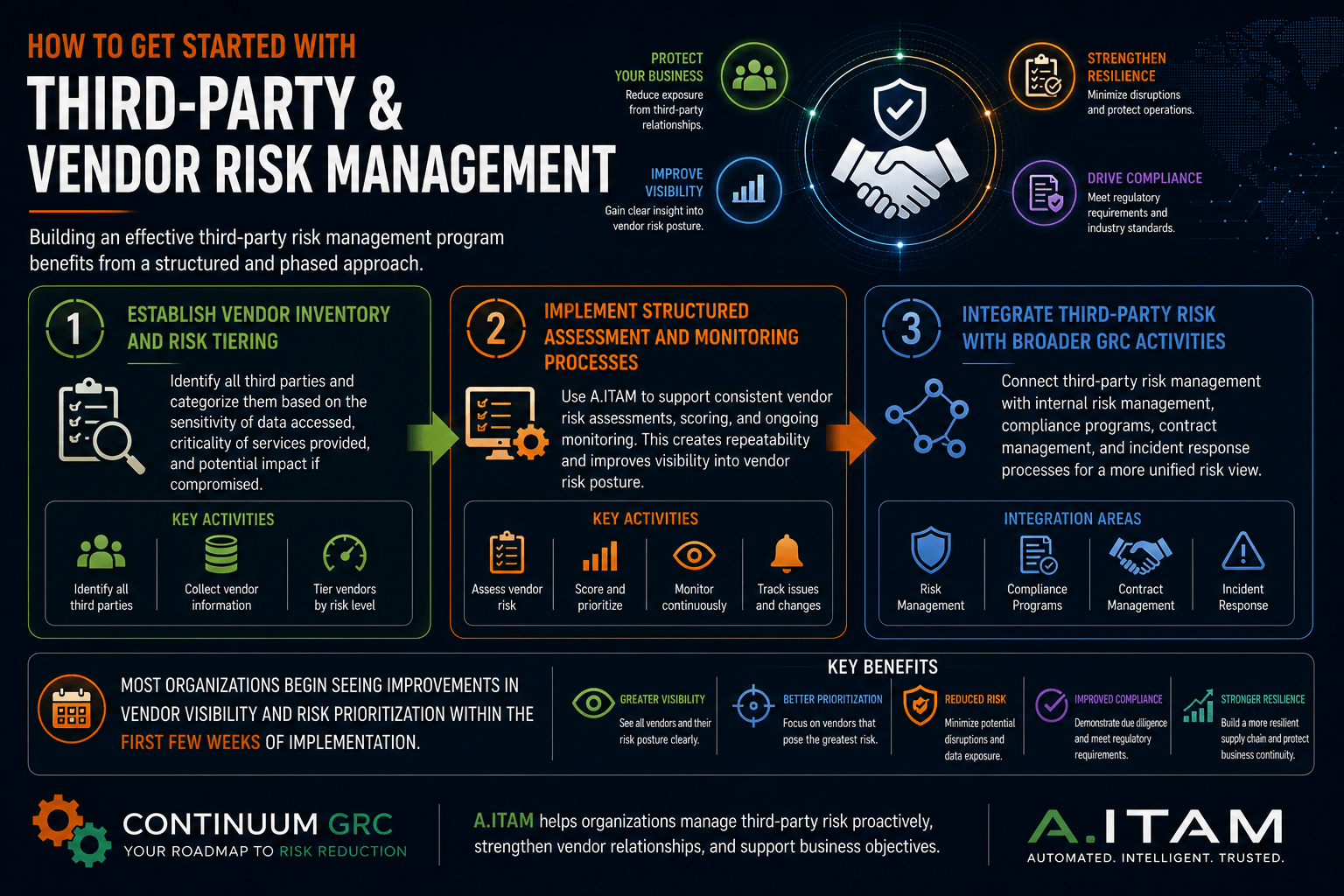
How to Get Started with Third-Party & Vendor Risk Management
Building an effective third-party risk management program benefits from following established methodologies. Resources such as the NIST Cybersecurity Supply Chain Risk Management (C-SCRM) framework and guidance from CISA offer practical approaches for identifying critical vendors, assessing risk, and implementing ongoing oversight.
Step 1: Establish Vendor Inventory and Risk Tiering: Identify all third parties and categorize them based on the sensitivity of data accessed, criticality of services provided, and potential impact if compromised.
Step 2: Implement Structured Assessment and Monitoring Processes: Use A.ITAM to support consistent vendor risk assessments, scoring, and ongoing monitoring. This creates repeatability and improves visibility into vendor risk posture.
Step 3: Integrate Third-Party Risk with Broader GRC Activities: Connect third-party risk management with internal risk management, compliance programs, contract management, and incident response processes for a more unified risk view.
Most organizations begin seeing improvements in vendor visibility and risk prioritization within the first few weeks of implementation.
Why Choose Continuum GRC for Third-Party & Vendor Risk Management
Continuum GRC supports third-party and vendor risk management as part of an integrated governance, risk, and compliance platform. Rather than treating vendor risk as a disconnected activity, A.ITAM allows organizations to align third-party oversight with broader risk management, compliance, and audit activities.
Key advantages include the following:
- A unified platform for third-party risk, internal risk, and compliance
- Structured workflows and consistent risk assessment capabilities
- Strong documentation and evidence management features
- Experience supporting regulated and security-conscious organizations
Frequently Asked Questions
Third-Party & Vendor Risk Management is the process of identifying, assessing, monitoring, and mitigating cybersecurity and operational risks that arise from relationships with external vendors and service providers. Effective third-party risk management helps organizations reduce the risk of supply chain attacks, meet regulatory expectations, protect sensitive data shared with vendors, and maintain business continuity. A.ITAM supports centralized vendor inventory, structured risk assessments, risk scoring, ongoing monitoring, remediation tracking, and documentation within a single platform. Not necessarily. A.ITAM allows organizations to manage third-party risk alongside internal risk management, compliance, and broader GRC activities. Many organizations begin improving vendor visibility and assessment processes within days or weeks. Full implementation with custom workflows and integrations typically takes several weeks depending on organizational complexity and the number of vendors.
What is Third-Party & Vendor Risk Management?
Why is third-party risk management important?
How can A.ITAM help with third-party risk management?
Do I need a separate tool for third-party risk management?
How long does it take to implement third-party risk management with A.ITAM?
Ready to Strengthen Your Third-Party & Vendor Risk Management Program?
Improve your ability to identify, assess, and monitor risks from vendors and service providers with greater structure and visibility.
Start your free 14-day trial today and experience intelligent GRC automation powered by A.ITAM.