SOC 2 Compliance Automation & Audit Readiness | Continuum GRC
Table of Contents
ToggleStreamline SOC 2 Type 1 and Type 2 readiness with automated evidence management, Trust Services Criteria mapping, audit workflows, and AITAMBot™.
SOC 1, SOC 2 & SOC 3 Compliance Automation
Simplify SOC 2 Type 1 and Type 2 audit readiness with automated evidence collection, control management, Trust Services Criteria mapping, AI-assisted compliance workflows, and continuous monitoring.
Continuum GRC helps SaaS providers, cloud service organizations, managed service providers, technology companies, and other service organizations prepare for SOC examinations and maintain organized compliance programs.
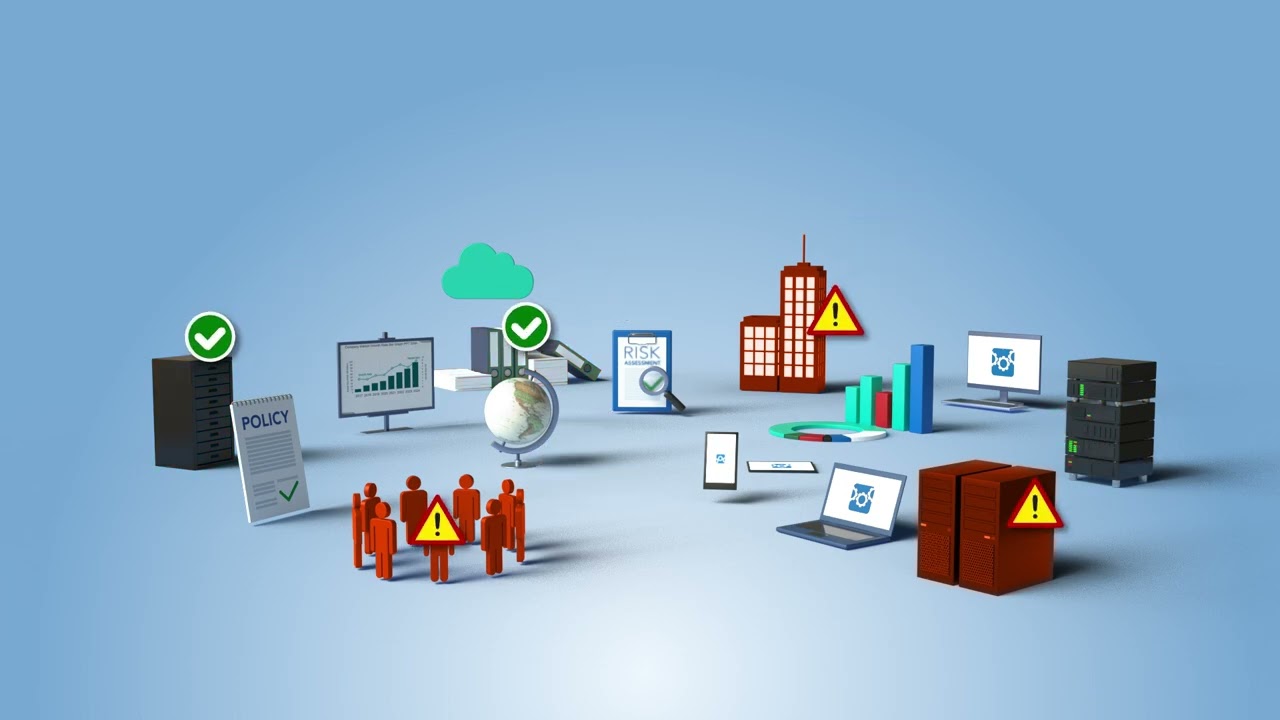
The platform connects policies, security controls, evidence, risk assessments, audit preparation, findings, and remediation within one integrated governance, risk, and compliance environment.
Whether your organization is preparing for its first SOC 2 Type 1 examination, maintaining a SOC 2 Type 2 reporting cycle, or managing SOC 1 and SOC 3 requirements, Continuum GRC helps reduce fragmented documentation and improve visibility into audit readiness.
Move beyond annual evidence collection toward continuous SOC compliance management.
Understanding SOC 1, SOC 2 & SOC 3
| SOC Report | Primary Focus | Typical Use | Continuum GRC Support |
|---|---|---|---|
|
SOC 1
Financial Reporting Controls
|
Controls at a service organization relevant to user entities' internal control over financial reporting (ICFR). | Payroll processors, financial transaction processors, claims administrators, and other service organizations whose services may affect customers' financial reporting. | Control documentation, process ownership, evidence organization, risk management, audit preparation, findings management, and remediation tracking. |
|
SOC 2
Trust Services Criteria
|
Controls relevant to the applicable AICPA Trust Services Criteria: Security, Availability, Processing Integrity, Confidentiality, and Privacy. | SaaS providers, cloud service organizations, managed service providers, data processors, and other technology or service organizations seeking to provide customers with assurance about their controls. | Trust Services Criteria mapping, SOC 2 Type 1 and Type 2 readiness, automated evidence collection, control monitoring, exception tracking, and AI-assisted compliance workflows. |
|
SOC 3
General-Use Assurance Report
|
A general-use report addressing the applicable Trust Services Criteria, based on an examination of controls similar to those covered by SOC 2, but without the same level of detailed reporting. | Public-facing assurance for customers, prospective customers, business partners, and other stakeholders who do not require the detailed information provided in a SOC 2 report. | Control management, Trust Services Criteria mapping, supporting evidence organization, assessment readiness, documentation management, and continuous compliance monitoring. |
Important: SOC 1, SOC 2, and SOC 3 are independent CPA attestation reporting engagements, not cybersecurity certifications. SOC 1 addresses controls relevant to financial reporting, while SOC 2 and SOC 3 address applicable Trust Services Criteria. Continuum GRC supports compliance management and audit readiness but does not independently issue SOC reports or CPA attestation opinions.
SOC reports are independent CPA attestation reports, not cybersecurity certifications. SOC 1 focuses on controls relevant to financial reporting, while SOC 2 and SOC 3 address applicable Trust Services Criteria. Continuum GRC supports the documentation, control management, evidence collection, and readiness activities needed for these examinations. Final SOC reports are issued by qualified independent CPA practitioners.
SOC 2 Type 1 vs Type 2: Which Report Does Your Organization Need?
SOC 2 Type 1 and Type 2 reports evaluate controls against applicable Trust Services Criteria, but they provide different levels of assurance.
SOC 2 Type 1 — Control Design at a Point in Time
A Type 1 report addresses the suitability of the design of controls as of a specified date. It is commonly considered by organizations beginning their SOC 2 reporting journey.
SOC 2 Type 2 — Control Design and Operating Effectiveness
A Type 2 report addresses the suitability of control design and operating effectiveness over a specified review period. The examination requires sufficient evidence demonstrating that controls operated throughout the reporting period.
How Continuum GRC Supports Both Report Types
Continuum GRC helps organizations document control implementation, assign control owners, collect evidence, manage policies, track findings, and prepare records for independent examination.
For Type 2 reporting, continuous evidence management helps teams maintain documentation throughout the examination period instead of relying on a last-minute audit preparation effort.
Important: There is no universally mandated SOC 2 Type 2 observation period. The reporting period should be established with the independent CPA practitioner and reflect the assurance needs of intended report users.
| Trust Services Category | What It Addresses | Continuum GRC Support |
|---|---|---|
|
Security
Common Criteria
|
Protection of information and systems against unauthorized access, unauthorized disclosure, and damage that could compromise the organization's security commitments and system requirements. Includes logical access, risk management, monitoring, change management, and incident response controls. | Security control mapping, risk assessments, access review documentation, policy management, evidence collection, incident tracking, and continuous compliance monitoring. |
| Availability | Systems are available for operation and use in accordance with the organization's commitments and system requirements. Includes capacity management, system monitoring, backup, recovery, and business continuity activities. | Availability control documentation, business continuity planning, disaster recovery evidence, monitoring records, incident management, and corrective-action tracking. |
| Processing Integrity | System processing is complete, valid, accurate, timely, and authorized in accordance with organizational commitments and system requirements. Addresses processing controls, error handling, and data validation. | Processing control mapping, documented procedures, testing evidence, exception tracking, corrective actions, and audit readiness workflows. |
| Confidentiality | Information designated as confidential is protected throughout its lifecycle in accordance with organizational commitments and system requirements. Includes classification, access restrictions, retention, and secure disposal. | Confidentiality control mapping, data classification documentation, access management evidence, policy management, risk assessments, and compliance monitoring. |
| Privacy | Personal information is collected, used, retained, disclosed, and disposed of in accordance with the organization's privacy commitments and applicable Trust Services Criteria. Includes privacy notices, consent, data subject rights, and personal information management. | Privacy control mapping, policy and notice documentation, privacy risk assessments, personal information inventory support, evidence management, and remediation tracking. |
Important: The Security category, including the Common Criteria, is included in SOC 2 examinations. Availability, Processing Integrity, Confidentiality, and Privacy are included when applicable to the service organization's system, commitments, and reporting scope. Continuum GRC supports control management, evidence collection, and audit readiness but does not independently issue SOC 2 reports or CPA attestation opinions.
Automated SOC 2 Evidence Collection & Audit Preparation
SOC 2 readiness requires organized, reliable evidence demonstrating how applicable controls are designed and, for Type 2 examinations, how they operated during the reporting period.
Continuum GRC centralizes control documentation and supporting evidence, helping compliance teams coordinate activities across departments and technology systems.
SOC 2 evidence management capabilities include:
- Associate evidence with applicable Trust Services Criteria and controls.
- Organize policies, procedures, access reviews, system records, and risk assessments.
- Track control ownership, review responsibilities, and evidence requests.
- Collect information through supported integrations and configurable workflows.
- Identify missing, outdated, or incomplete documentation.
- Maintain records supporting the defined examination period.
- Organize evidence for independent CPA review.
- Track findings and remediation activities.
Automated evidence collection improves the efficiency of compliance operations, but collected evidence must still be evaluated for relevance, completeness, and the applicable reporting period.

From SOC Requirements to Continuous Audit Readiness
SOC compliance is an ongoing process of documenting controls, collecting evidence, reviewing effectiveness, addressing exceptions, and monitoring changes.
Continuum GRC connects these activities within a centralized compliance management environment.
Organizations can use the platform to maintain control ownership, manage recurring evidence requests, track audit preparation activities, and identify issues requiring corrective action.
This approach helps organizations prepare for annual SOC examinations while improving day-to-day visibility into their control environment.
SOC 2 Exceptions, Findings & Remediation Management
Identifying and resolving control deficiencies is an essential part of SOC examination preparation.
Continuum GRC helps compliance teams document potential exceptions, assign corrective actions, establish remediation deadlines, and monitor resolution activities.
Key capabilities include:
- Track potential control deficiencies and evidence gaps.
- Assign remediation activities to accountable personnel.
- Maintain corrective-action documentation.
- Associate findings with applicable Trust Services Criteria.
- Track follow-up reviews and supporting evidence.
- Maintain historical records for subsequent examination periods.
A documented remediation action does not automatically eliminate an exception identified during an examination. The independent CPA practitioner evaluates the significance of exceptions and their effect on the SOC report.
AI-Assisted SOC 2 Compliance with AITAMBot™
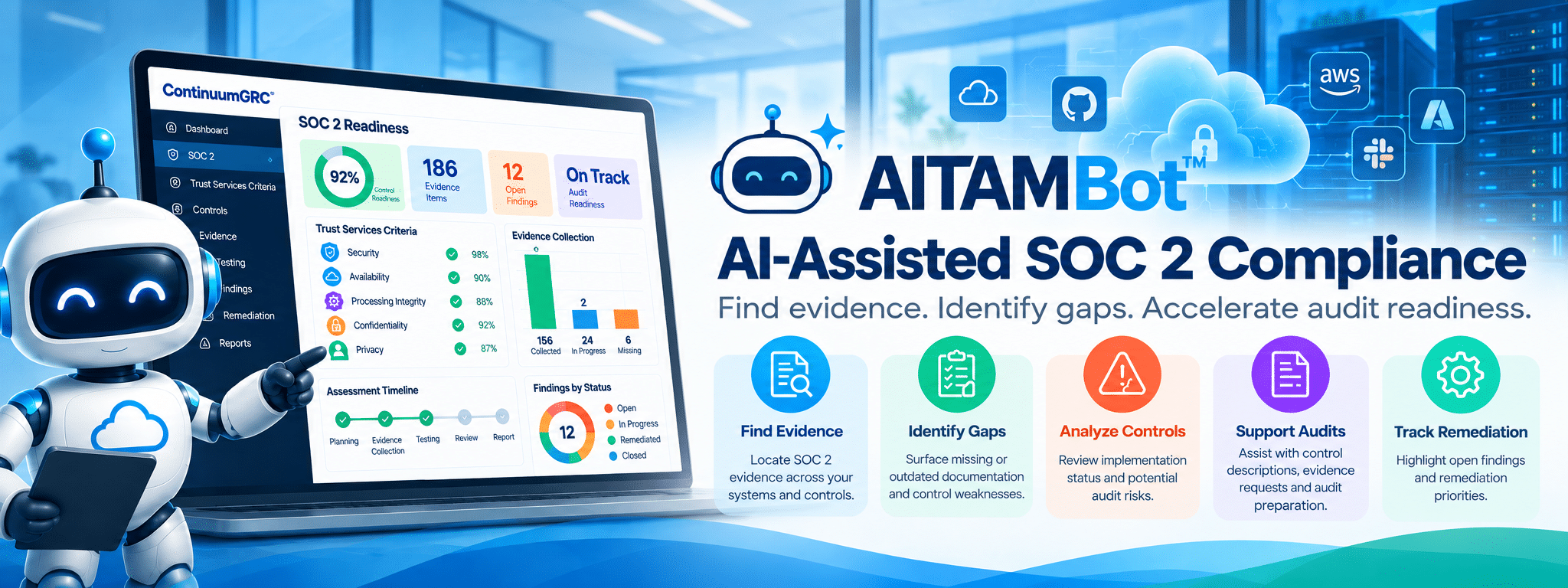
AITAMBot™ helps organizations improve SOC examination readiness by making compliance information easier to locate, review, and manage.
Find Evidence: Locate documentation associated with SOC controls and Trust Services Criteria.
Identify Gaps: Surface missing, incomplete, or outdated evidence and implementation records.
Analyze Controls: Assist compliance teams in reviewing control documentation and potential weaknesses.
Support Examinations: Help organize evidence requests, control descriptions, policies, and audit preparation activities.
Track Remediation: Highlight open findings, corrective actions, and outstanding responsibilities.
AITAMBot™ provides AI-assisted compliance support within Continuum GRC. It does not independently issue SOC reports, provide a CPA attestation opinion, or replace the professional judgment of an independent auditor.
Reuse SOC 2 Evidence Across ISO 27001, NIST, HIPAA & Other Frameworks
Many organizations managing SOC 2 also maintain cybersecurity, privacy, and regulatory compliance programs.
Continuum GRC supports cross-framework control mapping and evidence reuse, helping organizations reduce repetitive documentation activities.
Relevant evidence may support multiple compliance initiatives, including SOC 2, ISO/IEC 27001, NIST frameworks, HIPAA security requirements, and other applicable programs.
Evidence reuse must account for differences in scope, control objectives, testing methods, reporting periods, and applicable requirements.
Continuum GRC's library of 100+ compliance frameworks helps organizations maintain a coordinated approach to managing overlapping obligations.
How to Prepare for a SOC 2 Examination
A successful SOC 2 readiness program begins with a clearly defined system boundary, relevant Trust Services Criteria, documented controls, and organized evidence.
Continuum GRC supports a structured readiness process:
1. Define the Examination Scope
Identify relevant services, systems, infrastructure, personnel, subservice organizations, and commitments.
2. Select Applicable Trust Services Criteria
Determine which criteria apply to the system and its commitments.
3. Document Controls
Record control activities, responsible personnel, policies, procedures, and implementation details.
4. Assess Readiness
Identify gaps in control design, implementation, or supporting documentation.
5. Collect and Organize Evidence
Maintain relevant records for the examination date or reporting period.
6. Address Deficiencies
Assign corrective actions, track remediation, and retain supporting documentation.
7. Support the Independent Examination
Provide organized control descriptions and evidence to the independent CPA practitioner.
8. Maintain Continuous Readiness
Monitor changes, review control responsibilities, and maintain documentation for subsequent examination periods.
SOC 1, SOC 2 & SOC 3 Compliance Platform Comparison – 2026
Compare SOC compliance automation platforms based on Trust Services Criteria mapping, SOC 2 Type 1 and Type 2 readiness, automated evidence collection, AI-assisted compliance, exception management, and continuous monitoring.
| Feature | Continuum GRC | Drata | Secureframe | Vanta | Sprinto |
|---|---|---|---|---|---|
| Platform & Framework Capabilities | |||||
| FedRAMP Authorized SaaS Platform | ✓ Yes | Not publicly confirmed | Not publicly confirmed | Not publicly confirmed | Not publicly confirmed |
| SOC 1, SOC 2 & SOC 3 Compliance Modules | ✓ Yes | Verify SOC 1/3 coverage | Verify SOC 1/3 coverage | Verify SOC 1/3 coverage | Verify SOC 1/3 coverage |
| SOC 2 Trust Services Criteria Mapping | ✓ Yes | Supported | Supported | Supported | Supported |
| Custom Compliance Framework Creation | ✓ Yes | Supported | Supported | Supported | Verify current offering |
| Compliance Framework Library | 100+ Frameworks | Multiple Frameworks | Multiple Frameworks | Multiple Frameworks | Multiple Frameworks |
| SOC 2 Examination Readiness & Documentation | |||||
| SOC 2 Type 1 Readiness | ✓ Yes | Supported | Supported | Supported | Supported |
| SOC 2 Type 2 Evidence Management | ✓ Yes | Supported | Supported | Supported | Supported |
| Examination Period Evidence Tracking | ✓ Configurable | Verify period features | Verify period features | Verify period features | Verify period features |
| Control Ownership & Documentation | ✓ Yes | Supported | Supported | Supported | Supported |
| Exception & Remediation Tracking | ✓ Yes | Supported | Supported | Supported | Supported |
| Independent CPA Examination | Separate professional engagement | Verify partner options | Verify partner options | Verify partner options | Verify partner options |
| Evidence Automation & Continuous Monitoring | |||||
| Automated Evidence Collection | ✓ Yes | Supported | Supported | Supported | Supported |
| Cross-Framework Evidence Reuse | ✓ Yes | Supported | Supported | Supported | Supported |
| Continuous Monitoring & Alerts | ✓ Yes | Supported | Supported | Supported | Supported |
| Real-Time Compliance Dashboards | ✓ Yes | Supported | Supported | Supported | Supported |
| AI-Assisted Compliance & Readiness Tools | |||||
| AI-Assisted Compliance Analysis | ✓ AITAMBot™ | Drata AI | Secureframe AI | Vanta AI | Verify current offering |
| Dedicated AI Auditor Tool | ✓ AITAMBot™ | Not directly comparable | Not directly comparable | Not directly comparable | Not directly comparable |
| Built-In SOC Templates & Policies | ✓ Yes | Supported | Supported | Supported | Supported |
| Free 14-Day Trial (No Credit Card) | ✓ Yes | Verify current terms | Verify current terms | Verify current terms | Verify current terms |
| Free SOC Readiness Tools | ✓ Free SOC Compliance Tools | Verify current offering | Verify current offering | Verify current offering | Verify current offering |
Comparison notes: Feature availability may vary by subscription, configuration, service scope, and product updates. "Not publicly confirmed" indicates that a specific capability has not been verified for this comparison and does not mean the vendor lacks that capability. Continuum GRC provides SOC compliance management and examination readiness software. SOC reports are issued through independent CPA attestation engagements. AITAMBot™ assists compliance professionals but does not replace independent CPA examination procedures or professional judgment.
Frequently Asked Questions
SOC 2 is an AICPA attestation reporting framework used to evaluate controls relevant to the applicable Trust Services Criteria. A SOC 2 report is issued by an independent CPA practitioner. SOC 1 addresses controls relevant to user entities' financial reporting. SOC 2 addresses applicable Trust Services Criteria and provides detailed reporting. SOC 3 provides a less detailed, general-use report on the same subject matter as SOC 2. Type 1 addresses control design at a specified date. Type 2 addresses control design and operating effectiveness over a specified period. No. SOC 2 is an independent CPA attestation report, not a certification issued by a certification body. Security is included in SOC 2 examinations. Availability, Processing Integrity, Confidentiality, and Privacy are included when applicable to the system and its commitments. There is no universally mandated minimum observation period. The reporting period should be determined with the independent CPA practitioner based on the intended users' assurance needs. Yes. Organizations may pursue Type 1 before Type 2, although a Type 1 report is not a mandatory prerequisite. Evidence may include access reviews, policies, risk assessments, change-management records, incident-response records, vulnerability-management documentation, and other materials relevant to the selected criteria and controls. Penetration testing is not universally mandated as a standalone requirement for every SOC 2 examination. Testing activities should be determined through the organization's risks, commitments, controls, and applicable criteria. The independent CPA practitioner evaluates identified exceptions and determines their effect on the examination conclusions and report. Yes, where the evidence is relevant to both programs and satisfies applicable scope, timing, and documentation requirements. Yes. Continuum GRC includes SOC 1, SOC 2, and SOC 3 compliance management modules. AITAMBot™ assists with evidence discovery, documentation analysis, identifying potential gaps, and organizing compliance information. No. Continuum GRC provides compliance management software. Independent CPA practitioners perform SOC examinations and issue the corresponding reports. Many organizations obtain SOC 2 reports annually to satisfy customer and contractual expectations. The appropriate reporting cycle depends on business requirements and intended report users.
What is SOC 2 compliance?
What is the difference between SOC 1, SOC 2, and SOC 3?
What is the difference between SOC 2 Type 1 and Type 2?
Is SOC 2 a certification?
Which Trust Services Criteria are required?
How long does a SOC 2 Type 2 observation period need to be?
Can a company begin with SOC 2 Type 1?
What evidence is needed for SOC 2?
Does SOC 2 require penetration testing?
How are SOC 2 exceptions handled?
Can SOC 2 evidence be reused for ISO 27001?
Does Continuum GRC support SOC 1 and SOC 3?
How does AITAMBot™ help with SOC 2?
Does Continuum GRC issue SOC reports?
How often should SOC 2 examinations be performed?
Simplify Your Next SOC 2 Examination with Continuum GRC
Prepare for SOC 2 Type 1 and Type 2 examinations with centralized controls, automated evidence collection, AI-assisted compliance management, and continuous monitoring.
Whether you are beginning your first SOC 2 readiness program or maintaining an established annual reporting cycle, Continuum GRC helps organize the work behind ongoing audit readiness.
Modules include:
- AICPA SOC 1
- AICPA SOC 2 & 3
- AICPA Quality Management (QM)
Contact us using the form below or calling us at 1-888-896-6207 for assistance.