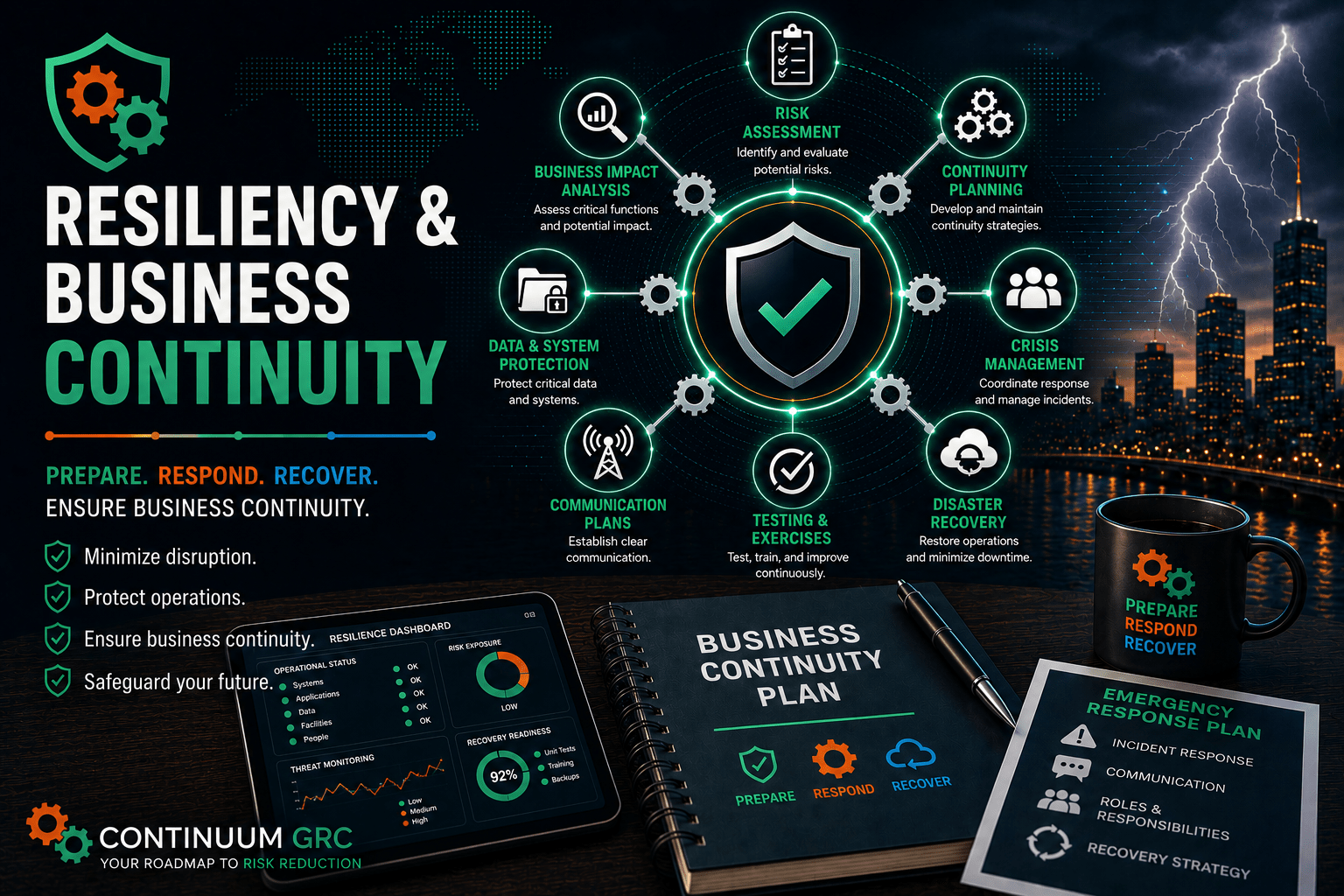
Organizations today face an increasing number of disruptive events — from cyberattacks and natural disasters to supply chain failures and regulatory mandates. The ability to anticipate, withstand, recover from, and adapt to these disruptions has become a critical business capability.
Many organizations still manage Resiliency & Business Continuity through static plans, infrequent testing, and disconnected tools. These traditional approaches often result in outdated recovery strategies, untested assumptions, limited visibility into third-party dependencies, and difficulty demonstrating a resilience posture to regulators, customers, and executive leadership.
A.ITAM provides a modern, integrated approach to Resiliency & Business Continuity. The platform helps organizations move beyond compliance-driven continuity planning toward true operational resilience. By combining structured resilience assessments, automated evidence collection, continuous monitoring, and intelligent support through AITAMBot, organizations can build, test, and maintain more robust and credible continuity and recovery capabilities.
Key Challenges in Resiliency & Business Continuity
Table of Contents
ToggleOrganizations commonly encounter the following challenges when managing resiliency and business continuity:
| Challenge | Description | Business Impact |
|---|---|---|
| Siloed Resilience and Risk Data | Business continuity plans, risk assessments, and incident response processes exist in separate systems with little integration. | Inconsistent decision-making during disruptions and difficulty understanding overall resilience posture. |
| Outdated or Infrequent Business Impact Analyses | Business Impact Analyses (BIAs) are often performed annually or only after major changes, leading to stale recovery priorities. | Recovery strategies that no longer align with current business operations and critical functions. |
| Limited or Ineffective Resilience Testing | Recovery plans are rarely tested in realistic scenarios or only through basic tabletop exercises. | False confidence in recovery capabilities and unpreparedness during actual disruptions. |
| Poor Visibility into Third-Party Resilience | Limited insight into the business continuity capabilities of critical vendors and service providers. | Significant concentration risk and potential cascading failures during supplier disruptions. |
| Disconnected Incident Response and Continuity Processes | Incident response, disaster recovery, and business continuity activities operate in isolation. | Slow, uncoordinated response during major events and extended recovery times. |
| Difficulty Demonstrating Resilience to Stakeholders | Lack of centralized evidence and reporting to show resilience posture to regulators, customers, and leadership. | Increased regulatory scrutiny, lost business opportunities, and reputational risk. |
These challenges are well documented in leading resilience and continuity frameworks. The ISO 22301 standard provides requirements for establishing and maintaining an effective business continuity management system. Similarly, NIST SP 800-34 Rev. 1 offers comprehensive guidance on contingency planning, while the NIST Cybersecurity Framework includes specific outcomes related to recovery and resilience.
How A.ITAM and AITAMBot Support Resiliency & Business Continuity
A.ITAM enables organizations to take a more integrated and proactive approach to resiliency and business continuity. Instead of maintaining separate, static plans, the platform supports ongoing resilience assessment, automated evidence management, and coordinated recovery planning.
Key capabilities include:
- Integrated Resilience and Risk Data: A.ITAM brings together business impact analyses, risk assessments, continuity plans, and incident response data into a single platform for better decision-making during both planning and actual disruptions.
- Automated Business Impact Analysis Support: The platform helps maintain current BIAs by linking them to risk data and change management processes, reducing the effort required to keep recovery priorities accurate and up to date.
- Resilience Testing and Exercise Management: A.ITAM supports the planning, execution, and documentation of tabletop exercises, simulations, and technical recovery tests with structured workflows and evidence capture.
- Third-Party Resilience Oversight: Organizations can assess, monitor, and document the continuity capabilities of critical vendors directly within the platform, improving supply chain resilience visibility.
- Coordinated Incident and Continuity Workflows: The platform helps align incident response activities with business continuity and disaster recovery processes for faster, more effective response during major events.
- AITAMBot Intelligence: AITAMBot can analyze resilience data, identify gaps in continuity coverage, suggest improvements to recovery strategies, and help prioritize testing and remediation efforts.
This integrated approach helps organizations build more credible and maintainable resilience programs while reducing the manual effort traditionally required.
Key Capabilities for Resiliency & Business Continuity
A.ITAM delivers the following core capabilities to support resiliency and business continuity programs:
- Centralized management of business continuity plans, disaster recovery plans, and resilience documentation
- Support for Business Impact Analysis (BIA) maintenance and linkage to risk data
- Structured workflows for resilience testing, tabletop exercises, and recovery validation
- Third-party and supply chain resilience assessment and monitoring
- Integration between incident response, business continuity, and disaster recovery processes
- Automated evidence collection and centralized repository for resilience activities
- Real-time dashboards showing resilience posture, recovery readiness, and gaps
- AI-assisted gap analysis and improvement recommendations via AITAMBot
These capabilities align with the contingency planning controls found in NIST SP 800-53 and the requirements outlined in ISO 22301.
Benefits of Implementing Resiliency & Business Continuity with A.ITAM
Organizations that adopt a more integrated and automated approach to resiliency and business continuity typically experience several important benefits:
- Improved Recovery Readiness: Better-maintained plans, more frequent and realistic testing, and clearer recovery priorities lead to faster and more effective responses during disruptions.
- Reduced Operational Disruption: Coordinated incident response and continuity processes help minimize the duration and impact of disruptive events on the organization.
- Stronger Third-Party Resilience: Improved visibility into vendor continuity capabilities reduces concentration risk and potential cascading failures during supplier disruptions.
- Better Regulatory and Customer Confidence: Centralized evidence and clear reporting make it easier to demonstrate resilience posture to regulators, auditors, and business partners.
- More Efficient Use of Resources: Automation of evidence collection, plan maintenance, and exercise documentation frees continuity and risk teams to focus on higher-value activities.
- Enhanced Decision-Making During Crises: Integrated data and dashboards provide leadership with better situational awareness when disruptions occur.
How to Get Started with Resiliency & Business Continuity
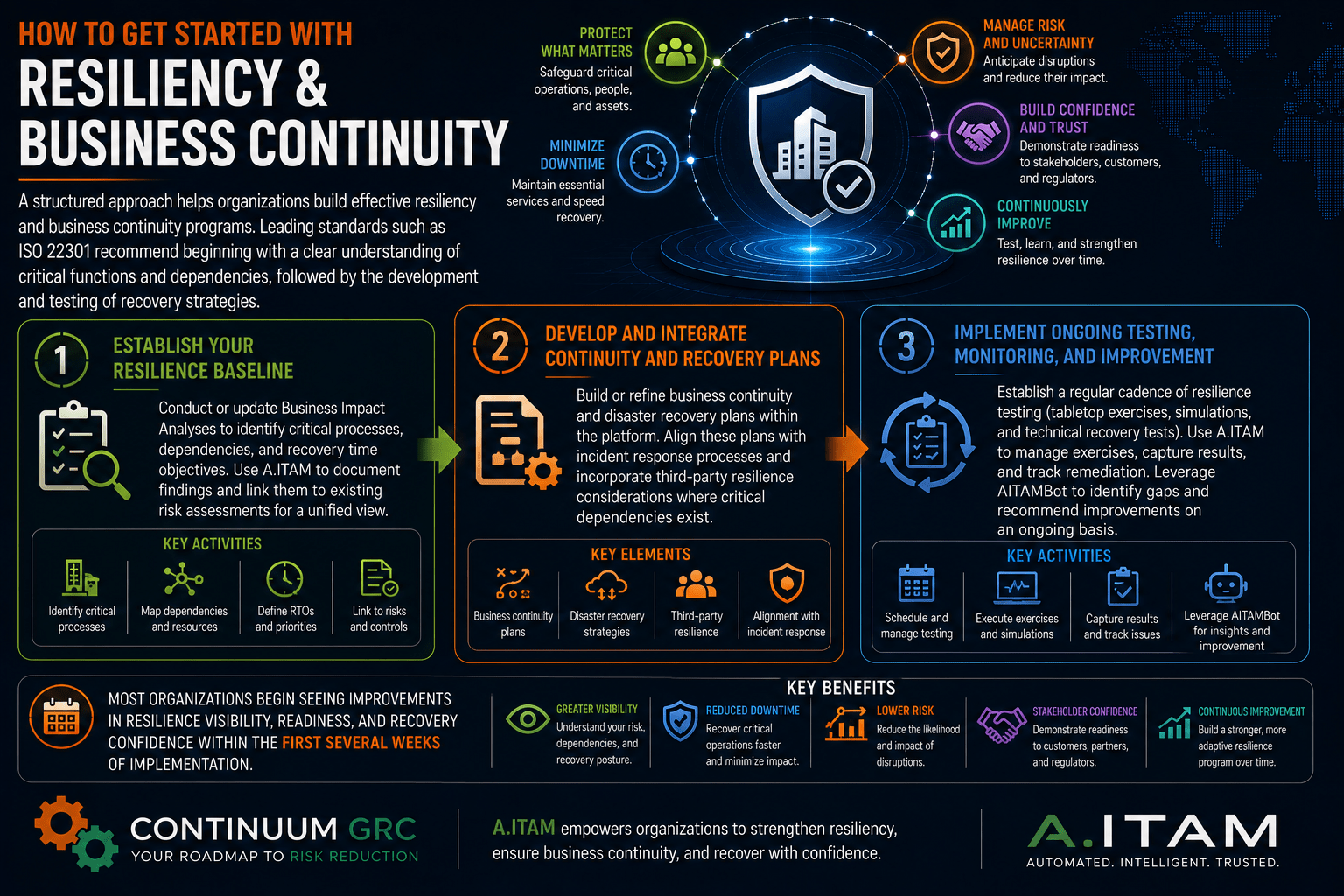
A structured approach helps organizations build effective resiliency and business continuity programs. Leading standards such as ISO 22301 recommend beginning with a clear understanding of critical functions and dependencies, followed by the development and testing of recovery strategies.
Step 1: Establish Your Resilience Baseline: Conduct or update Business Impact Analyses to identify critical processes, dependencies, and recovery time objectives. Use A.ITAM to document findings and link them to existing risk assessments for a unified view. Guidance from both ISO 22301 and NIST SP 800-34 emphasizes that BIAs should be kept current and connected to overall risk management activities.
Step 2: Develop and Integrate Continuity and Recovery Plans: Build or refine business continuity and disaster recovery plans within the platform. Align these plans with incident response processes and incorporate third-party resilience considerations where critical dependencies exist. This creates a more coordinated and realistic recovery framework.
Step 3: Implement Ongoing Testing, Monitoring, and Improvement: Establish a regular cadence of resilience testing, including tabletop exercises, simulations, and technical recovery tests. Use A.ITAM to manage exercises, capture results, and track remediation. Leverage AITAMBot to identify gaps and recommend improvements on an ongoing basis. Both ISO 22301 and NIST SP 800-34 stress the importance of exercising plans regularly and using the results to drive continuous improvement of resilience capabilities.
Why Choose Continuum GRC for Resiliency & Business Continuity
Continuum GRC helps organizations build practical, integrated resilience programs that go beyond checkbox compliance. A.ITAM was designed to address the real operational challenges of maintaining business continuity and disaster recovery capabilities in complex environments.
Key advantages include the following:
- Strong integration between risk, continuity, and incident response data
- Support for both planning and ongoing resilience validation
- Intelligent assistance through AITAMBot to identify gaps and prioritize improvements
- Proven support for organizations with strict regulatory or customer-driven resilience requirements
Frequently Asked Questions
Business continuity focuses on maintaining or quickly restoring critical business functions during and after a disruption. Disaster recovery focuses more specifically on restoring IT systems, data, and technology infrastructure. Leading practice recommends testing at least annually, with more frequent testing for critical functions or after significant changes to operations, technology, or third-party dependencies. Yes. A.ITAM supports the assessment, documentation, and ongoing monitoring of critical vendors’ business continuity capabilities as part of your overall resilience program. AITAMBot can analyze resilience data, identify gaps in continuity coverage, suggest improvements to recovery strategies, and help prioritize testing and remediation activities. Yes. The platform supports structured documentation, evidence management, and reporting that help organizations meet regulatory expectations around business continuity and operational resilience. A.ITAM allows organizations to link incident response workflows with business continuity and disaster recovery plans, enabling more coordinated and effective responses during major events. A.ITAM supports common resilience-related frameworks and standards, including ISO 22301, NIST guidance on contingency planning, and various industry-specific business continuity requirements.
What is the difference between business continuity and disaster recovery?
How often should organizations test their business continuity plans?
Can A.ITAM help with third-party resilience management?
How does AITAMBot assist with resiliency and business continuity?
Is A.ITAM suitable for organizations with strict regulatory resilience requirements?
How does A.ITAM integrate incident response with business continuity?
What frameworks does A.ITAM support for resiliency and business continuity?
Ready to Strengthen Your Resiliency & Business Continuity Program?
Build more integrated, testable, and defensible resilience capabilities with A.ITAM.
Start your free 14-day trial today and experience intelligent GRC automation powered by A.ITAM.