Organizations today face increasing pressure to demonstrate that their controls are properly designed, consistently operating, and aligned with regulatory requirements—not just during periodic audits, but on an ongoing basis. Regulators, customers, and internal stakeholders expect clear, defensible evidence of control effectiveness.
Many organizations still rely on manual processes, spreadsheets, and point-in-time testing to manage audit and regulatory controls. These traditional approaches often lead to audit fatigue, incomplete evidence, delayed issue identification, and difficulty maintaining visibility into control performance between audit cycles.
A.ITAM enables organizations to move from reactive, audit-driven compliance to a more proactive and continuous approach to Audit & Regulatory Controls. The platform combines structured control management with intelligent automation through AITAMBot, helping organizations reduce the operational burden of audits while improving the quality, consistency, and defensibility of their regulatory control environment.
Key Challenges in Audit & Regulatory Controls
Table of Contents
ToggleOrganizations frequently encounter the following challenges when managing audit and regulatory controls:
| Challenge | Description | Business Impact |
|---|---|---|
| Manual Evidence Collection | Teams spend excessive time manually gathering, organizing, and formatting evidence for audits and regulatory requests. | High labor costs, audit delays, and increased risk of missing or incomplete evidence. |
| Point-in-Time Testing Only | Controls are typically tested only during audit periods rather than monitored on a continuous basis. | Control failures may go undetected for long periods, increasing risk exposure. |
| Inconsistent Control Mapping | Difficulty maintaining clear linkages between controls and multiple regulatory requirements across frameworks. | Redundant testing, audit findings, and challenges demonstrating adequate compliance coverage. |
| Audit Fatigue and Resource Strain | Frequent audits across different frameworks create repeated disruption and heavy manual workload. | Team burnout, delayed business initiatives, and declining quality of evidence over time. |
| Limited Visibility into Control Effectiveness | Lack of real-time dashboards and monitoring showing control performance and trends. | Reactive rather than proactive risk management and late identification of control issues. |
| Disorganized Evidence and Audit Trails | Evidence is often scattered across systems, emails, and shared drives with poor version control. | Difficulty defending the operating effectiveness of controls during audits and examinations. |
These challenges align with guidance from leading control frameworks. The COSO Internal Control Framework emphasizes the importance of ongoing monitoring activities as a core component of effective internal control. Similarly, NIST SP 800-53 and ISO 27001 stress the need for systematic control assessment, continuous monitoring where appropriate, and the retention of evidence to support assurance activities.
How A.ITAM and AITAMBot Support Audit & Regulatory Controls
A.ITAM is designed to transform how organizations manage audit and regulatory controls. Rather than treating audits as high-stress, periodic events, the platform supports continuous control monitoring, automated evidence collection, and structured audit workflows.
Key ways A.ITAM supports audit and regulatory controls include the following:
- Automated Evidence Collection and Organization: A.ITAM can automatically gather, timestamp, and organize evidence from connected systems, significantly reducing the manual effort typically required during audit preparation.
- Continuous Control Monitoring: Instead of testing controls only during audit windows, organizations can monitor key controls on an ongoing basis and receive alerts when performance falls outside expected parameters.
- Unified Control Mapping Across Regulations: Maintain a single source of truth for controls while clearly demonstrating how those controls address requirements across multiple regulatory frameworks, reducing redundant testing.
- Structured Audit Workflows: Define and automate audit planning, evidence requests, review processes, and finding management directly within the platform.
- Centralized Evidence Repository with Full Audit Trail: All evidence is stored with complete version history, access logs, and chain-of-custody information, making it easier to demonstrate control operation during examinations.
- AITAMBot Intelligence: AITAMBot can analyze control performance data, identify potential gaps or anomalies, suggest improvements to control design or testing, and help prioritize areas that may require attention before an audit begins.
This combination of automation and intelligence allows organizations to maintain a stronger state of continuous audit readiness while reducing the operational disruption typically associated with regulatory examinations.
Key Capabilities for Audit & Regulatory Controls
A.ITAM provides the following core capabilities to support audit and regulatory control programs:
- Automated collection and organization of audit evidence across integrated systems
- Continuous monitoring of control effectiveness with configurable alerts and thresholds
- Unified mapping of controls to multiple regulatory frameworks
- Structured workflows for audit planning, execution, and finding management
- Centralized evidence repository with full version control and complete audit history
- Real-time dashboards showing control performance and overall compliance posture
- AI-assisted gap analysis and control improvement recommendations via AITAMBot
- Seamless integration with policy management, risk assessment, and incident response activities
Benefits of Implementing Audit & Regulatory Controls with A.ITAM
Organizations that adopt a more automated and continuous approach to audit and regulatory controls typically realize several important benefits:
- Reduced Audit Preparation Time: Automated evidence collection and organization can significantly decrease the time and effort required to prepare for audits and regulatory reviews.
- Improved Audit Outcomes: Better organized evidence, clearer control mapping, and documented operating effectiveness generally lead to fewer findings and smoother examination processes.
- Lower Audit Fatigue: By maintaining a more continuous state of readiness, organizations reduce the repeated operational disruption caused by preparing for multiple audits throughout the year.
- Greater Visibility into Control Performance: Real-time dashboards and ongoing monitoring provide leadership with better insight into the effectiveness of regulatory controls on an ongoing basis rather than only during audit periods.
- Stronger Regulatory Posture: Consistent evidence trails and the proactive identification of control issues help demonstrate a more mature and well-managed control environment to regulators and auditors.
- More Efficient Use of Resources: Automation allows compliance and audit teams to shift focus from repetitive manual evidence gathering to higher-value activities such as risk analysis and control improvement.
How to Get Started with Audit & Regulatory Controls
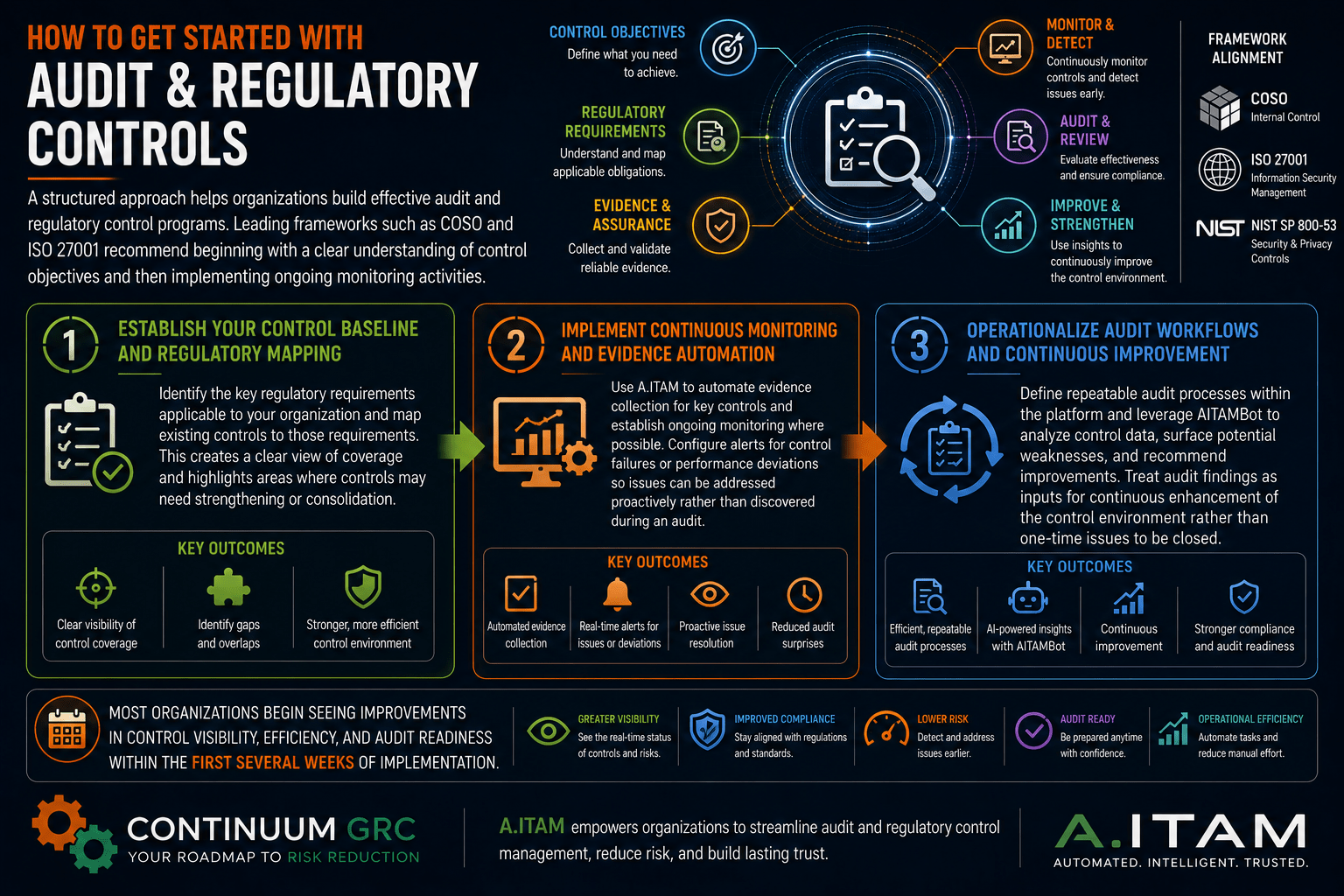
A structured approach helps organizations build effective audit and regulatory control programs. Leading frameworks such as the COSO Internal Control Framework and ISO 27001 recommend beginning with a clear understanding of control objectives followed by the implementation of ongoing monitoring activities.
Step 1: Establish Your Control Baseline and Regulatory Mapping: Identify the key regulatory requirements applicable to your organization and map existing controls to those requirements. This exercise creates a clear view of coverage and highlights areas where controls may need strengthening, consolidation, or additional evidence support.
Step 2: Implement Continuous Monitoring and Evidence Automation: Use A.ITAM to automate evidence collection for key controls and establish ongoing monitoring where feasible. Configure alerts for control failures or performance deviations so issues can be identified and addressed proactively rather than discovered during an audit.
Step 3: Operationalize Audit Workflows and Continuous Improvement: Define repeatable audit processes within the platform and leverage AITAMBot to analyze control data, surface potential weaknesses, and recommend improvements. Treat audit findings as valuable inputs for the ongoing enhancement of the control environment rather than isolated issues to be closed.
Why Choose Continuum GRC for Audit & Regulatory Controls
Continuum GRC specializes in helping organizations build efficient, auditable control environments that can withstand regulatory scrutiny. A.ITAM was developed to address the real operational challenges of managing regulatory controls and preparing for audits across complex, multi-framework environments.
Key advantages include the following:
- Strong automation of evidence collection and continuous control monitoring
- Unified control mapping across multiple regulatory requirements
- Intelligent assistance through AITAMBot to reduce manual analysis and improve prioritization
- Proven support for organizations undergoing frequent or rigorous audits
Frequently Asked Questions
Audit and regulatory controls refer to the policies, procedures, and technical measures an organization implements to ensure compliance with regulatory requirements and to provide assurance during audits that controls are operating effectively. Traditional audit testing is typically performed at a point in time (usually during the audit). Continuous monitoring evaluates control performance on an ongoing basis, allowing issues to be identified and addressed much earlier. Yes. A.ITAM automates much of the evidence collection and organization process, which is often one of the most time-consuming parts of audit preparation. Yes. The platform allows organizations to maintain a single set of controls while clearly demonstrating how those controls address requirements across multiple frameworks. AITAMBot can analyze control performance data, identify potential gaps or anomalies, suggest improvements, and help prioritize areas that may require attention before an audit. Yes. A.ITAM is particularly valuable for organizations that face multiple audits per year, as it helps maintain a continuous state of audit readiness rather than requiring intensive preparation before each examination. Many organizations begin realizing time savings in evidence collection and improved visibility within the first few weeks. Full benefits typically increase as more controls are brought into automated monitoring workflows.
What are Audit & Regulatory Controls?
How does continuous control monitoring differ from traditional audit testing?
Can A.ITAM help reduce the time spent preparing for audits?
Does A.ITAM support multiple regulatory frameworks at once?
How does AITAMBot assist with audit and regulatory controls?
Is A.ITAM suitable for organizations that undergo frequent audits?
How long does it typically take to see benefits from implementing A.ITAM for audit controls?
Ready to Strengthen Your Audit & Regulatory Controls?
Reduce audit preparation time, improve control visibility, and maintain continuous regulatory readiness with A.ITAM.
Start your free 14-day trial today and experience intelligent GRC automation powered by A.ITAM.