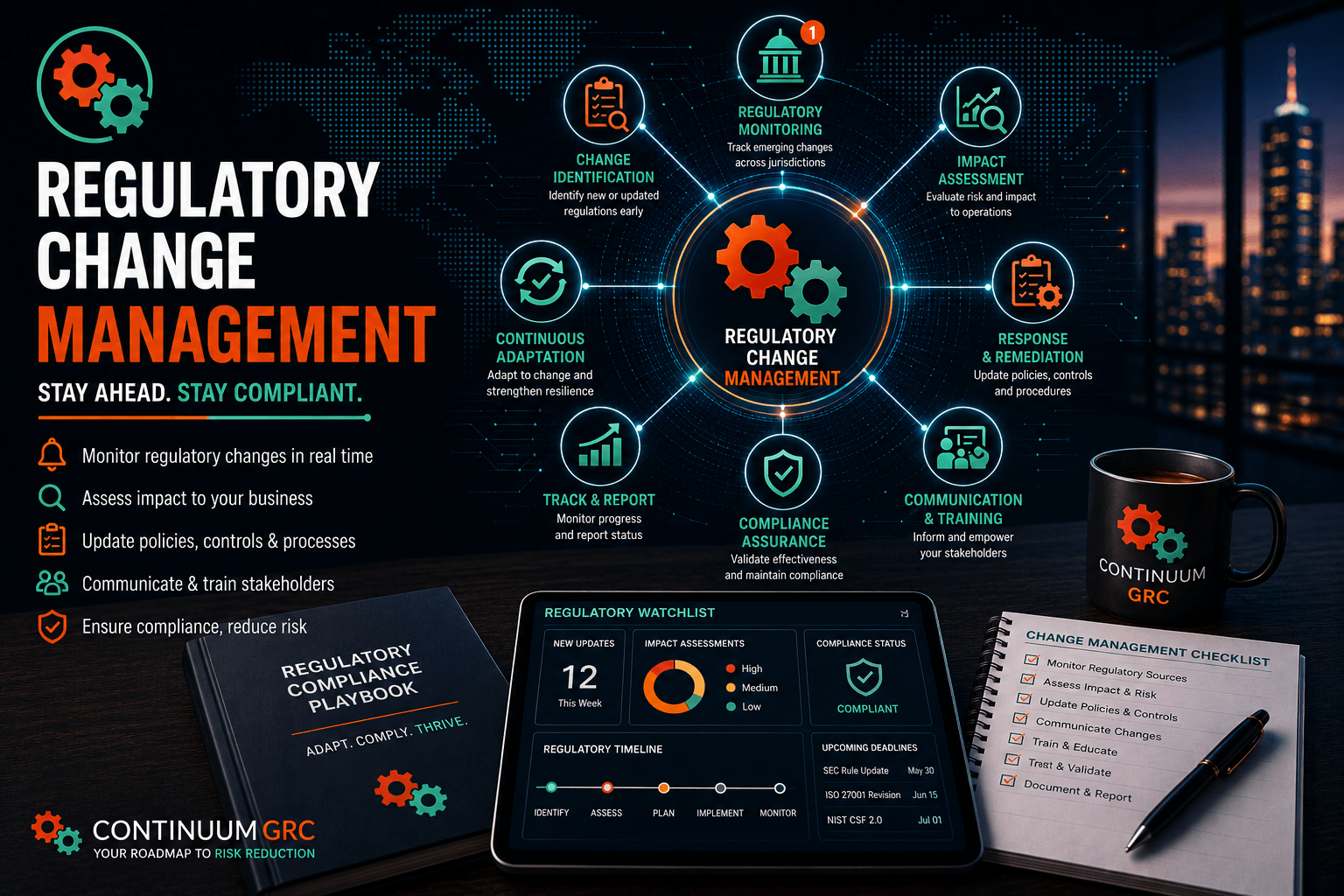
Stay ahead of evolving regulations with automated monitoring, impact assessment, and intelligent control mapping powered by AITAMBot.
Why Regulatory Change Management Matters
Table of Contents
ToggleOrganizations today operate in an increasingly complex and fast-changing regulatory environment. New laws, amendments, enforcement actions, and guidance are released regularly across multiple jurisdictions and industries. According to leading research, organizations that fail to effectively manage regulatory change face significantly higher compliance risks and operational costs.
Managing regulatory change has become a strategic priority for organizations worldwide. As regulatory complexity continues to grow, companies are increasingly turning to structured frameworks to stay compliant. The international standard ISO 37301:2021—Compliance management systems provides guidance on establishing, developing, implementing, evaluating, maintaining, and improving an effective compliance management system—including how to handle regulatory change.
Effective regulatory change management helps organizations:
- Reduce the risk of non-compliance and associated penalties
- Avoid gaps in controls and policies
- Maintain continuous audit readiness
- Reduce the operational burden of reacting to regulatory updates
- Demonstrate proactive compliance to regulators, customers, and boards
Failing to keep up with regulatory changes can lead to outdated policies, misaligned controls, compliance violations, and increased scrutiny during audits or investigations. In highly regulated industries, the cost of noncompliance can be significant—both financially and reputationally.
A strong regulatory change management program enables organizations to move from reactive firefighting to proactive, strategic compliance.
Key Challenges in Regulatory Change Management
These challenges are well documented across the compliance industry. Research from Deloitte highlights that many organizations struggle with the volume and speed of regulatory updates, often leading to gaps in compliance and increased operational burden.
| Challenge | Description | Potential Impact |
|---|---|---|
| Volume and Velocity of Change | High volume of regulatory updates across multiple jurisdictions and frameworks. | Overwhelm, missed changes, and compliance gaps. |
| Identifying Relevant Changes | Difficulty determining which regulatory updates actually apply to the organization. | Wasted effort or missed obligations. |
| Assessing Impact | Evaluating how regulatory changes affect existing policies, controls, and processes. | Incomplete or delayed remediation. |
| Updating Controls and Policies | Mapping regulatory changes to internal controls and updating documentation. | Outdated controls and audit findings. |
| Cross-Functional Coordination | Involving legal, compliance, risk, IT, and business units in change response. | Slow response and inconsistent implementation. |
| Maintaining Evidence of Compliance | Documenting how the organization responded to regulatory changes. | Weak audit trail and regulatory findings. |
| Resource Constraints | Limited time and expertise to monitor and respond to regulatory changes. | Increased risk and reliance on external consultants. |
These challenges are interconnected. Without a structured and technology-supported approach, organizations often struggle to keep pace with regulatory developments while maintaining day-to-day compliance operations.
How A.ITAM and AITAMBot Support Regulatory Change Management
Managing regulatory change manually is time-consuming, error-prone, and often reactive. A.ITAM and AITAMBot help organizations move from reactive compliance to a more proactive and structured approach by combining intelligent monitoring with workflow automation.
The platform supports regulatory change management in the following ways:
- Regulatory Monitoring and Alerts: Automatically track updates across supported frameworks and receive timely notifications about relevant regulatory changes, reducing the risk of missing critical updates.
- Impact Assessment Support: Help evaluate how regulatory changes may affect existing controls, policies, and compliance programs. This allows teams to quickly understand the scope of required changes instead of manually reviewing every update.
- Control and Policy Mapping: Map regulatory requirements to internal controls and identify where updates or new controls are needed. This significantly reduces the time required to translate regulatory changes into actionable compliance tasks.
- Change Documentation and Evidence: Maintain clear, auditable records of regulatory changes and how the organization responded to them. This creates strong documentation for audits, regulators, and internal reviews.
- Cross-Framework Visibility: Understand how a single regulatory change may impact multiple compliance frameworks simultaneously. This is especially valuable for organizations managing overlapping requirements such as NIST, ISO, CMMC, and others.
- Workflow and Task Management: Assign and track remediation activities across legal, compliance, risk, and business teams when regulatory changes require action. This improves accountability and reduces delays in implementation.
- Integration with Broader GRC Programs: Connect regulatory change activities with risk management, policy management, control remediation, and audit readiness. This creates a more unified and strategic approach to compliance rather than treating regulatory change as an isolated task.
By combining monitoring, analysis, and structured workflows, A.ITAM helps organizations respond to regulatory changes more proactively while maintaining strong documentation and reducing manual effort.
Key Capabilities for Regulatory Change Management
A.ITAM supports the following core capabilities to help organizations manage regulatory change effectively:
- Automated monitoring of regulatory updates across supported frameworks
- Impact analysis of regulatory changes on existing controls and obligations
- Mapping of regulatory requirements to internal controls and policies
- Centralized documentation of regulatory changes and organizational responses
- Workflow management for remediation and control updates
- Cross-framework visibility of regulatory obligations
- Evidence collection for demonstrating compliance with regulatory changes
- Integration with risk, compliance, and audit programs
These capabilities help organizations reduce the manual effort of regulatory change management while improving consistency and audit readiness.
Benefits of Strong Regulatory Change Management
Organizations that implement structured regulatory change management programs typically experience several important benefits. According to Thomson Reuters, companies with mature regulatory change processes are better positioned to reduce compliance risk, improve operational efficiency, and respond more quickly to new regulatory requirements.
Key benefits include the following:
- Reduced Risk of Non-Compliance: Proactive identification and structured response to regulatory changes lowers the likelihood of violations, fines, enforcement actions, and reputational damage.
- Improved Audit and Regulatory Readiness: Maintaining clear records of regulatory changes and organizational responses makes it significantly easier to demonstrate compliance during audits and regulatory reviews.
- Greater Operational Efficiency: Automation of monitoring and impact assessment reduces the manual workload on compliance, legal, and risk teams, allowing them to focus on higher-value activities.
- Better Cross-Functional Alignment: Structured workflows and visibility help ensure that relevant teams (legal, compliance, IT, business units) are involved early when regulatory changes require action.
- Faster Adaptation to New Requirements: Early awareness combined with structured response processes enables organizations to implement necessary changes more quickly and with less operational disruption.
- Reduced Reliance on External Consultants: Strong internal capabilities for monitoring and assessing regulatory changes can lower dependence on outside advisors for routine regulatory updates.
- Enhanced Strategic Decision-Making: Better visibility into upcoming regulatory trends supports more informed business planning, risk appetite decisions, and long-term compliance strategy.
- Competitive Advantage: Organizations that adapt quickly and effectively to regulatory changes are often better positioned to meet customer expectations, win regulated contracts, and maintain trust with partners and regulators.
How to Get Started with Regulatory Change Management
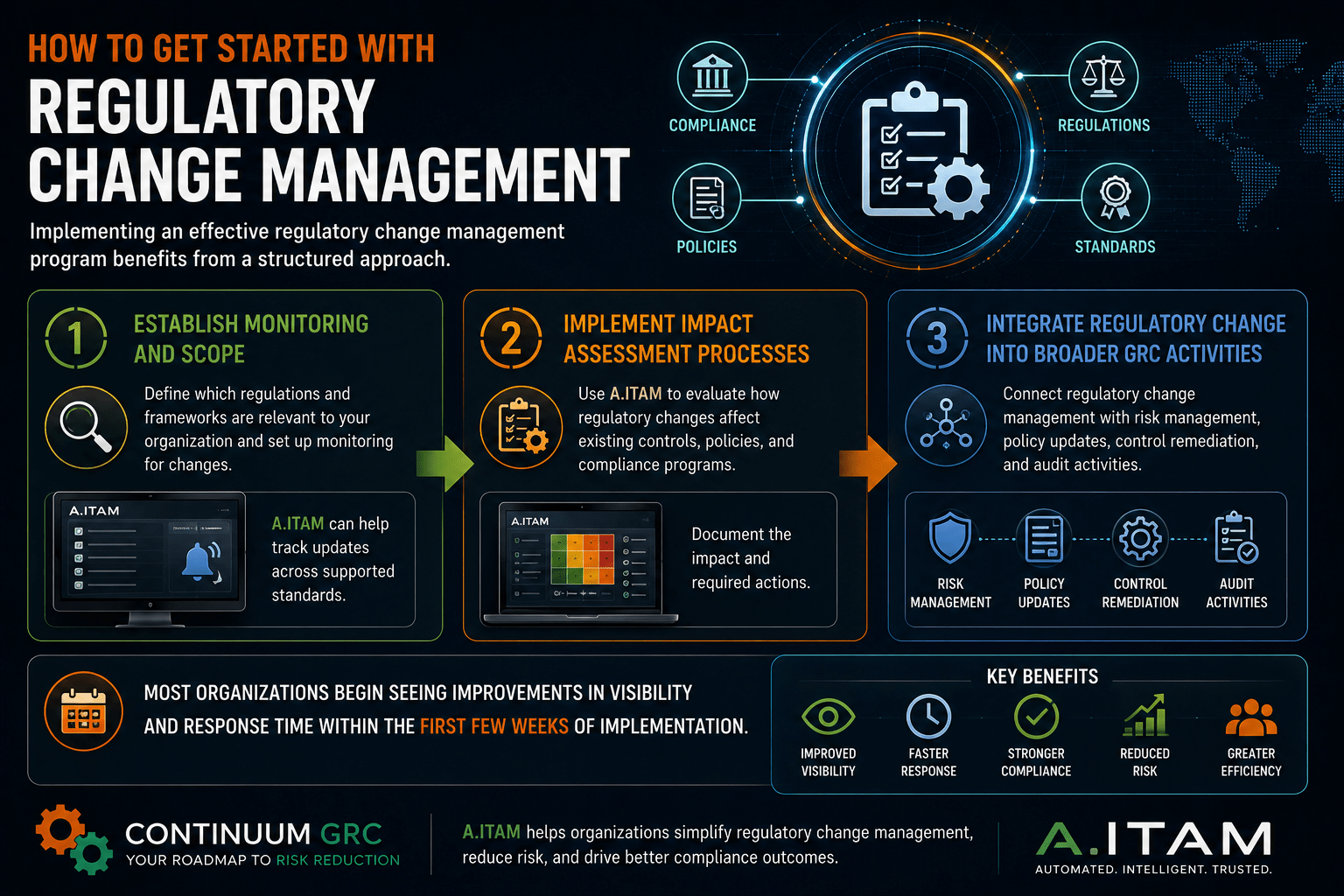
Implementing an effective regulatory change management program benefits from a structured approach. Many organizations begin by assessing their current capabilities against established best practices. Resources from firms such as PwC emphasize the importance of combining technology, clear processes, and cross-functional collaboration when building regulatory change capabilities.
Step 1: Establish Monitoring and Scope:
Define which regulations and frameworks are relevant to your organization and set up monitoring for changes. A.ITAM can help track updates across supported standards.
Step 2: Implement Impact Assessment Processes:
Use A.ITAM to evaluate how regulatory changes affect existing controls, policies, and compliance programs. Document the impact and required actions.
Step 3: Integrate Regulatory Change into Broader GRC Activities:
Connect regulatory change management with risk management, policy updates, control remediation, and audit activities. This creates a more unified and proactive compliance posture.
Most organizations begin seeing improvements in visibility and response time within the first few weeks of implementation.
Why Choose Continuum GRC for Regulatory Change Management
Continuum GRC supports regulatory change management as part of an integrated governance, risk, and compliance platform. Rather than treating regulatory change as a disconnected activity, A.ITAM allows organizations to align regulatory monitoring and response with broader risk and compliance programs.
Key advantages include the following:
- Unified platform for regulatory change, risk, and compliance
- Automation and workflow support through AITAMBot
- Strong documentation and evidence capabilities
- Cross-framework visibility and mapping
- Experience supporting organizations in highly regulated environments
Frequently Asked Questions
What is Regulatory Change Management?
Regulatory Change Management is the process of identifying, analyzing, and responding to changes in laws, regulations, standards, and guidance that affect an organization’s compliance obligations.
Why is regulatory change management important?
Failing to keep up with regulatory changes can lead to outdated controls, policy gaps, compliance violations, and increased risk during audits or regulatory reviews.
How can A.ITAM help with regulatory change management?
A.ITAM supports regulatory monitoring, impact assessment, control mapping, documentation, and workflow management for responding to regulatory changes.
Do I need a separate tool for regulatory change management?
Not necessarily. A.ITAM allows organizations to manage regulatory change activities within the same platform used for risk management, compliance, and audit activities.
How long does it take to implement regulatory change management with A.ITAM?
Many organizations begin improving visibility and response processes within days or weeks. Full implementation with custom workflows typically takes a few weeks depending on organizational complexity.
Ready to Strengthen Your Regulatory Change Management Program?
Stay ahead of evolving regulations with greater visibility, automation, and control.
Start your free 14-day trial today and experience intelligent GRC automation powered by A.ITAM.