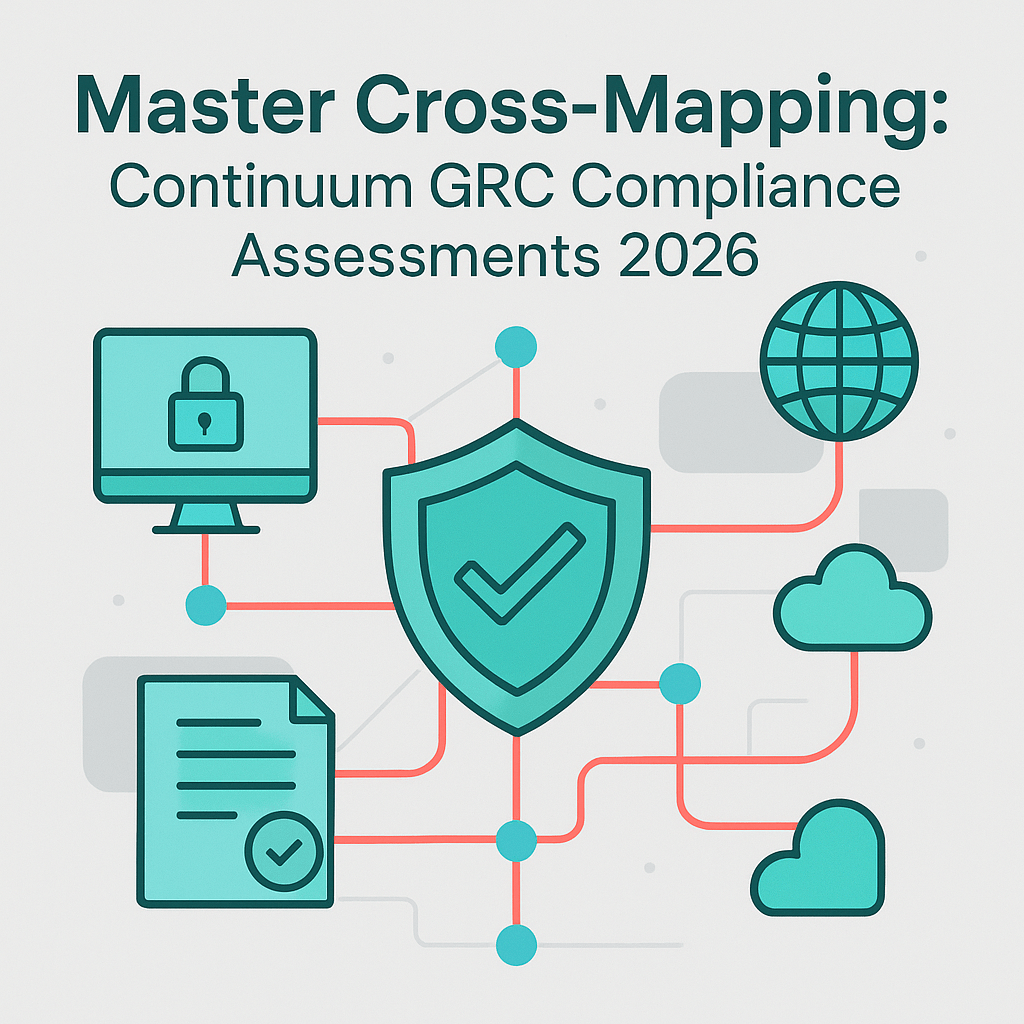
In 2026, organizations navigating overlapping regulatory requirements face mounting pressure to optimize resources while maintaining rigorous security postures. Cross-mapping of standards enables compliance assessments that deliver measurable efficiency gains in risk management without sacrificing control depth.
Key Takeaways
- Cross-mapping reduces redundant control testing by up to 60% across frameworks such as NIST SP 800-171 Rev 3 and CMMC 2.0.
- Organizations using structured mapping methodologies report 35-45% lower audit preparation costs according to recent industry benchmarks.
- Effective cross-mapping requires both technical control alignment and organizational change management to address cultural resistance.
- Continuum GRC platforms provide automated mapping capabilities that maintain traceability to source requirements like NIST SP 800-53 and ISO 27001.
The Strategic Imperative for Cross-Mapping in 2026 Compliance Assessments
Regulatory convergence continues to accelerate, with federal contractors and critical infrastructure providers simultaneously subject to DFARS/NIST 800-171, CMMC 2.0, FedRAMP, and emerging state-level mandates. Rather than treating each framework as an isolated silo, forward-thinking CISOs recognize that cross-mapping creates a unified control library that satisfies multiple attestations from a single evidence set. This approach directly addresses the “why” behind compliance: protecting sensitive data while avoiding the exponential cost growth that occurs when controls are implemented and audited in isolation.
Technical Mapping Between NIST SP 800-171 Rev 3 and CMMC 2.0
NIST SP 800-171 Rev 3 contains 110 security requirements organized into 14 families. CMMC 2.0 Level 2 inherits these requirements with minimal deviation, yet organizations must still demonstrate explicit traceability during assessments. Cross-mapping reveals that 87 of the 110 controls align directly, while the remaining 23 require supplemental evidence for CMMC-specific assessment objectives. For example, NIST SP 800-171 control 3.1.1 (AC-2) maps to CMMC CA.L2-3.1.1, but auditors increasingly scrutinize the implementation of privileged access reviews under both frameworks simultaneously.
Step-by-Step Cross-Mapping Methodology
- Inventory all applicable frameworks and extract control language into a normalized matrix.
- Perform semantic alignment using NIST SP 800-53 as the reference taxonomy for families such as Access Control (AC) and Audit and Accountability (AU).
- Identify control gaps where one framework imposes additional assessment procedures (e.g., CMMC requires explicit demonstration of policy enforcement).
- Develop unified policies and procedures that satisfy the strictest interpretation across mapped controls.
- Automate evidence collection using Continuum GRC connectors to maintain continuous compliance rather than point-in-time snapshots.
Real-World Implementation: Reducing Multi-Framework Audit Fatigue
A defense contractor supporting both DoD and civilian agency contracts previously maintained separate compliance teams for NIST 800-171 and FedRAMP Moderate. After implementing cross-mapping within the Continuum GRC platform, the organization consolidated 214 unique control statements into 98 unified controls. Audit preparation time dropped from 1,200 hours annually to 480 hours. The mapping also surfaced an edge case: FedRAMP required additional monitoring under AU-6 that was not explicitly called out in their existing NIST 800-171 implementation, prompting an architectural adjustment to log aggregation before the next assessment cycle.
Common Pitfalls to Avoid During Cross-Mapping Projects
- Over-reliance on automated tools without human validation of control intent and implementation evidence.
- Ignoring organizational change management, leading to resistance from teams accustomed to framework-specific workflows.
- Failing to update mappings when frameworks evolve (e.g., future revisions to NIST SP 800-171 or CMMC).
- Neglecting documentation of rationale for control equivalence decisions, which auditors frequently challenge.
Frequently Asked Questions About Cross-Mapping Standards
How does cross-mapping affect SOC 2 and ISO 27001 assessments?
Mapping Trust Services Criteria to ISO 27001 Annex A controls allows organizations to leverage a single set of policies for both SOC 2 Type II and ISO 27001 certification, provided the mapping documentation demonstrates equivalence in risk treatment.
What resource investment is required for initial cross-mapping?
Most mid-sized organizations require 6-10 weeks of dedicated effort from a cross-functional team, plus ongoing maintenance of approximately 4-6 hours per month using automated platforms like those offered by Continuum GRC.
Cross-mapping is not a one-time exercise but an ongoing discipline that must adapt to regulatory shifts. Organizations that treat it as a strategic capability rather than a tactical checkbox consistently achieve lower risk exposure and higher operational efficiency.
Ready to transform your compliance program through intelligent cross-mapping? Contact Continuum GRC to schedule a demonstration of our assessment platform.
About Continuum GRC
We also provide risk management and compliance support for every major regulation and compliance framework on the market, including:
- FedRAMP
- GovRAMP
- GDPR
- NIST 800-53
- DFARS NIST 800-171, 800-172
- CMMC
- SOC 1, SOC 2
- HIPAA
- PCI DSS 4.0
- IRS 1075, 4812
- COSO SOX
- ISO 27000 Series
- ISO 9000 Series
- CJIS
- C5
- LADMF
- 100+ Frameworks
Continuum GRC is a proactive cybersecurity® and the only FedRAMP-authorized cybersecurity audit platform in the world. Call 1-888-896-6207 to discuss your organization’s cybersecurity needs and learn how we can help protect your systems and ensure compliance.
Related Posts