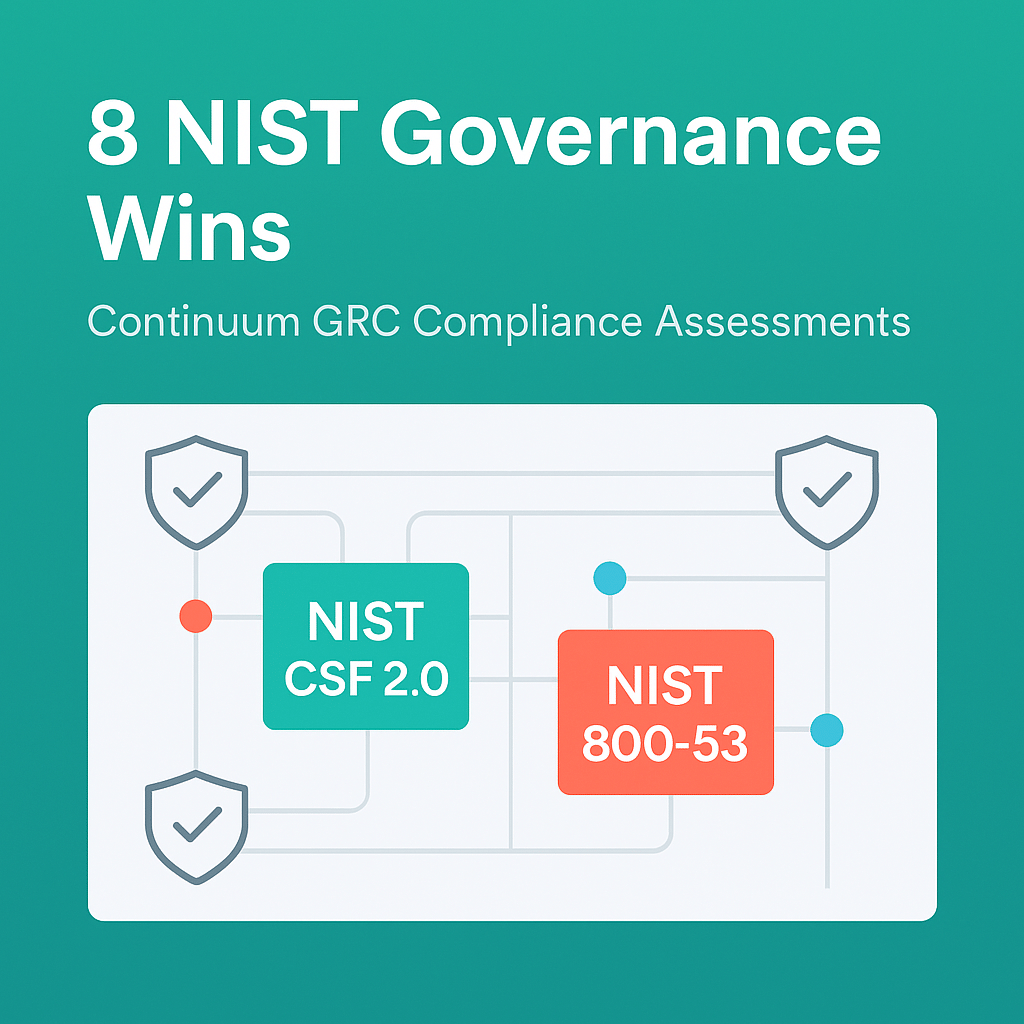
NIST CSF 2.0, NIST 800-53, governance risk compliance, compliance assessments, cybersecurity audits, control maturity, and Continuum GRC now belong in the same executive conversation. The shift is not simply toward more controls; it is toward board-visible governance that proves risk decisions, control ownership, cyber resilience, and evidence integrity across regulated systems.
Executive Summary: Governance Is Now the Audit Backbone
The most important NIST change for security leaders is structural: NIST Cybersecurity Framework 2.0 places Govern alongside Identify, Protect, Detect, Respond, and Recover as a top-level Function, which makes leadership accountability, policy, risk strategy, oversight, and supply-chain governance explicit audit subjects rather than background assumptions.
For organizations preparing cybersecurity audits, NIST CSF 2.0 provides the governance vocabulary, while NIST SP 800-53 Rev. 5, Update 1 provides a detailed control catalog for security and privacy safeguards. Used together, they create a governance-first audit backbone that can support FedRAMP, CMMC 2.0, DFARS/NIST 800-171, SOC 1, SOC 2, CJIS, PCI DSS, GovRAMP, C5, ISO 27001, HIPAA, GDPR, and LADMF programs.
- Win 1: Translate executive cyber risk into auditable outcomes.
- Win 2: Build a unified control library instead of duplicating evidence.
- Win 3: Measure control maturity, not just control existence.
- Win 4: Make risk registers defensible during cybersecurity audits.
- Win 5: Strengthen third-party and supply-chain governance.
- Win 6: Connect technical telemetry to compliance assessments.
- Win 7: Create reusable evidence for multi-framework assurance.
- Win 8: Give leaders a practical remediation roadmap.
The business case is direct. IBM reports the global average cost of a data breach at USD 4.99 million, and IBM also reports that breaches involving an AI model or application averaged USD 5.33 million compared with USD 4.70 million where AI was not involved or involvement was unknown in its study, according to IBM Think – Every AI agent followed the rules, and the data still leaked. Governance is the management system that determines whether control investments reduce that exposure or simply create more audit paperwork.
Why NIST CSF 2.0 and NIST 800-53 Work Better Together
NIST CSF 2.0 is outcome-oriented. NIST states that the Framework Core is organized around Functions, Categories, and Subcategories that describe cybersecurity outcomes, according to NIST – Cybersecurity Framework. NIST 800-53 is control-oriented. NIST describes SP 800-53 as a catalog of security and privacy controls for information systems and organizations, according to NIST SP 800-53 Rev. 5, Update 1.
The nuance matters. A CSF outcome such as governance oversight does not tell a team exactly how to configure identity proofing, logging, access reviews, or incident response workflows. NIST 800-53 controls such as AC-2 Account Management, IA-2 Identification and Authentication, AU-2 Event Logging, IR-4 Incident Handling, RA-3 Risk Assessment, CA-7 Continuous Monitoring, and SR-3 Supply Chain Controls provide implementation and assessment depth, according to NIST SP 800-53 Rev. 5, Update 1.
Conversely, a control implementation without governance context may pass a checklist review while still failing to reduce enterprise risk. NIST SP 800-37 Rev. 2 defines the Risk Management Framework as a process for categorizing systems, selecting controls, implementing controls, assessing controls, authorizing systems, and monitoring controls. That lifecycle is where NIST CSF 2.0 governance and NIST 800-53 control rigor meet.
Continuum GRC’s perspective is that governance risk compliance programs become stronger when assessments begin with business-critical outcomes and then trace those outcomes to technical controls, evidence, ownership, and maturity. Continuum GRC discusses NIST 800-53 audit readiness and cybersecurity assessment execution in Continuum GRC – NIST 800-53 with Continuum GRC Cybersecurity Audits in 2026.
The 8 NIST Governance Wins
1. Board-Level Risk Becomes Audit-Ready Evidence
Many organizations say cybersecurity is an enterprise risk, but their audit evidence still lives in firewall screenshots, ticket exports, policy PDFs, and spreadsheet comments. NIST CSF 2.0 changes the conversation by making Govern a top-level Function that addresses organizational context, risk management strategy, cybersecurity supply-chain risk management, roles, policies, and oversight, according to NIST Cybersecurity Framework 2.0.
The governance win is traceability. A board-approved risk appetite statement should connect to a risk register entry, a selected control set, a system owner, a control owner, a test procedure, and a remediation decision. In practical compliance assessments, auditors often find that leadership has approved policies but has not approved measurable tolerances for overdue vulnerabilities, privileged access exceptions, vendor risk ratings, or incident response recovery objectives.
A practical solution is to build a governance evidence chain:
- Define the business service and regulatory scope.
- Map NIST CSF 2.0 Govern outcomes to risk register categories.
- Map risk register entries to NIST 800-53 controls such as PM-9 Risk Management Strategy, RA-3 Risk Assessment, CA-5 Plan of Action and Milestones, and CA-7 Continuous Monitoring, according to NIST SP 800-53 Rev. 5, Update 1.
- Require evidence that shows operating effectiveness, not only policy approval.
2. A Unified Control Library Reduces Audit Fatigue
Multi-framework organizations rarely have a single compliance obligation. A cloud service provider may need FedRAMP, SOC 2, ISO 27001, PCI DSS, and HIPAA evidence. A defense contractor may need CMMC 2.0, DFARS 252.204-7012, and NIST SP 800-171 evidence. A state or local government vendor may need GovRAMP and CJIS evidence.
NIST 800-53 is a strong backbone because FedRAMP baselines are built around NIST SP 800-53 controls, as reflected in FedRAMP – Documents and Templates. NIST SP 800-171 Rev. 3 provides requirements for protecting controlled unclassified information in nonfederal systems and organizations, according to NIST SP 800-171 Rev. 3. DFARS 252.204-7012 requires covered defense contractors to provide adequate security for covered defense information and rapidly report cyber incidents, according to Electronic Code of Federal Regulations – DFARS 252.204-7012.
The control-library win is evidence reuse with discipline. One access review may support SOC 2 logical access, ISO 27001 access control, NIST 800-53 AC-2, and HIPAA Security Rule access management only if it covers the same system boundary, population, control objective, review period, and approval criteria. Continuum GRC addresses cross-framework evidence reuse and control mapping in Continuum GRC – Master Cross-Mapping for Compliance Assessments 2026.
3. Control Maturity Becomes Measurable
A binary pass-or-fail audit view hides operational risk. A control can exist, yet remain immature because it is manually performed, inconsistently evidenced, limited to a subset of systems, or dependent on a single administrator. NIST 800-53A provides assessment procedures for determining whether controls are implemented correctly, operating as intended, and producing the desired outcome, according to NIST SP 800-53A Rev. 5.
Continuum GRC recommends evaluating maturity across five practical dimensions:
- Design adequacy: Does the control address the risk scenario?
- Implementation coverage: Does the control apply to all in-scope assets and identities?
- Operating consistency: Is the control performed on schedule and by accountable owners?
- Evidence integrity: Is the evidence complete, time-bound, tamper-resistant, and independently reviewable?
- Continuous improvement: Are exceptions analyzed, remediated, and escalated?
In one anonymized assessment, a SaaS provider had a documented vulnerability management policy and regular scanner output, but the scan scope excluded ephemeral workloads and third-party managed components. The audit issue was not lack of scanning; it was incomplete scope governance. Mapping the gap to NIST 800-53 RA-5 Vulnerability Monitoring and Scanning and CA-7 Continuous Monitoring made the remediation specific, testable, and executive-visible, according to NIST SP 800-53 Rev. 5, Update 1.
4. Cyber-Risk Registers Become Defensible
Risk registers often fail audits because they record issues without defensible likelihood, impact, ownership, treatment decisions, or review cadence. NIST SP 800-30 provides guidance for conducting risk assessments, including identifying threat sources, threat events, vulnerabilities, likelihood, impact, and risk, according to NIST SP 800-30 Rev. 1.
The governance win is turning subjective concern into structured risk decisions. For example, an organization may accept a compensating control for legacy MFA limitations, but that acceptance should identify affected users, data sensitivity, compensating monitoring, expiration date, business approver, and residual risk. That risk decision can then map to NIST 800-53 IA-2, AC-6 Least Privilege, AU-6 Audit Record Review, and RA-7 Risk Response, according to NIST SP 800-53 Rev. 5, Update 1.
5. Supply-Chain Risk Moves from Procurement to Governance
Supply-chain risk is no longer limited to vendor questionnaires. NIST CSF 2.0 includes cybersecurity supply-chain risk management as a governance outcome area, according to NIST Cybersecurity Framework 2.0. NIST 800-53 includes a Supply Chain Risk Management family with controls such as SR-3 Supply Chain Controls and Processes, SR-5 Acquisition Strategies, Tools, and Methods, and SR-6 Supplier Assessments and Reviews, according to NIST SP 800-53 Rev. 5, Update 1.
A common audit finding is that procurement collects vendor attestations, while security never validates whether the vendor supports incident notification, encryption, logging, data return, subcontractor disclosure, or right-to-audit clauses. The solution is to classify vendors by data type, service criticality, network connectivity, regulatory impact, and resilience dependency, then assign control depth based on that classification.
6. Continuous Monitoring Replaces the Point-in-Time Illusion
Traditional audits can overvalue evidence captured during a narrow review window. NIST SP 800-137 defines information security continuous monitoring as maintaining ongoing awareness of information security, vulnerabilities, and threats to support organizational risk management decisions, according to NIST SP 800-137. FedRAMP also emphasizes continuous monitoring artifacts, reporting, and ongoing authorization practices through its program documentation, according to FedRAMP – Documents and Templates.
The contrarian point: automation does not automatically create assurance. Automated evidence is valuable only when the source system is authoritative, the query logic is validated, the asset inventory is complete, and exceptions are triaged by accountable personnel. Otherwise, automated evidence can accelerate the production of incomplete evidence.
Continuum GRC’s guidance is to define control telemetry before collecting screenshots: identity provider logs for access controls, endpoint management status for configuration controls, vulnerability scanner coverage for RA-5, SIEM alerts for AU and IR controls, ticketing workflows for remediation, and change records for CM-3 Configuration Change Control, according to NIST SP 800-53 Rev. 5, Update 1.
7. Multi-Framework Assurance Becomes Interoperable
NIST governance assessments become more valuable when they support other compliance outcomes. The HIPAA Security Rule requires administrative, physical, and technical safeguards for electronic protected health information, according to Electronic Code of Federal Regulations – HIPAA Security Rule. PCI DSS defines security requirements for protecting payment account data, according to PCI Security Standards Council – Standards. The AICPA describes SOC services as reporting mechanisms for system and organization controls, according to AICPA & CIMA – SOC Suite of Services.
For government and regulated markets, the same governance model can support CJIS through the FBI CJIS Security Policy Resource Center, according to FBI – CJIS Security Policy Resource Center; C5 cloud assurance through the German Federal Office for Information Security, according to BSI – Cloud Computing Compliance Criteria Catalogue; GDPR obligations through the European Union regulation text, according to European Union – General Data Protection Regulation; and LADMF access controls through NTIS, according to NTIS – Limited Access Death Master File.
8. Remediation Becomes a Governed Investment Roadmap
The final win is prioritization. NIST CSF 2.0 supports profiles that describe current and target cybersecurity outcomes, according to NIST – Cybersecurity Framework. NIST 800-53 supports control selection, tailoring, and assessment when used with the Risk Management Framework, according to NIST SP 800-37 Rev. 2.
A mature remediation roadmap should separate quick fixes from architectural change. Missing policy approval may be remediated quickly. Incomplete asset inventory, fragmented identity architecture, weak logging coverage, and inconsistent third-party oversight usually require phased projects, budget, executive sponsorship, and change management.
A Practical NIST Governance Assessment Methodology
For 2026 planning, Continuum GRC recommends a four-phase assessment model.
Phase 1: Establish Scope and Governance Context
- Define system boundaries, data types, business services, hosting models, and inherited controls.
- Identify applicable frameworks: NIST 800-53, NIST CSF 2.0, FedRAMP, CMMC 2.0, DFARS/NIST 800-171, SOC 1, SOC 2, CJIS, PCI DSS, GovRAMP, C5, ISO 27001, HIPAA, GDPR, and LADMF.
- Assign executive sponsors, system owners, control owners, evidence owners, and risk owners.
Phase 2: Map Outcomes to Controls
- Map CSF Govern outcomes to NIST 800-53 Program Management, Risk Assessment, Assessment Authorization and Monitoring, and Supply Chain Risk Management controls.
- Map technical outcomes to Access Control, Identification and Authentication, Audit and Accountability, Configuration Management, Incident Response, System and Communications Protection, and System and Information Integrity controls.
- Document control inheritance and shared responsibility for cloud services.
Phase 3: Test Design and Operating Effectiveness
- Use NIST 800-53A assessment objectives to test whether controls are implemented and operating as intended, according to NIST SP 800-53A Rev. 5.
- Sample evidence across user populations, assets, vendors, incidents, vulnerabilities, changes, and exceptions.
- Validate evidence lineage from source systems rather than accepting isolated screenshots.
Phase 4: Prioritize Remediation by Risk and Assurance Value
- Classify findings by risk severity, regulatory impact, exploitability, and dependency.
- Create POA&M entries with owner, milestone, target date, compensating control, and validation method.
- Report executive metrics that show risk reduction, audit readiness, and control maturity movement.
Common Pitfalls to Avoid
- Confusing documentation with implementation: Policies do not prove control operation unless they are linked to procedures, records, approvals, and monitoring evidence.
- Mapping too broadly: One control may support several frameworks, but evidence reuse fails when the system boundary, population, or test period does not match.
- Ignoring inherited controls: Cloud customers must understand shared responsibility rather than assuming provider certification covers customer configuration.
- Underfunding remediation: Governance findings often require process redesign, identity modernization, logging architecture, vendor oversight, and executive decision cycles.
- Leaving culture out of GRC: Control owners need time, authority, training, and escalation paths; otherwise compliance becomes a seasonal scramble.
Frequently Asked Questions
Is NIST CSF 2.0 a substitute for NIST 800-53?
No. NIST CSF 2.0 is an outcome framework, while NIST 800-53 is a detailed control catalog. NIST describes CSF 2.0 as a cybersecurity risk management framework, according to NIST – Cybersecurity Framework, and NIST describes SP 800-53 as a catalog of security and privacy controls, according to NIST SP 800-53 Rev. 5, Update 1.
How long does a governance-first NIST assessment take?
A limited-scope readiness assessment can often be structured in weeks, while enterprise-wide assessments involving multiple business units, cloud environments, vendors, and regulatory frameworks usually require phased planning, evidence collection, interviews, testing, and remediation governance. The timeline depends on scope, evidence quality, asset inventory maturity, and stakeholder availability.
Can NIST governance work support CMMC 2.0?
Yes. The DoD describes CMMC as a program for assessing implementation of cybersecurity requirements, according to DoD CIO – Cybersecurity Maturity Model Certification, and NIST SP 800-171 Rev. 3 defines requirements for protecting controlled unclassified information in nonfederal systems, according to NIST SP 800-171 Rev. 3. Governance-first mapping helps ensure SSPs, POA&Ms, risk acceptances, and evidence records are coherent.
Call to Action: Turn NIST Governance into Audit-Ready Assurance
If your organization is preparing for NIST 800-53, FedRAMP, CMMC, DFARS/NIST 800-171, SOC 2, HIPAA, PCI DSS, CJIS, GovRAMP, C5, ISO 27001, GDPR, or LADMF obligations, the strongest starting point is not another spreadsheet. It is a governance-first compliance assessment that connects executive risk decisions to tested controls, defensible evidence, and measurable maturity.
Continuum GRC helps organizations align NIST CSF 2.0 outcomes with NIST 800-53 controls, rationalize overlapping frameworks, assess control maturity, and prepare for cybersecurity audits with evidence that stands up to scrutiny. Contact Continuum GRC to move from compliance activity to governance assurance.
Sources and References
- NIST – Cybersecurity Framework 2.0
- NIST – Cybersecurity Framework
- NIST – SP 800-53 Rev. 5, Update 1
- NIST – SP 800-53A Rev. 5
- NIST – SP 800-37 Rev. 2
- NIST – SP 800-30 Rev. 1
- NIST – SP 800-137
- NIST – SP 800-171 Rev. 3
- Electronic Code of Federal Regulations – DFARS 252.204-7012
- DoD CIO – Cybersecurity Maturity Model Certification
- FedRAMP – Documents and Templates
- Electronic Code of Federal Regulations – HIPAA Security Rule
- PCI Security Standards Council – Standards
- AICPA & CIMA – SOC Suite of Services
- FBI – CJIS Security Policy Resource Center
- BSI – Cloud Computing Compliance Criteria Catalogue
- European Union – General Data Protection Regulation
- NTIS – Limited Access Death Master File
- IBM Think – Every AI agent followed the rules, and the data still leaked
- Continuum GRC – NIST 800-53 with Continuum GRC Cybersecurity Audits in 2026
- Continuum GRC – Master Cross-Mapping for Compliance Assessments 2026
About Continuum GRC
We also provide risk management and compliance support for every major regulation and compliance framework on the market, including:
- FedRAMP
- GovRAMP
- GDPR
- NIST 800-53
- DFARS NIST 800-171, 800-172
- CMMC
- SOC 1, SOC 2
- HIPAA
- PCI DSS 4.0
- IRS 1075, 4812
- COSO SOX
- ISO 27000 Series
- ISO 9000 Series
- CJIS
- C5
- LADMF
- 100+ Frameworks
Continuum GRC is a proactive cybersecurity® and the only FedRAMP-authorized cybersecurity audit platform in the world. Call 1-888-896-6207 to discuss your organization’s cybersecurity needs and learn how we can help protect your systems and ensure compliance.
Related Posts