SOC 2 AI controls are no longer an optional appendix to a traditional audit. In 2026, AI governance, cloud-control inheritance, privacy compliance, and multi-framework assurance are converging into one evidence problem: can your organization prove that trust services controls operate continuously across data, models, vendors, and infrastructure? Continuum GRC helps security and compliance leaders modernize SOC 2 programs by aligning risk management, cybersecurity audits, privacy obligations, and reusable evidence across frameworks without reducing SOC 2 to a checklist exercise.
The key shift is that SOC 2 is becoming a governance report as much as a security report. According to IBM, organizations reporting breaches involving an AI model or application had an average breach cost of USD 5.33 million, compared with USD 4.70 million for breaches without AI involvement or where AI involvement was unknown, and IBM also reported that 21% of breached organizations in its study involved an AI model or application IBM – Every AI Agent Followed the Rules, and the Data Still Leaked. That is why modern SOC 2 risk management must evaluate not only access, logging, encryption, and change control, but also AI use cases, training data exposure, prompt handling, model output review, third-party AI dependencies, and privacy impacts.
Executive Summary: Seven SOC 2 AI Audit Wins
For CISOs, compliance officers, product security leaders, and cloud architects, the strongest SOC 2 modernization strategy is to treat AI governance and cloud assurance as integrated control domains rather than separate initiatives. The following seven wins create a defensible path to audit readiness:
- Win 1: Build SOC 2 AI governance into enterprise risk management by aligning AI inventories, model-use approvals, and risk acceptance with the AICPA Trust Services Criteria and the NIST AI Risk Management Framework NIST – Artificial Intelligence Risk Management Framework.
- Win 2: Map AI and cloud controls to SOC 2 criteria such as CC3.2 risk identification, CC4.1 monitoring, CC6 access control, CC7 system operations, CC8 change management, and CC9 risk mitigation, as described in the AICPA Trust Services Criteria AICPA – Trust Services Criteria.
- Win 3: Reuse evidence across frameworks including SOC 2, ISO 27001, NIST 800-53, FedRAMP, CMMC, DFARS/NIST 800-171, HIPAA, PCI DSS, CJIS, GovRAMP, C5, GDPR, and LADMF through a unified control library.
- Win 4: Replace point-in-time audit scrambles with continuous control monitoring, mirroring the broader federal move toward persistent validation reflected in FedRAMP 20x discussions AWS Public Sector Blog – Continuous Monitoring under FedRAMP 20x.
- Win 5: Strengthen privacy compliance inside SOC 2 by connecting data classification, retention, consent, data subject rights, and vendor processing to the SOC 2 privacy category and applicable privacy laws.
- Win 6: Make third-party and AI vendor risk auditable by requiring contractual security commitments, data-use restrictions, breach notification expectations, and ongoing monitoring.
- Win 7: Convert audit findings into a measurable risk roadmap with accountable owners, evidence requirements, remediation milestones, and executive reporting.
Why SOC 2 Modernization Now Means AI Governance, Cloud Controls, and Privacy
The AICPA describes SOC for Service Organizations reports as reports that help service organizations communicate information about controls relevant to user entities and stakeholders AICPA & CIMA – System and Organization Controls SOC Suite of Services. In practice, that means SOC 2 has become a board-level trust mechanism for SaaS providers, managed service providers, data platforms, healthcare technology companies, fintechs, and AI-enabled cloud services.
The problem is that many SOC 2 programs still reflect yesterday’s system boundary. A typical legacy readiness file may include policies, annual access reviews, vulnerability scans, a change-ticket sample, and a handful of incident-response artifacts. Those controls remain necessary, but they do not adequately answer modern assurance questions: Which AI tools process customer data? Which cloud services inherit controls from a hyperscaler? Which third-party APIs influence production decisions? Which logs prove that privileged activity, model prompts, and data exports were monitored?
NIST frames AI risk management around the functions Govern, Map, Measure, and Manage, and NIST’s generative AI profile applies those functions to risks such as data leakage, harmful output, synthetic content, and model misuse NIST – AI 600-1 Generative AI Profile. The practical SOC 2 lesson is clear: AI cannot be governed solely by acceptable-use language. It needs inventory, ownership, control design, testing, monitoring, and exception handling.
Win 1: Establish SOC 2 AI Controls Through a Governed AI Inventory
The first audit win is to create an AI inventory that is specific enough to support risk assessment and evidence testing. A credible SOC 2 AI inventory should identify business owner, technical owner, model or tool category, data types processed, customer data exposure, privacy impact, vendor dependency, integration point, authentication method, logging source, output-use case, and approval status.
This matters because SOC 2 auditors evaluate whether management identifies and assesses risks that could affect the achievement of service commitments and system requirements under the AICPA Trust Services Criteria, including CC3.2 and CC3.4 AICPA – Trust Services Criteria. If AI use is invisible to risk management, the organization cannot credibly demonstrate that AI risks were evaluated, accepted, mitigated, or monitored.
Implementation checklist for AI inventory readiness
- Require business units to register AI systems before production use.
- Classify AI tools as internal productivity, customer-facing, decision-support, autonomous workflow, or embedded product functionality.
- Document whether customer data, regulated data, source code, credentials, or confidential business information can enter prompts, training workflows, retrieval systems, or logs.
- Map each AI use case to SOC 2 criteria, privacy obligations, access controls, monitoring requirements, and incident-response procedures.
- Perform periodic recertification of AI tools and remove unapproved shadow AI integrations.
Continuum GRC has written about using AI automation to improve GRC efficiency and evidence management, including the shift away from manual audit preparation toward more integrated compliance operations Continuum GRC – Boost GRC Efficiency with AI Automation.
Win 2: Connect SOC 2 to NIST 800-53, ISO 27001, and NIST AI RMF
A mature SOC 2 program should not live in isolation. NIST SP 800-53 Rev. 5 provides a comprehensive catalog of security and privacy controls that can support governance, access control, audit logging, configuration management, incident response, risk assessment, system acquisition, and supply-chain risk management NIST – SP 800-53 Rev. 5 Security and Privacy Controls. ISO/IEC 27001 defines requirements for an information security management system, and ISO describes it as a standard for managing information security risks ISO – ISO/IEC 27001 Information Security Management.
For AI-specific governance, ISO/IEC 42001 provides a management-system standard for artificial intelligence, while NIST AI RMF provides a risk-management framework for trustworthy AI ISO – ISO/IEC 42001 Artificial Intelligence Management System NIST – Artificial Intelligence Risk Management Framework. The practical win is not to duplicate documentation, but to cross-map requirements so one evidence object can satisfy several assurance needs.
Example crosswalk for SOC 2 AI controls
- AI risk assessment: SOC 2 CC3 risk assessment, NIST 800-53 RA family, NIST AI RMF Map and Measure functions.
- Prompt and data-loss controls: SOC 2 CC6 logical access, CC7 operations, NIST 800-53 AC and SI families, ISO 27001 access control and operations controls.
- Model change management: SOC 2 CC8 change management, NIST 800-53 CM family, ISO 27001 change-management controls.
- Vendor AI services: SOC 2 CC9 risk mitigation, NIST 800-53 SR family, and privacy-processing obligations.
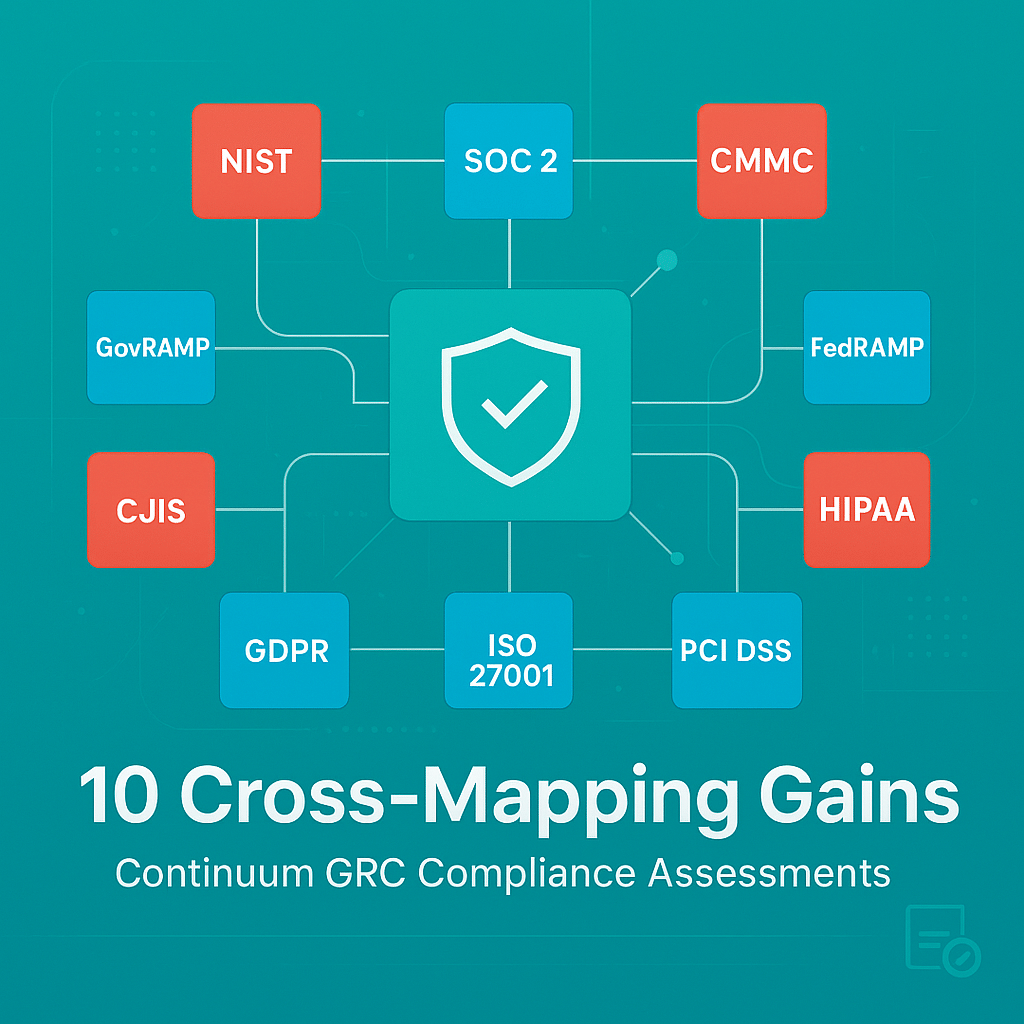
Continuum GRC has addressed cross-mapping as a practical way to reduce duplicative assessment work across compliance programs Continuum GRC – Master Cross-Mapping for Compliance Assessments.
Win 3: Design Cloud Controls Around Inheritance, Not Assumption
Cloud control inheritance is often misunderstood. A cloud provider may operate physical security, infrastructure resilience, and certain platform controls, but the customer usually remains accountable for identity configuration, data protection, logging, workload hardening, vulnerability remediation, tenant segmentation, and secure change practices. SOC 2 auditors commonly find gaps where organizations cite cloud-provider certifications but cannot show how their own responsibilities are implemented.
FedRAMP’s modernization direction reinforces the importance of continuous validation. AWS explains that FedRAMP 20x shifts away from annual, human-driven assessment activities toward persistent automated validation and continuously generated evidence, and AWS describes an implementation pattern using AWS Config conformance packs with 128 rules covering up to 46 Key Security Indicators AWS Public Sector Blog – Continuous Monitoring under FedRAMP 20x. SOC 2 teams can apply the same principle even when FedRAMP authorization is not in scope: evidence should come from normal operations, not emergency audit collection.
Cloud evidence that strengthens SOC 2 audits
- Identity-provider exports showing MFA enforcement, privileged access groups, and periodic access review evidence.
- Configuration snapshots proving encryption, network restrictions, key rotation, and public-access blocking.
- Change records linking infrastructure-as-code commits, peer approval, deployment logs, and rollback procedures.
- Centralized logging evidence showing collection, retention, alerting, and escalation workflows.
- Vulnerability and patch evidence tied to remediation service-level expectations.
Win 4: Build Privacy Compliance Into the SOC 2 System Description
Privacy cannot be bolted onto SOC 2 after security testing is complete. The SOC 2 privacy category evaluates commitments related to collection, use, retention, disclosure, and disposal of personal information as described in the AICPA Trust Services Criteria AICPA – Trust Services Criteria. GDPR imposes obligations for lawful processing, transparency, data subject rights, and processor accountability, and the European Union publishes the General Data Protection Regulation as the controlling legal text European Union – General Data Protection Regulation.
Healthcare organizations and business associates must also consider HIPAA Security Rule expectations for administrative, physical, and technical safeguards for electronic protected health information, and HHS provides professional guidance and compliance information for the HIPAA Security Rule HHS ASPR TRACIE – HIPAA Security Rule Resources. Payment environments must address PCI DSS requirements, and the PCI Security Standards Council identifies PCI DSS v4.0.1 as a limited revision to address stakeholder feedback and questions related to PCI DSS v4.0 PCI Security Standards Council – Official PCI Security Standards Council Site.
The audit win is to make privacy operational. Data maps should identify AI prompt data, embeddings, telemetry, support tickets, analytics events, backups, and vendor transfers. Retention schedules should match actual system behavior. Deletion requests should be tested against production, backup, warehouse, and downstream processing environments. When privacy commitments are vague, audit testing becomes unpredictable; when privacy commitments are precise, control evidence becomes repeatable.
Win 5: Turn Third-Party AI Risk Into Testable Evidence
Third-party risk is a recurring SOC 2 issue because outsourced services can affect confidentiality, availability, processing integrity, security, and privacy. For AI services, the risk expands to data reuse, prompt retention, model training rights, cross-border processing, output explainability, and dependency concentration.
IBM’s breach-cost research reinforces why AI and third-party exposure deserve board attention, with IBM reporting a global average breach cost of USD 4.99 million IBM – Every AI Agent Followed the Rules, and the Data Still Leaked. A defensible SOC 2 vendor-risk file should include vendor tiering, due diligence, contractual security terms, data-processing terms, SOC report review, residual-risk decisions, and ongoing monitoring.
Contract clauses to verify for AI vendors
- No training on customer data without documented authorization.
- Defined retention periods for prompts, outputs, logs, and uploaded files.
- Encryption requirements for data in transit and at rest.
- Subprocessor disclosure and approval workflows.
- Incident notification requirements and forensic cooperation language.
- Audit rights or independent assurance reporting.
Win 6: Align SOC 2 With CMMC, DFARS/NIST 800-171, CJIS, C5, GovRAMP, and LADMF
Multi-framework assurance is not simply a documentation convenience; it is a control-design discipline. Defense contractors handling covered defense information must address DFARS clause 252.204-7012, which requires safeguarding covered defense information and cyber incident reporting to the Department of Defense Acquisition.gov – DFARS 252.204-7012. NIST SP 800-171 Rev. 3 provides requirements for protecting controlled unclassified information in nonfederal systems and organizations NIST – SP 800-171 Rev. 3 Protecting Controlled Unclassified Information. The Department of Defense identifies CMMC 2.0 as the model for assessing defense contractors’ implementation of cybersecurity requirements DoD CIO – Cybersecurity Maturity Model Certification.
For organizations serving state, justice, health, finance, and public-sector markets, SOC 2 may need to coexist with CJIS, GovRAMP, C5, LADMF, HIPAA, PCI DSS, ISO 27001, and FedRAMP-aligned controls. Lazarus Alliance has also discussed evidence reusability across SOC 2, ISO 27001, CMMC, NIST SP 800-171, PCI DSS, HIPAA, GovRAMP, and related frameworks when evidence addresses the same system, measure, and security objective Lazarus Alliance – FedRAMP 20x Automation and Cybersecurity Audits.
The practical approach is to maintain one authoritative control library with framework overlays. Each control should have mapped citations, control owner, implementation statement, evidence type, frequency, test method, exception criteria, and remediation workflow. This prevents the common failure pattern in which the same access-control evidence is collected separately for SOC 2, ISO 27001, HIPAA, and customer security questionnaires.
Win 7: Convert SOC 2 Findings Into a Risk-Based Remediation Roadmap
Organizations often treat SOC 2 findings as isolated audit defects, but the stronger approach is to translate each finding into a risk statement, root cause, affected control family, impacted trust services category, compensating control, remediation owner, target milestone, and validation method. This is especially important for AI governance because the same root cause may appear in several places: incomplete data inventory, weak vendor intake, excessive privileges, insufficient logging, or lack of change-management gates.
Anonymized audit scenario: AI feature launch before governance
In one common scenario, a SaaS provider adds an AI summarization feature to customer support workflows. The engineering team enables the feature through a third-party API, but the vendor record does not identify prompt retention, the data map excludes support-ticket attachments, and the change ticket does not document privacy review. During SOC 2 readiness, the organization can produce general access-control evidence but cannot prove that AI-specific data flows were approved.
The remediation path is straightforward but disciplined: update the AI inventory, revise the vendor-risk tier, add privacy review to the secure development lifecycle, configure logging for API calls, implement prompt redaction, update the system description, and test the control over a defined operating period. The lesson is not that AI features should be delayed indefinitely. The lesson is that product velocity must include auditable governance gates.
Common Pitfalls to Avoid in SOC 2 AI and Multi-Framework Assurance
- Assuming an AI policy is an AI control. Policies help define intent, but auditors need evidence of approval, enforcement, monitoring, and exception handling.
- Relying on cloud provider reports without customer-side evidence. Inherited controls do not replace tenant configuration, identity governance, monitoring, and workload security.
- Mapping frameworks at the title level only. A SOC 2 control mapped to NIST 800-53 or ISO 27001 must share the same scope, system boundary, implementation, and evidence objective.
- Ignoring privacy in AI workflows. Prompt logs, embeddings, support transcripts, analytics records, and training datasets can all create privacy and confidentiality exposure.
- Collecting screenshots as the primary evidence strategy. Screenshots can support testing, but repeatable exports, system-generated reports, ticket histories, and automated configuration evidence are stronger for continuous assurance.
- Failing to document risk acceptance. Executive approval should be tied to residual risk, compensating controls, business justification, and review cadence.
A Practical SOC 2 AI Controls Roadmap for 2026
A realistic modernization program can be phased without overwhelming security and compliance teams:
- Weeks 1-2: Confirm system boundaries, trust services categories, customer commitments, AI use cases, cloud platforms, and applicable framework overlays.
- Weeks 3-5: Build the AI inventory, data-flow map, vendor-risk register, and unified control library.
- Weeks 6-8: Validate access controls, logging, vulnerability management, encryption, change management, incident response, and privacy controls against SOC 2 criteria.
- Weeks 9-12: Remediate control gaps, automate evidence where feasible, update the SOC 2 system description, and complete management review.
- Ongoing: Monitor key controls continuously, review AI tools periodically, test incident scenarios, and refresh evidence before the next audit cycle.
Resource needs typically include a control owner from security, a compliance lead, cloud engineering support, legal or privacy participation, vendor-management input, and executive sponsorship. The cost driver is rarely the audit alone; it is usually the remediation required when governance, data mapping, logging, and vendor oversight have not kept pace with product and cloud adoption.
How Continuum GRC Helps Create SOC 2 AI Audit Wins
Continuum GRC supports organizations that need practical, risk-based SOC 2 modernization across AI governance, cloud controls, privacy compliance, cybersecurity audits, and multi-framework assurance. The value is not merely organizing evidence; it is helping leaders understand which controls reduce risk, which evidence will withstand scrutiny, and which framework mappings can be reused without overclaiming equivalence.
For organizations preparing for SOC 1, SOC 2, ISO 27001, FedRAMP, GovRAMP, CMMC, DFARS/NIST 800-171, HIPAA, PCI DSS, CJIS, C5, GDPR, LADMF, and related assessments, Continuum GRC helps connect the control environment to the business reality: cloud-native operations, AI-enabled workflows, privacy obligations, vendor dependencies, and executive accountability. To explore SOC 2 AI controls, risk management, and audit readiness support, contact Continuum GRC for a focused readiness discussion.
Sources and References
- IBM – Every AI Agent Followed the Rules, and the Data Still Leaked
- NIST – Artificial Intelligence Risk Management Framework
- NIST – AI 600-1 Generative AI Profile
- AICPA & CIMA – System and Organization Controls SOC Suite of Services
- AICPA – Trust Services Criteria
- NIST – SP 800-53 Rev. 5 Security and Privacy Controls
- ISO – ISO/IEC 27001 Information Security Management
- ISO – ISO/IEC 42001 Artificial Intelligence Management System
- AWS Public Sector Blog – Continuous Monitoring under FedRAMP 20x
- European Union – General Data Protection Regulation
- HHS ASPR TRACIE – HIPAA Security Rule Resources
- PCI Security Standards Council – Official PCI Security Standards Council Site
- Acquisition.gov – DFARS 252.204-7012
- NIST – SP 800-171 Rev. 3 Protecting Controlled Unclassified Information
- DoD CIO – Cybersecurity Maturity Model Certification
- Continuum GRC – Boost GRC Efficiency with AI Automation
- Continuum GRC – Master Cross-Mapping for Compliance Assessments
- Lazarus Alliance – FedRAMP 20x Automation and Cybersecurity Audits
About Continuum GRC
We also provide risk management and compliance support for every major regulation and compliance framework on the market, including:
- FedRAMP
- GovRAMP
- GDPR
- NIST 800-53
- DFARS NIST 800-171, 800-172
- CMMC
- SOC 1, SOC 2
- HIPAA
- PCI DSS 4.0
- IRS 1075, 4812
- COSO SOX
- ISO 27000 Series
- ISO 9000 Series
- CJIS
- C5
- LADMF
- 100+ Frameworks
Continuum GRC is a proactive cybersecurity® and the only FedRAMP-authorized cybersecurity audit platform in the world. Call 1-888-896-6207 to discuss your organization’s cybersecurity needs and learn how we can help protect your systems and ensure compliance.
Related Posts