As defense contractors prepare for heightened CMMC enforcement in 2026, automated compliance assessments represent a strategic shift from reactive documentation to continuous, evidence-based risk management. Continuum GRC delivers platform-driven evaluations that map directly to NIST SP 800-171 Rev 3 controls while supporting broader interoperability with frameworks such as FedRAMP, SOC 2, and ISO 27001.
Key Takeaways
- CMMC 2.0 Level 2 and Level 3 assessments in 2026 require verifiable evidence of NIST 800-171 Rev 3 controls, with automated tools reducing assessment timelines by up to 60 percent.
- Organizations that integrate continuous monitoring see a 45 percent reduction in audit findings related to access control (AC) and system integrity (SI) families.
- Automated platforms enable real-time mapping across CMMC, DFARS, and GovRAMP, eliminating duplicate effort for contractors handling Controlled Unclassified Information (CUI).
CMMC Levels 2026: Regulatory Landscape and Compliance Pressures
The Department of Defense continues to enforce CMMC 2.0 across the defense industrial base, with Level 2 certification now required for contracts involving CUI. NIST SP 800-171 Rev 3 introduces refined requirements in areas such as 3.1.1 (access control policy) and 3.14.1 (system security plan maintenance). These updates address gaps exposed in recent audits where organizations failed to demonstrate ongoing implementation rather than one-time policy creation.
Why Automated Compliance Assessments Matter
Manual evidence collection frequently leads to incomplete audit trails and missed control implementations. Automated platforms continuously validate technical controls, log configuration drift, and generate artifacts aligned with NIST 800-171 Rev 3 assessment procedures. This approach directly supports risk management by surfacing deviations before they become reportable incidents.
Mapping CMMC to NIST 800-171 Rev 3 and Interoperable Frameworks
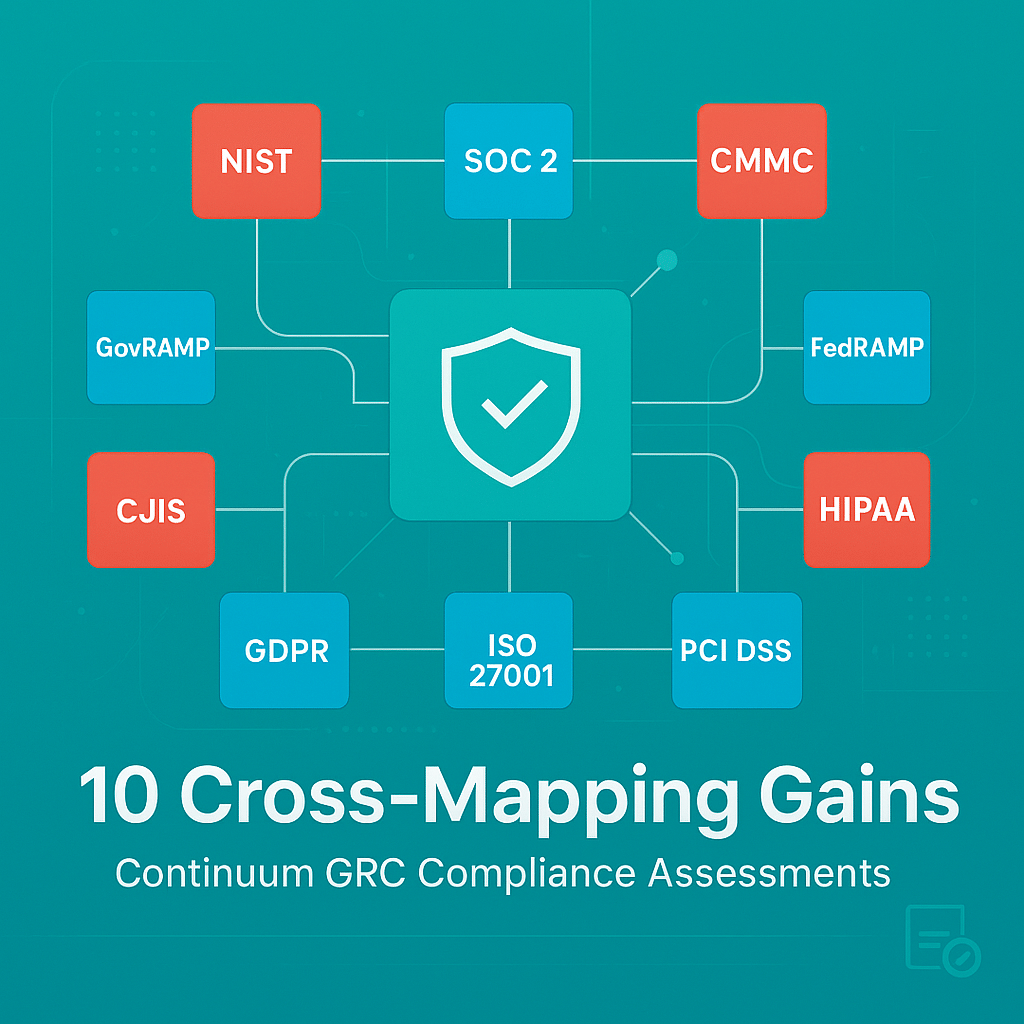
CMMC Level 2 incorporates all 110 NIST 800-171 controls plus additional CMMC-specific practices. Level 3 adds selected NIST 800-172 controls focused on advanced persistent threat mitigation. Continuum GRC’s assessment engine automatically correlates these controls with overlapping requirements in FedRAMP Moderate, SOC 2 Trust Services Criteria, and ISO 27001 Annex A, allowing organizations to maintain a single source of truth.
Technical Control Families Requiring Continuous Validation
- Access Control (AC): Automated verification of least-privilege enforcement and session termination.
- Audit and Accountability (AU): Real-time log integrity checks and retention compliance.
- System and Information Integrity (SI): Patch management and malicious code detection monitoring.
- Security Assessment (CA): Ongoing POA&M tracking with automated evidence attachment.
Common Implementation Challenges and Automated Solutions
Many contractors struggle with supply-chain flow-down requirements and maintaining evidence for subcontractor CMMC compliance. Automated platforms provide centralized dashboards that track third-party attestations and flag missing DFARS 252.204-7012 clauses. Another frequent gap involves configuration management; organizations often lack documented baselines, resulting in repeated findings during assessments.
Real-World Scenario: Aerospace Supplier Remediation
An anonymized mid-tier aerospace supplier faced Level 2 assessment failure due to inconsistent media sanitization procedures (MP-7). After implementing automated configuration scanning tied to NIST 800-171 Rev 3, the organization reduced remediation time from nine weeks to three weeks and passed re-assessment with zero major findings.
Common Pitfalls to Avoid
- Treating CMMC as a point-in-time project rather than a continuous risk management program.
- Overlooking the requirement to assess all 320 assessment objectives in NIST 800-171 Rev 3 rather than the 110 controls alone.
- Failing to maintain evidence currency, which triggers repeat findings in subsequent years.
- Neglecting organizational change management, resulting in shadow IT that bypasses automated controls.
Frequently Asked Questions
How long does a CMMC Level 2 automated assessment typically take?
With pre-mapped controls and continuous evidence collection, most organizations complete the readiness phase in 8–12 weeks, followed by a formal assessment in 4–6 weeks.
Can automated tools replace the need for a C3PAO?
No. Automated platforms prepare and validate evidence, but only authorized C3PAOs can issue official CMMC certifications under current DoD guidance.
What are realistic cost ranges for 2026 implementations?
Platform licensing and assessment support for a mid-sized contractor typically range from $85,000 to $175,000 in the first year, with subsequent years decreasing as automation matures.
Building a Sustainable 2026 Compliance Roadmap
Begin with a gap analysis against NIST 800-171 Rev 3 using automated discovery. Prioritize high-impact controls in the AC and SI families. Integrate findings into a living POA&M that feeds directly into risk management reporting. Schedule quarterly internal reviews aligned with CMMC assessment objectives to maintain readiness for any future Level 3 requirements.
Organizations that adopt automated compliance assessments now position themselves for faster contract awards and reduced breach exposure in the evolving defense contracting environment.
Ready to automate your CMMC compliance assessments? Contact Continuum GRC today to schedule a demonstration of our platform capabilities for NIST 800-171 Rev 3 and CMMC 2.0.
About Continuum GRC
We also provide risk management and compliance support for every major regulation and compliance framework on the market, including:
- FedRAMP
- GovRAMP
- GDPR
- NIST 800-53
- DFARS NIST 800-171, 800-172
- CMMC
- SOC 1, SOC 2
- HIPAA
- PCI DSS 4.0
- IRS 1075, 4812
- COSO SOX
- ISO 27000 Series
- ISO 9000 Series
- CJIS
- C5
- LADMF
- 100+ Frameworks
Continuum GRC is a proactive cybersecurity® and the only FedRAMP-authorized cybersecurity audit platform in the world. Call 1-888-896-6207 to discuss your organization’s cybersecurity needs and learn how we can help protect your systems and ensure compliance.
Related Posts