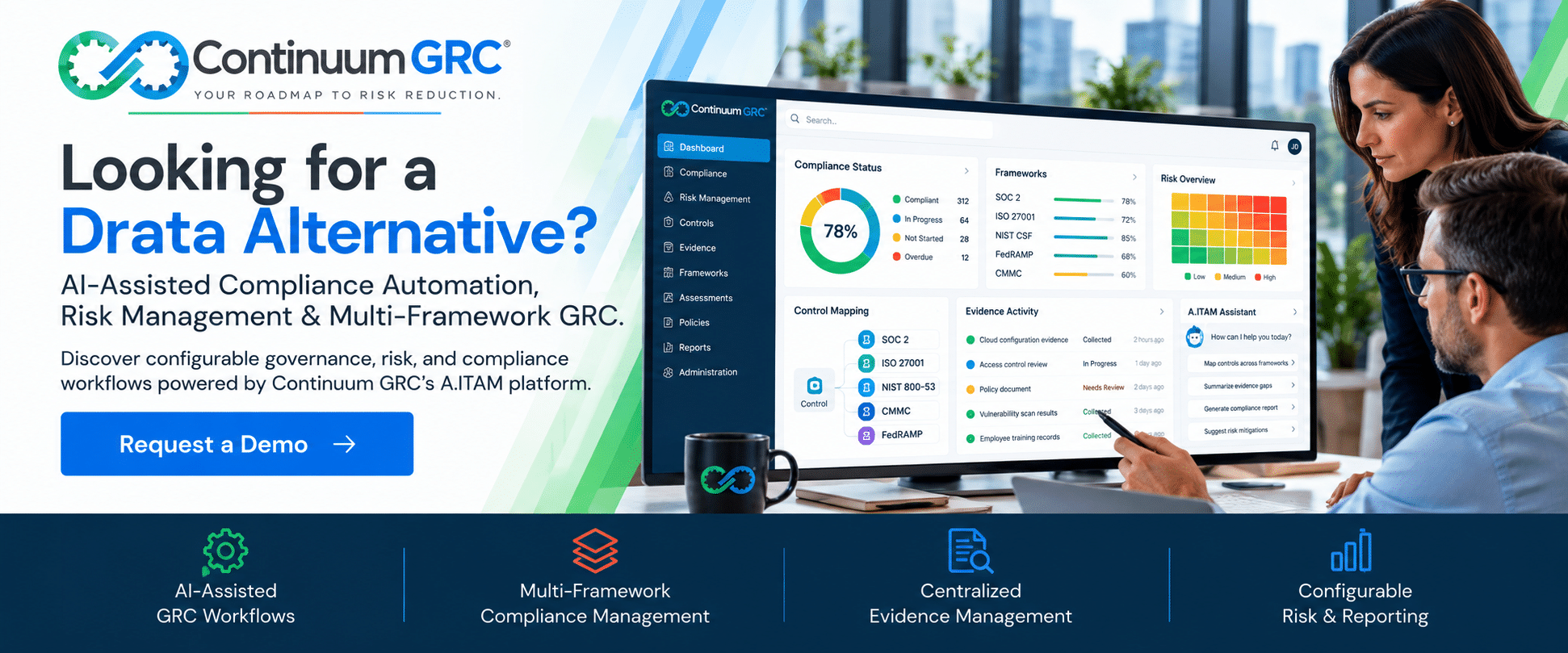
AI-Assisted Governance, Risk, Compliance Automation, and Multi-Framework Management
Table of Contents
ToggleEvaluating Drata for SOC 2 compliance automation, ISO 27001, cybersecurity risk management, audit readiness, or continuous compliance monitoring?
Consider Continuum GRC, a configurable governance, risk, and compliance platform designed to help organizations manage regulatory requirements, organize audit evidence, coordinate security controls, and streamline compliance workflows.
Powered by the A.ITAM platform, Continuum GRC brings together compliance management, risk assessment, control mapping, documentation, reporting, and AI-assisted workflows in a centralized environment.
Whether you're launching a new compliance program or managing complex requirements across multiple frameworks, Continuum GRC offers an alternative worth evaluating.
Why Consider Continuum GRC as an Alternative to Drata?
Drata is a recognized compliance automation platform offering automated evidence collection, continuous monitoring, framework mapping, risk management, and AI-powered capabilities.
Continuum GRC offers another approach: a configurable GRC platform that helps organizations build and operate compliance programs aligned with their regulatory obligations, internal processes, and organizational structure.
1. Configurable Governance, Risk, and Compliance Management
Compliance requirements vary across industries, business models, and regulatory environments.
Continuum GRC supports customizable workflows, questionnaires, controls, risk assessments, and reporting structures so organizations can adapt their GRC programs to their needs.
Rather than evaluating software solely by the number of prebuilt integrations, organizations should also consider how effectively a platform accommodates their unique control environment, governance structure, and reporting obligations.
2. AI-Assisted Compliance Management With A.ITAM
Continuum GRC incorporates AI-assisted capabilities to support compliance operations and reduce repetitive administrative work.
Depending on the configured functionality, these workflows can support:
- Compliance requirement analysis
- Control mapping and organization
- Evidence classification and review
- Risk assessment activities
- Audit preparation
- Compliance documentation
- Workflow coordination
- Management reporting
AI-assisted outputs should remain subject to appropriate human review and validation, particularly when used in regulated or independently audited environments.
3. Multi-Framework Compliance Management
Many organizations must satisfy overlapping cybersecurity and regulatory requirements.
Continuum GRC helps teams organize controls and evidence across multiple frameworks, including programs involving:
- SOC 2
- ISO/IEC 27001
- NIST Cybersecurity Framework
- NIST SP 800-53
- NIST SP 800-171
- FedRAMP
- CMMC
- HIPAA
- PCI DSS
- GDPR
- Other industry-specific requirements
Organizations can evaluate opportunities to reuse controls, policies, procedures, and evidence across frameworks while preserving framework-specific requirements.
Framework management software supports compliance activities; it does not independently confer certification, authorization, or regulatory compliance.
4. Centralized Audit Evidence Management
Preparing for an audit often involves coordinating evidence across IT, cybersecurity, human resources, legal, finance, and operations.
Continuum GRC provides a centralized environment for managing compliance documentation, organizing evidence, tracking requirements, and coordinating responsibilities.
This approach can help reduce fragmented spreadsheets, disconnected document repositories, and inconsistent audit preparation processes.
5. Risk Management Beyond Individual Compliance Frameworks
An effective GRC program should connect regulatory requirements with business risk.
Continuum GRC supports risk assessment and management activities, including risk registers, control relationships, remediation tracking, and reporting.
This helps organizations evaluate cybersecurity and compliance issues in the context of broader governance and risk management priorities.
6. Customizable Workflows and Reporting
Compliance teams need different workflows depending on their regulatory obligations, internal governance requirements, and organizational structure.
Continuum GRC supports configurable processes and reporting capabilities designed to accommodate different operational models.
When comparing Continuum GRC with Drata, evaluate the actual configuration options available under each proposed subscription and the implementation effort required.
7. A Platform for Ongoing GRC Operations
Compliance is not a one-time project.
Continuum GRC helps organizations maintain an organized record of control requirements, evidence, assessments, risk decisions, and remediation activities.
The objective is to support ongoing governance and audit readiness rather than treating compliance as an annual documentation exercise.
Continuum GRC vs. Drata: Compare Compliance Automation Platforms
Looking for a Drata alternative? Compare Continuum GRC and Drata across AI-assisted compliance automation, multi-framework management, audit evidence, risk management, integrations, and enterprise GRC functionality to determine which platform best fits your organization's requirements.
| Evaluation Criteria | Continuum GRC | Drata |
|---|---|---|
| Primary Platform Focus | Configurable governance, risk, compliance, and audit management | Continuous compliance automation, enterprise GRC, and trust management |
| AI-Assisted GRC | ✓ A.ITAM and AITAMBot capabilities for AI-assisted GRC workflows | AI-assisted compliance, risk, and trust management capabilities |
| Compliance Automation | Configurable workflows, evidence management, control mapping, and AI-assisted processes | Automated evidence collection, continuous monitoring, and compliance workflows |
| SOC 2 Compliance | ✓ Control management, evidence tracking, and audit readiness | SOC 2 automation, monitoring, and auditor collaboration |
| ISO/IEC 27001 | ✓ ISMS controls, documentation, and evidence workflows | ISO 27001 automation, control management, and continuous monitoring |
| NIST Frameworks | NIST CSF, SP 800-53, SP 800-171, and related control management workflows | NIST-related framework support and configurable controls; verify framework coverage |
| FedRAMP Compliance Workflows | ✓ FedRAMP-oriented control, evidence, and assessment management | FedRAMP-related framework and compliance management; confirm program-specific scope |
| CMMC Compliance Workflows | ✓ CMMC-related requirements, controls, and evidence management | CMMC-related framework management capabilities; confirm supported requirements |
| Cross-Framework Mapping | ✓ Control relationships and reusable compliance evidence | Shared controls and multi-framework mapping |
| Evidence Management | Centralized evidence organization, tracking, and documentation | Centralized evidence with integration-driven collection |
| Automated Evidence Collection | Automation through supported integrations and configured workflows | Extensive prebuilt integrations and automated evidence collection |
| Continuous Compliance Monitoring | Ongoing compliance tracking, dashboards, and configured workflows | Automated control monitoring, testing, and compliance alerts |
| Risk Management | ✓ Risk registers, assessments, remediation tracking, and reporting | Internal risk and third-party risk management |
| Third-Party Risk Management | Configurable vendor risk assessments and workflows; confirm module configuration | Dedicated third-party risk management functionality |
| Policy Management | Policy documentation, compliance workflows, and assigned responsibilities | Policy management, approvals, and control ownership |
| Custom Workflows | ✓ Configurable questionnaires, assessments, and GRC processes | Configurable controls, workflows, and workspaces |
| Audit Management | Evidence coordination, assessments, documentation, and reporting | Audit Hub and auditor collaboration workflows |
| Dashboards and Reporting | Customizable compliance, risk, and assessment reporting | Compliance, risk, and executive dashboards |
| Integrations and APIs | API-based connectivity and supported integrations | Extensive prebuilt integration ecosystem and APIs |
| FedRAMP-Authorized SaaS Option | ✓ FedRAMP-authorized platform; verify authorization boundary and deployment applicability | Verify current authorization status and applicable service boundary for proposed deployment |
| Implementation and Configuration | Configuration based on frameworks, workflows, modules, and organization needs | Implementation based on integrations, frameworks, workflows, and selected plan |
| Subscription Pricing | Modular subscription options; request a tailored proposal | Tiered and customized pricing; request a tailored proposal |
| Total Cost of Ownership | Evaluate subscription, configuration, integrations, support, and administration | Evaluate subscription, plan features, integrations, support, and administration |
| Primary Evaluation Fit | Organizations prioritizing configurable multi-framework GRC, risk management, and AI-assisted workflows | Organizations prioritizing automated evidence collection, continuous monitoring, and broad prebuilt integrations |
Comparison disclaimer: Information is provided for general evaluation purposes and may change. Both platforms offer overlapping compliance automation and GRC capabilities. Features may vary by subscription, implementation, configuration, and integration availability. Verify current capabilities, authorization boundaries, security qualifications, and pricing directly with each vendor. Use of GRC software does not itself constitute regulatory compliance, certification, or authorization. Continuum GRC is not affiliated with, sponsored by, or endorsed by Drata.
Where Continuum GRC May Be a Better Fit
Organizations Managing Multiple Regulatory Programs
Companies subject to federal, commercial, privacy, and industry-specific requirements may benefit from a GRC platform that supports configurable control structures and evidence reuse.
Continuum GRC can be evaluated for programs that extend beyond a single certification or compliance framework.
Teams That Need Custom Compliance Workflows
Organizations with unique approval processes, internal control structures, reporting needs, or regulatory obligations should examine how easily a platform can accommodate those requirements.
Continuum GRC's configurable approach may be attractive when standardized workflows are insufficient.
Organizations Seeking AI-Assisted GRC Operations
AI can assist with documentation, analysis, control mapping, and workflow coordination.
Continuum GRC's A.ITAM capabilities provide an opportunity to evaluate how AI can support compliance teams while preserving appropriate human oversight.
Businesses Connecting Risk Management and Compliance
Some organizations need to move beyond tracking audit tasks to establish a broader governance and risk management program.
Continuum GRC supports an integrated approach to risk assessment, control management, and compliance reporting.
Organizations Comparing Total Cost of Ownership
Subscription price is only one component of GRC software cost.
Buyers should also compare:
- Implementation and onboarding
- Required modules and frameworks
- Integration development and maintenance
- Administrative effort
- User licensing and access
- Configuration requirements
- Training and ongoing support
- Data migration
- Reporting customization
- Contract terms and renewal pricing
The right platform is the one that meets your operational needs at a sustainable total cost.
AI-Assisted Governance, Risk, Compliance Automation, and Multi-Framework Management
Evaluating Drata for SOC 2 compliance automation, ISO 27001, cybersecurity risk management, audit readiness, or continuous compliance monitoring?
Consider Continuum GRC, a configurable governance, risk, and compliance platform designed to help organizations manage regulatory requirements, organize audit evidence, coordinate security controls, and streamline compliance workflows.
Powered by the A.ITAM platform, Continuum GRC brings together compliance management, risk assessment, control mapping, documentation, reporting, and AI-assisted workflows in a centralized environment.
Whether you're launching a new compliance program or managing complex requirements across multiple frameworks, Continuum GRC offers an alternative worth evaluating.
Considering a Move From Drata to Continuum GRC?
Organizations may reevaluate their GRC platform when their regulatory obligations expand, workflows become more complex, costs change, or internal governance requirements evolve.
Continuum GRC may be worth evaluating if your organization wants to:
- Consolidate multiple compliance programs
- Introduce more customized GRC workflows
- Organize controls and evidence across frameworks
- Improve risk and remediation tracking
- Explore AI-assisted compliance management
- Centralize regulatory documentation
- Compare software subscription and implementation costs
- Reduce reliance on disconnected compliance tools
What Should a Migration Assessment Include?
Before changing platforms, examine:
- Current frameworks, controls, and evidence inventories
- Historical evidence and audit retention requirements
- Existing integrations and automated tests
- Risk registers, remediation items, and policy records
- Workflow and approval configurations
- Reporting requirements
- Data export and import capabilities
- Security, privacy, and contractual obligations
- Training and change management
- Parallel operation and cutover requirements
Not all data, automation, or integrations will transfer directly between platforms. Validate migration feasibility before committing to a transition.
Frequently Asked Questions About Drata Alternatives
What is a good alternative to Drata?
Continuum GRC is an option for organizations seeking configurable governance, risk, compliance, evidence management, and AI-assisted workflows.
Other alternatives include Vanta, Secureframe, Hyperproof, and enterprise GRC platforms. The best fit depends on the organization's requirements.
How is Continuum GRC different from Drata?
Continuum GRC emphasizes configurable GRC workflows, cross-framework compliance management, risk assessment, and its A.ITAM platform.
Drata emphasizes continuous compliance automation, integrated evidence collection, control monitoring, enterprise GRC, and trust management.
Both platforms offer overlapping capabilities, so a practical demonstration is important.
Does Continuum GRC support SOC 2 compliance?
Yes. Continuum GRC supports management of SOC 2-related controls, documentation, evidence, and audit preparation activities.
SOC 2 examinations and reports must be performed and issued by an appropriately qualified independent CPA firm.
Can Continuum GRC help with ISO 27001?
Yes. Continuum GRC can support ISO/IEC 27001 control management, documentation, risk assessment, and evidence organization.
ISO 27001 certification, where applicable, requires a separate certification process.
Does Continuum GRC support multiple compliance frameworks?
Yes. Continuum GRC is designed to help organizations manage controls and evidence across multiple cybersecurity and regulatory frameworks.
Actual framework availability and mapping depth should be confirmed during product evaluation.
Does Drata offer AI-powered compliance automation?
Yes. Drata provides AI capabilities for compliance, risk management, questionnaires, and related workflows.
Organizations comparing Drata and Continuum GRC should evaluate specific AI functions, governance controls, accuracy, and integration requirements.
Does Continuum GRC automate evidence collection?
Continuum GRC supports evidence management and automation-related workflows. The extent of automatic evidence collection depends on available integrations, configuration, and implementation.
Organizations requiring specific connector-based collection should validate those requirements in a demonstration.
Can Continuum GRC help with FedRAMP and CMMC?
Continuum GRC can support control management, evidence organization, and compliance workflows related to FedRAMP and CMMC requirements.
Using a GRC platform does not constitute FedRAMP authorization or CMMC certification.
Can Continuum GRC replace Drata?
Potentially, depending on the organization's workflows, framework requirements, integrations, evidence retention needs, and desired automation.
A requirements-based demonstration and migration assessment should precede any replacement decision.
How much does Continuum GRC cost compared with Drata?
Pricing depends on subscription scope, modules, users, implementation, integrations, and contractual terms.
Request comparable proposals from both vendors to evaluate total cost of ownership.
Is Continuum GRC suitable for enterprise compliance programs?
Continuum GRC supports configurable governance, risk, and compliance workflows that may be appropriate for complex organizational requirements.
Enterprise buyers should evaluate scalability, access controls, integrations, reporting, support, and deployment requirements.
Should I choose Drata or Continuum GRC?
Choose based on demonstrated fit rather than a generic feature checklist.
Drata may be attractive to teams prioritizing extensive prebuilt integrations and automated continuous monitoring. Continuum GRC may be attractive to teams prioritizing configurable GRC processes, regulatory coverage, and integrated risk and compliance management.
Discover a Different Approach to Governance, Risk, and Compliance
Your organization needs more than another compliance checklist.
Continuum GRC helps teams organize regulatory obligations, manage risk, coordinate evidence, and build sustainable compliance processes with configurable workflows and AI-assisted capabilities.
Whether you're evaluating Drata for the first time or considering a different GRC platform, Continuum GRC deserves a place in your software evaluation.
See How Continuum GRC Fits Your Requirements
Explore A.ITAM, review the platform's capabilities, and discuss your regulatory, operational, and integration requirements.
Contact us using the form below or calling us at 1-888-896-6207 for assistance.
Continuum GRC is independent of and is not affiliated with, sponsored by, or endorsed by Drata. Drata is a trademark of its respective owner. Product comparisons are informational and should be validated against current vendor documentation and demonstrations.