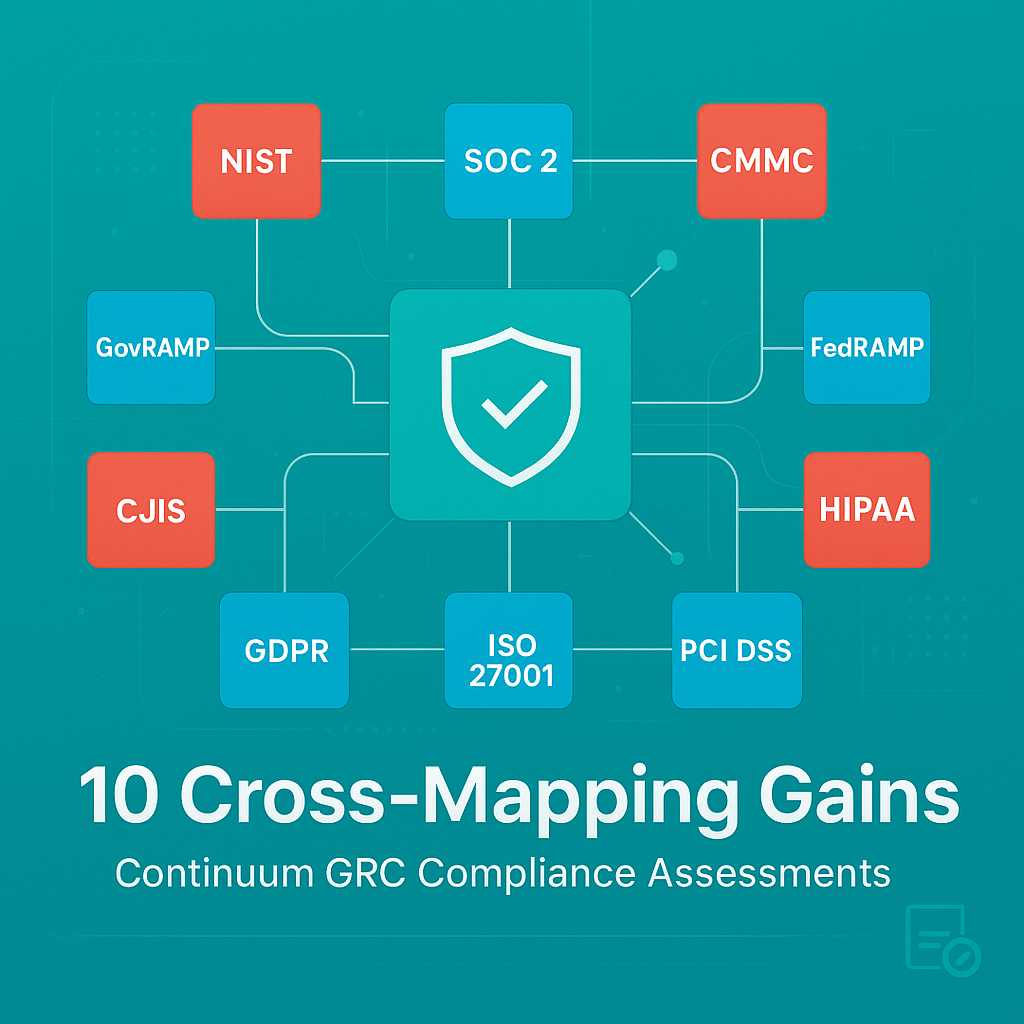
Cross-mapping is no longer a convenience feature for governance risk compliance teams; it is becoming the operating model for credible multi-framework compliance. In 2026, CISOs, compliance officers, and IT security leaders are expected to prove that one control environment can satisfy overlapping obligations across NIST 800-53, SOC 1, SOC 2, CMMC, DFARS/NIST 800-171, FedRAMP, GovRAMP, ISO 27001, HIPAA, PCI DSS, CJIS, C5, GDPR, CCPA, and LADMF without creating duplicative audit work.
The strategic advantage of Continuum GRC compliance assessments is the disciplined use of a unified control library: a normalized, evidence-driven structure that connects security objectives, mapped requirements, control owners, evidence artifacts, test procedures, risks, exceptions, and remediation plans. That is where cross-mapping changes from a spreadsheet exercise into an audit-ready compliance architecture.
Executive Summary: Why Cross-Mapping Matters Now
Organizations rarely fail compliance because they lack policies. They fail because evidence is fragmented, control language is inconsistent, system boundaries are unclear, and the same safeguard is tested multiple times under different framework labels. According to IBM, the global average cost of a data breach is USD 4.99 million, which makes control effectiveness and audit defensibility a board-level risk issue, not merely a compliance documentation task IBM – Every AI agent followed the rules, and the data still leaked.
The core insight: cross-mapping does not mean claiming that frameworks are identical. NIST SP 800-53 Rev. 5 contains a broad control catalog for federal information systems and organizations, while NIST SP 800-171 Rev. 3 focuses on protecting controlled unclassified information in nonfederal systems and organizations NIST – SP 800-53 Rev. 5 Security and Privacy Controls NIST – SP 800-171 Rev. 3 Protecting Controlled Unclassified Information. Effective cross-mapping identifies where evidence can be reused, where additional testing is required, and where framework-specific language creates obligations that cannot be safely collapsed.
- Cross-mapping gain: one evidence artifact can support several requirements when it addresses the same system, control objective, population, period, and operating effectiveness criterion.
- Compliance assessment gain: assessors can test common controls once, then document residual framework-specific deltas.
- Governance gain: leadership can see obligations through a single risk taxonomy rather than separate audit silos.
- Operational gain: control owners reduce duplicate requests, conflicting remediation priorities, and audit fatigue.
Continuum GRC has written extensively about cross-mapping and unified compliance assessment methods for complex regulatory environments Continuum GRC – Master Cross-Mapping for Compliance Assessments 2026.
The Unified Control Library: The Foundation of Multi-Framework Compliance
A unified control library is a structured repository that normalizes controls across frameworks into common security and privacy objectives. It should include the authoritative requirement text, framework identifier, mapped internal control, control owner, implementation statement, system scope, evidence type, testing procedure, frequency, risk rating, and remediation status.
This approach aligns well with the NIST Cybersecurity Framework 2.0, which organizes cybersecurity outcomes around the Functions Govern, Identify, Protect, Detect, Respond, and Recover NIST – Cybersecurity Framework. The NIST Cybersecurity Framework 2.0 also elevates governance as a top-level Function, making executive accountability, policy, oversight, roles, and supply-chain risk management explicit elements of cybersecurity risk management NIST – Cybersecurity Framework.
A practical unified control library typically contains five layers:
- Authoritative requirement layer: original framework clauses, controls, objectives, safeguards, or criteria.
- Common control layer: normalized control statements written in the organization’s language.
- Evidence layer: artifacts such as configuration exports, access reviews, vulnerability scans, change tickets, incident records, training logs, policies, risk assessments, and management approvals.
- Testing layer: sampling methodology, test steps, exceptions, compensating controls, and assessor notes.
- Risk layer: control deficiencies, residual risk, business impact, remediation owner, and target completion date.
The mistake many organizations make is treating cross-mapping as a many-to-many spreadsheet. A control library must be testable. If the mapping does not specify evidence, control population, sampling logic, and applicability conditions, it may reduce administrative effort but will not withstand a rigorous audit.
10 Cross-Mapping Gains with Continuum GRC Compliance Assessments
1. Evidence Reuse Without Overclaiming Equivalence
The first gain is controlled evidence reuse. For example, a quarterly privileged access review may support SOC 2 logical access criteria, ISO 27001 Annex A access control objectives, NIST SP 800-53 Rev. 5 access control controls, and HIPAA Security Rule access management expectations when the system boundary, covered user population, and review period are the same AICPA & CIMA – SOC Suite of Services ISO – ISO/IEC 27001 Information Security Management Systems HHS – HIPAA Security Rule.
The nuance is critical. Evidence reuse is appropriate only when the artifact proves the same control objective for the same environment. If a SOC 2 report covers a production SaaS platform but the CMMC assessment covers a separate enclave that processes controlled unclassified information, the evidence may be relevant but not sufficient.
2. Faster Scope Definition Across Complex Environments
Scope errors create some of the most expensive compliance failures. FedRAMP focuses on cloud service offerings used by federal agencies, while GovRAMP supports cloud security authorization for state and local government use cases FedRAMP – Federal Risk and Authorization Management Program GovRAMP – Cloud Security Authorization. PCI DSS applies to environments that store, process, or transmit cardholder data and can include connected systems that affect the security of the cardholder data environment PCI Security Standards Council – PCI DSS.
A unified control library helps teams build a framework-by-framework scope matrix before evidence collection begins. That scope matrix should define system components, data types, users, third-party services, inherited controls, excluded assets, and segmentation assumptions.
3. Cleaner Mapping Between CMMC, DFARS, and NIST 800-171
Defense contractors face a common challenge: DFARS clause 252.204-7012 requires safeguarding covered defense information and reporting cyber incidents to the Department of Defense within 72 hours after discovery eCFR – DFARS 252.204-7012. CMMC 2.0 provides the Department of Defense assessment program structure for verifying cybersecurity practices across levels DoD CIO – Cybersecurity Maturity Model Certification. NIST SP 800-171 Rev. 3 is the current NIST publication for protecting controlled unclassified information in nonfederal systems and organizations NIST – SP 800-171 Rev. 3 Protecting Controlled Unclassified Information.
Cross-mapping helps contractors distinguish three related but different workstreams: contractual clauses, control implementation, and assessment readiness. In practice, this means tying each CUI safeguard to the system security plan, technical evidence, risk decision, and plan of action and milestones. Continuum GRC provides dedicated support for DFARS, NIST 800-171, and CMMC readiness through its compliance assessment services Continuum GRC – DFARS NIST 800-171 and 800-172 Compliance Solutions.
4. Better FedRAMP, GovRAMP, and NIST 800-53 Control Inheritance
NIST SP 800-53 Rev. 5 provides a catalog of security and privacy controls that supports federal and nonfederal risk management programs NIST – SP 800-53 Rev. 5 Security and Privacy Controls. FedRAMP uses standardized security assessment, authorization, and continuous monitoring for cloud products and services used by federal agencies FedRAMP – Federal Risk and Authorization Management Program.
Control inheritance is often misunderstood. A cloud provider may inherit physical and environmental safeguards from an infrastructure provider, but customer-managed identity, encryption key management, logging configuration, vulnerability remediation, and incident response procedures often remain customer responsibilities. Cross-mapping clarifies inherited, shared, and customer-managed controls so audit teams do not assume coverage where none exists.
5. Stronger SOC 1 and SOC 2 Alignment with Operational Controls
SOC 1 reporting focuses on controls relevant to user entities’ internal control over financial reporting, while SOC 2 reporting addresses trust services categories such as security, availability, processing integrity, confidentiality, and privacy through the AICPA SOC suite AICPA & CIMA – SOC Suite of Services.
Cross-mapping prevents SOC reports from becoming isolated assurance products. A change management control tested for SOC 2 can also support ISO 27001 operations security, NIST configuration management expectations, PCI DSS secure system maintenance, and FedRAMP configuration management evidence when scope and testing criteria align. Continuum GRC has also addressed SOC 2 reporting enhancements involving AI and modern audit expectations Continuum GRC – SOC 2 Reporting Enhancements: AI and Audits.
6. Reduced Audit Fatigue for Control Owners
Control owners often receive repeated requests for the same artifact under different names: access review, user recertification, privilege review, account validation, or authorization review. A unified control library translates those requests into a single evidence calendar.
For example, one identity governance owner may maintain evidence for privileged access approvals, terminated-user removal, multi-factor authentication enforcement, service account review, and emergency access logging. Cross-mapping assigns each artifact to applicable frameworks and marks gaps where additional testing is needed.
7. More Accurate Privacy and Security Integration
Privacy frameworks and security frameworks overlap but are not interchangeable. The GDPR establishes obligations for personal data processing in the European Union legal framework, including principles such as lawfulness, fairness, transparency, purpose limitation, data minimization, accuracy, storage limitation, integrity, confidentiality, and accountability European Union – General Data Protection Regulation. The California Attorney General provides CCPA resources addressing California consumer privacy rights and business obligations California Attorney General – California Consumer Privacy Act.
A security control such as encryption may reduce privacy risk, but it does not by itself prove lawful processing, valid notice, deletion handling, data subject request fulfillment, or vendor contract governance. Cross-mapping should therefore distinguish confidentiality controls from privacy program controls.
8. Better Handling of Sector-Specific Frameworks: HIPAA, CJIS, C5, and LADMF
The HIPAA Security Rule establishes administrative, physical, and technical safeguards for electronic protected health information HHS – HIPAA Security Rule. The FBI CJIS Security Policy Resource Center provides security policy resources for organizations handling criminal justice information FBI – CJIS Security Policy Resource Center. Germany’s BSI C5 criteria catalog supports cloud security assurance for cloud service providers and customers BSI – Cloud Computing Compliance Criteria Catalogue C5. The NTIS Limited Access Death Master File program governs access to LADMF data products NTIS – Limited Access Death Master File.
Sector-specific frameworks often introduce unique eligibility, data-use, personnel, background screening, contractual, or jurisdictional expectations. Cross-mapping helps identify where general cybersecurity controls are sufficient and where a specialized control narrative is required.
9. More Defensible Risk Acceptance and POA&M Management
Plans of action and milestones become more effective when mapped to business risk, framework impact, and compensating controls. A single vulnerability management deficiency may affect NIST risk management, PCI DSS security testing, SOC 2 security criteria, HIPAA technical safeguards, and FedRAMP continuous monitoring expectations PCI Security Standards Council – PCI DSS HHS – HIPAA Security Rule FedRAMP – Federal Risk and Authorization Management Program.
Cross-mapping allows leadership to prioritize remediation based on cumulative compliance exposure. Instead of five separate low-priority findings, the organization may see one enterprise weakness with broad audit consequences.
10. Stronger AI Governance and Continuous Control Monitoring
AI-enabled systems increase the need for traceable governance, model oversight, data lineage, access management, and incident response. NIST AI Risk Management Framework 1.0 is organized around the functions Govern, Map, Measure, and Manage NIST – AI Risk Management Framework. IBM reports that organizations in its study with incidents involving an AI model or application had average breach costs of USD 5.33 million, compared with USD 4.70 million for breaches that did not involve AI or where AI involvement was unknown IBM – Every AI agent followed the rules, and the data still leaked.
The contrarian view is that AI does not remove the need for disciplined audit methods. Automation can collect evidence faster, but it can also replicate bad mappings at scale. A mature unified control library requires human validation of applicability, test sufficiency, and regulatory nuance.
Field Scenario: Consolidating Five Audits into One Control Architecture
Consider an anonymized SaaS provider serving healthcare, financial services, and public sector customers. The company needed SOC 2 reporting, HIPAA support for business associate commitments, PCI DSS scoping for payment functionality, NIST 800-53 alignment for public sector sales, and ISO 27001 readiness for enterprise procurement.
The initial state was typical: separate evidence folders, inconsistent control names, redundant ticket requests, multiple risk registers, and unclear ownership for shared cloud controls. The access management team was asked for similar evidence under at least four different audit labels. Vulnerability management reports existed, but remediation exceptions were tracked outside the compliance repository. Vendor risk reviews were performed, but there was no direct link between vendor criticality, data type, and control testing.
A unified control library changed the assessment approach:
- Identity controls were normalized into joiner-mover-leaver, privileged access, MFA, service account, and periodic review control families.
- Vulnerability management was mapped to scan coverage, risk ranking, remediation service-level objectives, exception approval, and retesting evidence.
- Incident response evidence was linked to tabletop exercises, escalation procedures, customer notification obligations, and post-incident corrective action.
- Third-party risk controls were mapped to data classification, contract requirements, security review depth, and continuous monitoring triggers.
- Privacy controls were separated from security controls so that notice, consent, retention, deletion, and data subject request evidence were not assumed to be covered by encryption and access controls.
The result was not fewer controls; it was fewer redundant controls. The organization still needed framework-specific evidence, but it no longer treated each assessment as a standalone fire drill.
A Practical Cross-Mapping Methodology for Compliance Assessments
Step 1: Define the Authoritative Framework Stack
Start by listing the frameworks that are contractually, legally, commercially, or strategically required. Common stacks include SOC 2 plus ISO 27001 for SaaS vendors, CMMC plus DFARS plus NIST 800-171 for defense contractors, FedRAMP plus NIST 800-53 for federal cloud offerings, and HIPAA plus SOC 2 for healthcare technology vendors.
Step 2: Establish System Boundaries and Data Classes
Document applications, infrastructure, endpoints, identity providers, cloud services, networks, data stores, administrative interfaces, third parties, and data types. Boundaries should identify CUI, ePHI, cardholder data, personal data, criminal justice information, LADMF data, and regulated government data where applicable.
Step 3: Normalize Controls into Families
Group controls into logical families such as governance, asset management, access control, configuration management, change management, vulnerability management, logging and monitoring, incident response, business continuity, vendor risk, privacy, encryption, personnel security, and secure development.
Step 4: Map Evidence to Objectives, Not Just Clauses
A strong evidence map answers four questions: what objective is being proven, which system population is included, what period is covered, and what test demonstrates operating effectiveness. If those four elements differ, the evidence should not be blindly reused.
Step 5: Test Once, Then Document Deltas
When control objectives overlap, test the common control once and document additional procedures for framework-specific deltas. For example, PCI DSS testing may require payment-environment specificity, while HIPAA testing may require ePHI safeguard relevance, and CMMC testing may require CUI enclave evidence.
Step 6: Maintain a Living Control Library
Controls change when architecture changes. Build update triggers for new cloud services, mergers, new data types, AI systems, geographic expansion, new customer contracts, and major regulatory obligations. Continuum GRC describes integrated risk platforms as a way to connect regulatory requirements, risk management, and audit evidence into a more sustainable operating model Continuum GRC – Integrated Risk Platforms for Regulatory Compliance.
Common Pitfalls to Avoid
- Assuming similar language means identical requirements: Access control appears in nearly every framework, but scope, evidence, timing, and testing expectations differ.
- Mapping without system boundaries: Evidence for one product, enclave, or cloud account may not apply to another.
- Ignoring inherited controls: Shared-responsibility environments require clear ownership between cloud provider, platform operator, customer, and managed service provider.
- Collapsing privacy into security: Encryption and MFA do not prove lawful processing, retention governance, or data subject rights fulfillment.
- Over-automating without validation: Automated evidence collection is valuable, but mapped artifacts still require assessor judgment.
- Failing to preserve audit trails: Control changes, risk acceptances, exceptions, and remediation decisions should be versioned and attributable.
Implementation Timeline and Resource Considerations
A realistic cross-mapping initiative usually proceeds in phases. A smaller organization with one primary product and two frameworks may establish a usable unified control library in several weeks. A regulated enterprise with multiple business units, cloud platforms, data types, and audit regimes should expect a phased roadmap spanning several months. Exact timing depends on scope complexity, evidence maturity, control ownership, and executive sponsorship.
Resource needs typically include a compliance lead, technical control owners, security engineering support, legal or privacy participation, procurement or vendor risk participation, and an executive risk owner. Tooling helps, but governance discipline matters more than software selection. The highest-value investment is often not a new dashboard; it is agreement on control definitions, evidence standards, and remediation accountability.
Frequently Asked Questions
What is cross-mapping in compliance assessments?
Cross-mapping is the process of connecting equivalent or related requirements across multiple frameworks to common internal controls, evidence artifacts, test procedures, and risk records. It supports multi-framework compliance without pretending every framework is identical.
What is a unified control library?
A unified control library is a normalized repository of controls that links authoritative framework requirements to internal control statements, owners, implementation details, evidence, testing procedures, findings, and remediation plans.
Can one audit satisfy every framework?
One audit process can support many frameworks, but one test rarely satisfies every requirement without qualification. Cross-mapping improves efficiency by identifying reusable evidence and documenting framework-specific deltas.
Where should an organization start?
Start with the frameworks that create immediate legal, contractual, revenue, or operational exposure. Then define system boundaries, identify regulated data, normalize common controls, and test high-risk areas such as access management, vulnerability management, incident response, logging, encryption, and vendor risk.
Call to Action: Build a Control Library That Auditors Can Trust
Cross-mapping delivers its greatest value when it is evidence-based, risk-aligned, and maintained as part of ongoing governance risk compliance operations. Continuum GRC compliance assessments help organizations consolidate overlapping obligations, reduce audit fatigue, clarify control ownership, and build defensible multi-framework compliance programs.
If your organization is managing SOC 2, ISO 27001, CMMC, DFARS/NIST 800-171, NIST 800-53, FedRAMP, GovRAMP, HIPAA, PCI DSS, CJIS, C5, GDPR, CCPA, LADMF, or another major framework, now is the time to move from disconnected spreadsheets to a unified control library. Contact Continuum GRC to discuss a cross-mapping strategy built for audit readiness, regulatory resilience, and executive visibility.
Sources and References
- IBM – Every AI agent followed the rules, and the data still leaked
- NIST – SP 800-53 Rev. 5 Security and Privacy Controls
- NIST – SP 800-171 Rev. 3 Protecting Controlled Unclassified Information
- NIST – Cybersecurity Framework
- Continuum GRC – Master Cross-Mapping for Compliance Assessments 2026
- AICPA & CIMA – SOC Suite of Services
- ISO – ISO/IEC 27001 Information Security Management Systems
- HHS – HIPAA Security Rule
- FedRAMP – Federal Risk and Authorization Management Program
- GovRAMP – Cloud Security Authorization
- PCI Security Standards Council – PCI DSS
- eCFR – DFARS 252.204-7012
- DoD CIO – Cybersecurity Maturity Model Certification
- Continuum GRC – DFARS NIST 800-171 and 800-172 Compliance Solutions
- Continuum GRC – SOC 2 Reporting Enhancements: AI and Audits
- European Union – General Data Protection Regulation
- California Attorney General – California Consumer Privacy Act
- FBI – CJIS Security Policy Resource Center
- BSI – Cloud Computing Compliance Criteria Catalogue C5
- NTIS – Limited Access Death Master File
- NIST – AI Risk Management Framework
- Continuum GRC – Integrated Risk Platforms for Regulatory Compliance
About Continuum GRC
We also provide risk management and compliance support for every major regulation and compliance framework on the market, including:
- FedRAMP
- GovRAMP
- GDPR
- NIST 800-53
- DFARS NIST 800-171, 800-172
- CMMC
- SOC 1, SOC 2
- HIPAA
- PCI DSS 4.0
- IRS 1075, 4812
- COSO SOX
- ISO 27000 Series
- ISO 9000 Series
- CJIS
- C5
- LADMF
- 100+ Frameworks
Continuum GRC is a proactive cybersecurity® and the only FedRAMP-authorized cybersecurity audit platform in the world. Call 1-888-896-6207 to discuss your organization’s cybersecurity needs and learn how we can help protect your systems and ensure compliance.
Related Posts