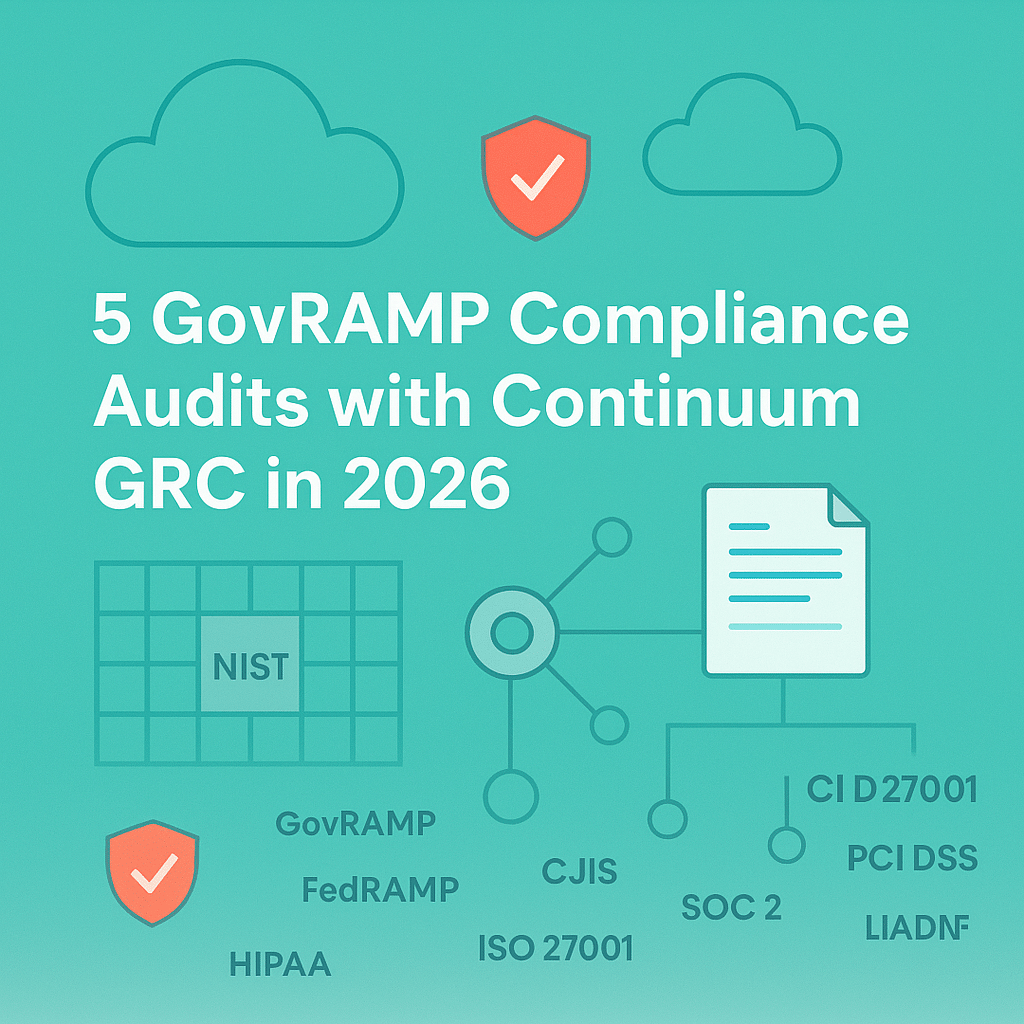
GovRAMP compliance audits are becoming a decisive SLED cloud security gate in 2026 because public-sector buyers increasingly want one security verification they can trust across many procurement decisions. The strategic shift is not simply more compliance audits; it is NIST-aligned assurance that turns GovRAMP, NIST 800-53, FedRAMP, CJIS, SOC 2, ISO 27001, PCI DSS, HIPAA, CMMC, C5, and LADMF evidence into a reusable control system instead of a stack of disconnected questionnaires.
The most important insight for cloud service providers is contrarian: the fastest GovRAMP path is rarely the narrowest GovRAMP-only project. In audit practice, organizations that scope GovRAMP as part of a cross-framework evidence architecture typically reduce duplicate interviews, avoid conflicting control narratives, and make continuous monitoring easier to sustain.
Executive Summary: Five GovRAMP Compliance Audits That Matter in 2026
GovRAMP describes its program as a standardized, NIST-aligned approach to security verification and continuous monitoring for service providers serving public-sector customers, according to GovRAMP – Getting Started with GovRAMP: A Guide for Service Providers. The State of Nevada explains the procurement value in plain language: GovRAMP helps providers meet minimum security controls in accordance with NIST 800-53 and supports a verify-once-to-serve-many model through standardized cybersecurity verification, according to State of Nevada – GovRAMP.
For CISOs, compliance officers, and cloud security leaders, the five most valuable GovRAMP compliance audits in 2026 are:
- Readiness and boundary audit: Validate the cloud service offering, system boundary, data flows, inherited controls, external services, and SLED use cases before formal evidence collection.
- NIST 800-53 control implementation audit: Test whether required administrative, technical, and operational controls are implemented, operating, and supportable with evidence.
- Cloud architecture and shared-responsibility audit: Determine where the provider, customer, hyperscaler, managed service provider, and subcontractors own control performance.
- Continuous monitoring and vulnerability evidence audit: Confirm that logging, vulnerability management, configuration management, incident response, and POA&M processes can survive ongoing review.
- Cross-framework evidence reuse audit: Map GovRAMP evidence to FedRAMP, CJIS, SOC 2, ISO 27001, PCI DSS, HIPAA, CMMC, C5, and LADMF without overclaiming equivalence.
Continuum GRC supports organizations preparing for GovRAMP and related cybersecurity assessments through structured control mapping, evidence organization, and assessment readiness workflows; see Continuum GRC – GovRAMP compliance support.
Why GovRAMP Is Becoming a SLED Cloud Security Procurement Signal
SLED buyers face a difficult assurance problem: they need cloud innovation, but they also need a defensible way to evaluate whether service providers can protect regulated public-sector data. GovRAMP addresses that problem by anchoring cloud assurance to NIST-aligned verification and continuous monitoring, according to GovRAMP – Getting Started with GovRAMP: A Guide for Service Providers.
This matters because NIST SP 800-53 Rev. 5 provides a broad control catalog covering access control, audit and accountability, configuration management, contingency planning, incident response, risk assessment, system and communications protection, system and information integrity, and related control families, according to NIST – Security and Privacy Controls for Information Systems and Organizations, SP 800-53 Rev. 5. In practice, that means GovRAMP evidence can become a common assurance language across procurement, security engineering, customer trust, and executive risk reporting.
The federal cloud market is already moving toward more structured and reusable assurance. FedRAMP reported 538 total FedRAMP Certified cloud service offerings, 92 new FedRAMP Certifications in its latest program update, and 760 new agency ATOs or ATUs, according to FedRAMP – From Foundation to Implementation. GovRAMP is not FedRAMP, but both programs reinforce the same board-level lesson: cloud security evidence must be reliable, repeatable, and continuously maintained.
Audit 1: GovRAMP Readiness and Boundary Validation
The first GovRAMP compliance audit should answer a deceptively simple question: what exactly is being assessed? Many failed readiness efforts begin with ambiguous system boundaries, undocumented administrative interfaces, unclear data residency assumptions, or third-party services that are treated as background infrastructure when they are actually part of the assessed service.
A strong boundary validation audit should review:
- Cloud service offering definition: Identify the exact product, deployment model, regions, tenants, APIs, support functions, and privileged management planes in scope.
- Data categorization: Determine whether the service processes regulated data such as criminal justice information, payment card data, protected health information, education records, controlled unclassified information, or death master file data.
- Network and identity paths: Trace administrator access, customer access, service-to-service authentication, remote support, break-glass access, and federated identity flows.
- Control inheritance: Document controls inherited from an infrastructure provider, controls owned by the service provider, and customer-responsibility controls that must be disclosed accurately.
- Evidence ownership: Assign accountable owners for policies, procedures, diagrams, logs, tickets, scans, configuration baselines, risk decisions, and remediation records.
In anonymized fieldwork, a SaaS provider preparing for SLED expansion believed its production environment was the only relevant boundary. The readiness audit found that support tooling, a data export pipeline, and a customer analytics subsystem also touched regulated tenant metadata. The finding was not a failure of technology; it was a failure of scoping discipline. The remediation plan added updated data-flow diagrams, segmented administrator roles, revised third-party service documentation, and evidence owners for each boundary component.
Audit 2: NIST 800-53 Control Implementation Testing
GovRAMP readiness depends heavily on NIST 800-53 control implementation quality. NIST SP 800-53 Rev. 5 defines security and privacy controls that organizations can tailor to systems and risk context, according to NIST – SP 800-53 Rev. 5. The audit question is not whether a policy mentions a control; the question is whether the control is implemented, operating, and evidenced.
High-value testing areas include:
- AC-2 Account Management: Test joiner, mover, leaver workflows; privileged account recertification; service account ownership; and dormant account handling, using NIST SP 800-53 control language as the reference point, according to NIST – SP 800-53 Rev. 5.
- IA-2 Identification and Authentication: Verify multifactor authentication coverage for privileged and non-privileged access paths where required by the selected baseline and risk treatment approach, using NIST SP 800-53 as the control source, according to NIST – SP 800-53 Rev. 5.
- AU-2 and AU-6 Audit Events and Audit Record Review: Confirm that event selection, log retention, review procedures, alert triage, and escalation records align with operational reality, using NIST SP 800-53 audit and accountability controls, according to NIST – SP 800-53 Rev. 5.
- CM-2 and CM-6 Baseline Configuration and Configuration Settings: Compare documented baselines with actual cloud configurations, hardened images, infrastructure-as-code templates, and exception approvals, using NIST SP 800-53 configuration management controls, according to NIST – SP 800-53 Rev. 5.
- RA-5 Vulnerability Monitoring and Scanning: Evaluate authenticated scanning, container image scanning, cloud control-plane findings, remediation SLAs, false-positive handling, and risk acceptance quality, using NIST SP 800-53 risk assessment controls, according to NIST – SP 800-53 Rev. 5.
- IR-4 Incident Handling: Review incident categorization, escalation, communications, lessons learned, and tabletop exercise evidence using NIST SP 800-53 incident response control expectations, according to NIST – SP 800-53 Rev. 5.
The most common implementation gap is evidence mismatch. For example, a policy may require quarterly access reviews, the ticketing system may show semiannual reviews, and identity logs may reveal accounts excluded from both cycles. An audit-ready program resolves that mismatch before external review by aligning policy language, system configuration, ticket workflow, and retained artifacts.
Audit 3: Cloud Architecture, Encryption, Logging, and Shared Responsibility
SLED cloud security is often weakened by shared-responsibility assumptions. A provider may inherit physical security from a hyperscaler, but the provider still owns tenant isolation, application authorization, logging configuration, vulnerability remediation, encryption design, key management choices, and customer-facing security documentation unless those responsibilities are formally allocated elsewhere.
This audit should test technical architecture against control intent:
- Encryption: Validate encryption in transit, encryption at rest, key ownership, key rotation, customer-managed key options, and administrative access to key material.
- Logging: Verify that identity, network, application, database, administrative, API, and security-tool events are collected and reviewable.
- Tenant isolation: Review access control design, object-level authorization, database segmentation, namespace isolation, and customer metadata separation.
- Secure configuration: Compare runtime cloud settings with approved baselines and infrastructure-as-code definitions.
- Resilience: Test backup scope, restoration evidence, failover assumptions, and dependency risks.
Framework interoperability becomes important here. The FBI explains that the CJIS Security Policy establishes security requirements for criminal justice information systems through its CJIS Security Policy Resource Center, according to FBI – CJIS Security Policy Resource Center. PCI DSS v4.0.1 is the current payment-security standard available through the PCI Security Standards Council document library, according to PCI Security Standards Council – PCI DSS Document Library. HHS describes the HIPAA Security Rule as establishing national standards to protect electronic protected health information, according to HHS – HIPAA Security Rule. A GovRAMP architecture audit should anticipate these overlaps instead of rediscovering them separately.
Audit 4: Continuous Monitoring, POA&M Discipline, and Evidence Freshness
A point-in-time GovRAMP evidence package is not enough. GovRAMP emphasizes continuous monitoring as part of its standardized verification approach, according to GovRAMP – Getting Started with GovRAMP: A Guide for Service Providers. NIST also emphasizes governance as a core cybersecurity function in the Cybersecurity Framework 2.0, according to NIST – Cybersecurity Framework 2.0, and NIST SP 800-221 Rev. 1 connects cybersecurity governance to enterprise ICT risk management, according to NIST – Governing and Managing ICT Risk Programs Within an Enterprise Risk Portfolio.
A continuous monitoring audit should evaluate:
- Vulnerability cadence: Are scans authenticated, complete, reviewed, risk-ranked, and remediated within documented timelines?
- POA&M integrity: Are weaknesses described precisely, assigned to accountable owners, tied to remediation milestones, and closed with evidence?
- Configuration drift: Are baseline deviations detected, approved, remediated, or risk accepted with appropriate justification?
- Security metrics: Do executives receive meaningful measures such as high-risk open findings, overdue remediation, privileged access exceptions, incident trends, and patch aging?
- Evidence freshness: Are artifacts current enough to support ongoing authorization, customer due diligence, and procurement reviews?
One practical rule from audit experience: if an artifact cannot be reproduced by someone other than the original control owner, it is not mature evidence. Screenshots without timestamps, spreadsheet risk registers without approval history, and vulnerability exports without remediation linkage routinely fail when challenged. Continuum GRC has written about NIST governance and audit readiness in Continuum GRC – NIST Governance Wins for Compliance Assessments.
Audit 5: Cross-Framework Evidence Reuse Without False Equivalence
Cross-framework evidence reuse is powerful, but it must be handled carefully. A single access review artifact may support GovRAMP, SOC 2, ISO 27001, and CMMC evidence needs, but only if the scope, population, timing, approval criteria, and control objective match each framework’s expectations.
Consider the interoperability landscape:
- SOC 1 and SOC 2: The AICPA describes SOC services as reporting options for controls at service organizations, including SOC 2 examinations aligned to trust services categories, according to AICPA & CIMA – System and Organization Controls Suite of Services.
- ISO 27001: ISO describes ISO/IEC 27001 as the international standard for information security management systems, according to ISO – ISO/IEC 27001 Information Security Management.
- CMMC and DFARS/NIST 800-171: The CMMC clause at 48 CFR 252.204-7021 describes CMMC as a framework for assessing contractor compliance with required information-security protections for systems processing, storing, or transmitting FCI or CUI, according to eCFR – 48 CFR 252.204-7021. NIST SP 800-171 Rev. 3 provides security requirements for protecting controlled unclassified information in nonfederal systems and organizations, according to NIST – SP 800-171 Rev. 3.
- C5: Germany’s Federal Office for Information Security describes C5 as a cloud computing compliance criteria catalogue, according to BSI – Cloud Computing Compliance Criteria Catalogue C5.
- LADMF: NTIS describes the Limited Access Death Master File program and certification requirements for access to LADMF data, according to NTIS – Limited Access Death Master File.
The practical methodology is a four-column evidence model:
- Control intent: What risk is the requirement trying to reduce?
- Control implementation: What process, system configuration, or governance activity performs the control?
- Evidence object: What artifact proves design and operating effectiveness?
- Framework applicability: Which frameworks can reasonably rely on that artifact, and what caveats apply?
For example, an access review can support NIST 800-53 AC-2, SOC 2 security criteria, ISO 27001 access control practices, and CMMC access control expectations. But if the review excludes database administrators, service accounts, emergency accounts, or contractor identities, the evidence may be only partially reusable. Reuse is not copying and pasting; it is controlled traceability.
A Practical GovRAMP Audit Methodology for Security Leaders
Use this phased approach to make GovRAMP compliance audits more predictable:
Phase 1: Executive Alignment and Scope Freeze
- Define the cloud service offering, customer types, data categories, regions, and operational dependencies.
- Appoint executive control owners for security, engineering, legal, procurement, privacy, support, and customer success.
- Create a boundary diagram and data-flow model that engineers and auditors both understand.
Phase 2: Control Mapping and Evidence Inventory
- Map GovRAMP expectations to NIST 800-53 control families and identify inherited, shared, provider-owned, and customer-owned controls.
- Build a reusable evidence library organized by control objective, system component, owner, date, and framework applicability.
- Identify evidence gaps before formal assessment activities begin.
Phase 3: Technical Validation
- Run access, logging, vulnerability, configuration, encryption, backup, incident response, and change-management tests.
- Compare policy requirements with operational records and system-generated evidence.
- Open POA&M items for weaknesses that cannot be remediated immediately.
Phase 4: Continuous Monitoring Operating Model
- Define recurring evidence refresh cycles for scans, access reviews, log reviews, configuration baselines, incident records, and risk exceptions.
- Report risk metrics to executives in governance language aligned to NIST CSF 2.0 Govern, Identify, Protect, Detect, Respond, and Recover functions, according to NIST – Cybersecurity Framework 2.0.
- Use cross-framework mappings to support customer due diligence and future audits without weakening evidence quality.
Continuum GRC discusses related FedRAMP evidence modernization and cloud audit trends in Continuum GRC – FedRAMP 20x Wins with Continuum GRC Audits, and Lazarus Alliance has addressed GovRAMP assessment preparation in Lazarus Alliance – GovRAMP Assessments: 7 SLED Must-Dos.
Common Pitfalls to Avoid in GovRAMP Compliance Audits
- Treating policies as evidence of operation: Policies describe intent; logs, tickets, approvals, configurations, and test results prove operation.
- Ignoring customer-responsibility controls: If customers must configure MFA, retention, encryption, or logging, the provider should document that dependency clearly.
- Overusing inheritance: Inherited infrastructure controls do not automatically cover application-layer authorization, tenant isolation, secure development, incident response, or customer support access.
- Building one-off audit folders: A static folder may help a review, but it will not sustain continuous monitoring or cross-framework evidence reuse.
- Mapping frameworks too aggressively: Evidence reuse fails when the artifact scope does not match the framework requirement.
- Underfunding remediation: The largest resource demand is often not document creation; it is engineering remediation, identity cleanup, logging expansion, vulnerability closure, and change-management discipline.
Frequently Asked Questions About GovRAMP Compliance Audits
Is GovRAMP the same as FedRAMP?
No. GovRAMP and FedRAMP are distinct programs, but both rely on NIST-aligned cloud assurance concepts. FedRAMP focuses on federal cloud authorization, while GovRAMP addresses public-sector cloud security verification for SLED buyers, according to GovRAMP – Getting Started with GovRAMP and FedRAMP – From Foundation to Implementation.
Can SOC 2 evidence be reused for GovRAMP?
Sometimes. SOC 2 evidence can support overlapping control objectives such as access control, change management, incident response, logging, and vendor risk, but the organization must confirm scope, control population, testing period, and control objective alignment with GovRAMP and NIST 800-53 expectations.
How long does GovRAMP readiness take?
In professional practice, the timeline depends on system complexity, engineering maturity, evidence quality, third-party dependencies, and the number of unresolved technical findings. A focused SaaS environment with mature identity, logging, vulnerability, and change-management evidence can move faster than a multi-product platform with unclear boundaries and inherited-control gaps.
What is the most common GovRAMP readiness finding?
The most common finding is not a missing policy; it is inconsistency between the policy, the control narrative, and system-generated evidence. Examples include privileged users missing from access reviews, vulnerability tickets without closure evidence, and diagrams that omit administrative or support paths.
Call to Action: Build GovRAMP Evidence Once, Reuse It Intelligently
GovRAMP compliance audits should not create another isolated compliance lane. They should become part of a unified assurance system that improves SLED cloud security, supports NIST 800-53 control traceability, strengthens customer trust, and reduces duplicate audit effort across frameworks.
If your organization is preparing for GovRAMP, expanding into SLED markets, or trying to reuse evidence across FedRAMP, CJIS, SOC 2, ISO 27001, PCI DSS, HIPAA, CMMC, C5, or LADMF, Continuum GRC can help you assess readiness, organize evidence, identify control gaps, and build a sustainable audit operating model.
Sources and References
- GovRAMP – Getting Started with GovRAMP: A Guide for Service Providers
- State of Nevada – GovRAMP
- NIST – Security and Privacy Controls for Information Systems and Organizations, SP 800-53 Rev. 5
- FedRAMP – From Foundation to Implementation
- NIST – Cybersecurity Framework 2.0
- NIST – Governing and Managing ICT Risk Programs Within an Enterprise Risk Portfolio
- FBI – CJIS Security Policy Resource Center
- PCI Security Standards Council – PCI DSS Document Library
- HHS – HIPAA Security Rule
- AICPA & CIMA – System and Organization Controls Suite of Services
- ISO – ISO/IEC 27001 Information Security Management
- eCFR – 48 CFR 252.204-7021
- NIST – SP 800-171 Rev. 3
- BSI – Cloud Computing Compliance Criteria Catalogue C5
- NTIS – Limited Access Death Master File
- Continuum GRC – GovRAMP compliance support
- Continuum GRC – NIST Governance Wins for Compliance Assessments
- Continuum GRC – FedRAMP 20x Wins with Continuum GRC Audits
- Lazarus Alliance – GovRAMP Assessments: 7 SLED Must-Dos
About Continuum GRC
We also provide risk management and compliance support for every major regulation and compliance framework on the market, including:
- FedRAMP
- GovRAMP
- GDPR
- NIST 800-53
- DFARS NIST 800-171, 800-172
- CMMC
- SOC 1, SOC 2
- HIPAA
- PCI DSS 4.0
- IRS 1075, 4812
- COSO SOX
- ISO 27000 Series
- ISO 9000 Series
- CJIS
- C5
- LADMF
- 100+ Frameworks
Continuum GRC is a proactive cybersecurity® and the only FedRAMP-authorized cybersecurity audit platform in the world. Call 1-888-896-6207 to discuss your organization’s cybersecurity needs and learn how we can help protect your systems and ensure compliance.
Related Posts