HIPAA cybersecurity audit readiness is no longer a paperwork exercise. For covered entities and business associates, the decisive audit question is whether ePHI safeguards, risk analysis, risk management, and operational resilience work under pressure—not merely whether policies exist. Continuum GRC helps healthcare organizations turn HIPAA audit preparation into a defensible, evidence-driven cybersecurity program that withstands regulator scrutiny, customer due diligence, ransomware stress, and board-level risk review.
The emerging insight for 2026 is simple but uncomfortable: a HIPAA audit failure is often not caused by one missing control. It is caused by weak traceability between ePHI locations, threat scenarios, safeguards, evidence, risk decisions, and remediation ownership.
Executive Summary: Six HIPAA Cybersecurity Audit Wins
Healthcare cybersecurity teams are under pressure to prove that HIPAA Security Rule safeguards are designed, implemented, monitored, and improved over time. The U.S. Department of Health and Human Services explains that effective risk management is an essential component of HIPAA Security Rule compliance and broader cybersecurity preparedness in HHS – Security Rule Guidance Material. HHS also states that covered entities should identify and implement administrative, physical, and technical safeguards to protect the confidentiality, integrity, and availability of electronic protected health information, or ePHI, in HHS – Security Rule Guidance Material.
Continuum GRC supports six practical HIPAA cybersecurity audit wins:
- Win 1: Build a risk analysis that starts with ePHI data flows, not generic asset lists.
- Win 2: Convert risk management into measurable remediation, exception, and executive governance workflows.
- Win 3: Prove ePHI safeguards across access control, audit logging, integrity, authentication, and transmission security.
- Win 4: Demonstrate resilience through incident response, ransomware readiness, contingency planning, and recovery evidence.
- Win 5: Bring business associates and critical vendors into the audit evidence boundary.
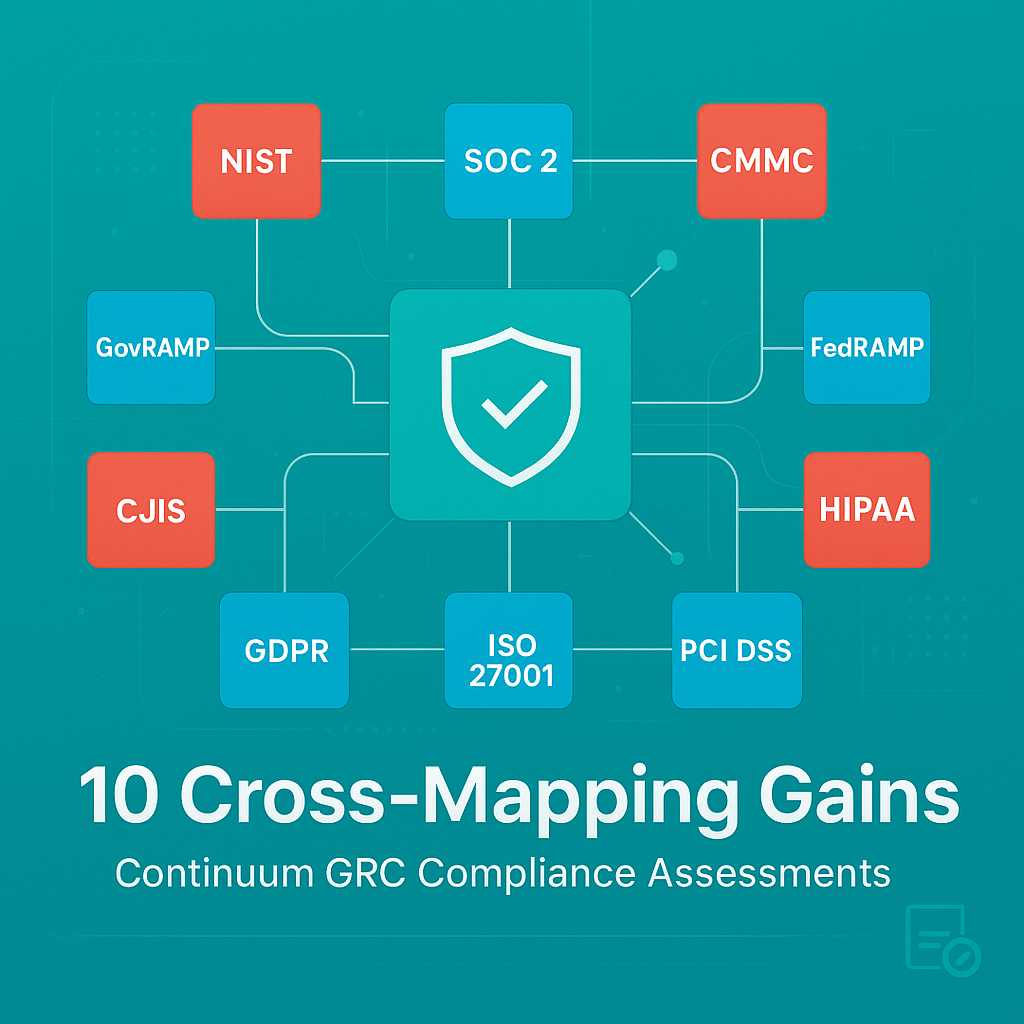
- Win 6: Reuse evidence across HIPAA, NIST 800-53, SOC 2, ISO 27001, PCI DSS, FedRAMP, CMMC, CJIS, GovRAMP, C5, LADMF, and GDPR without losing control intent.
Why HIPAA Cybersecurity Audits Are Different in 2026
HIPAA cybersecurity audits have become more technical because healthcare delivery depends on cloud platforms, patient portals, connected medical devices, revenue-cycle vendors, telehealth applications, identity providers, managed detection tools, and data analytics environments. The HIPAA Security Rule is codified at 45 CFR Part 164 Subpart C, including administrative safeguards at 45 CFR 164.308, physical safeguards at 45 CFR 164.310, technical safeguards at 45 CFR 164.312, organizational requirements at 45 CFR 164.314, and policies and documentation requirements at 45 CFR 164.316, as published in eCFR – 45 CFR Part 164 Subpart C Security Standards for the Protection of Electronic Protected Health Information.
The contrarian view: HIPAA audit readiness does not require every healthcare organization to implement the most expensive security architecture available. HIPAA requires reasonable and appropriate safeguards based on risk, size, complexity, capabilities, technical infrastructure, cost, and probability and criticality of potential risks, as reflected in eCFR – 45 CFR Part 164 Subpart C Security Standards for the Protection of Electronic Protected Health Information. The audit problem is that many organizations cannot show how they made those decisions.
That distinction matters. A compensating control may be defensible if it is tied to a documented risk scenario, approved by the right risk owner, time-bound, monitored, and tested. A policy exception buried in email is not. Continuum GRC’s HIPAA audit readiness approach focuses on defensible traceability: requirement to risk, risk to control, control to evidence, evidence to operating effectiveness, and gaps to remediation.
Win 1: Build a Risk Analysis Around Real ePHI Data Flows
The HIPAA Security Rule requires covered entities and business associates to conduct an accurate and thorough assessment of potential risks and vulnerabilities to the confidentiality, integrity, and availability of ePHI under 45 CFR 164.308(a)(1)(ii)(A), according to eCFR – 45 CFR Part 164 Subpart C Security Standards for the Protection of Electronic Protected Health Information. In practice, this is where many HIPAA audits begin to fail.
A mature risk analysis should identify where ePHI is created, received, maintained, transmitted, stored, backed up, replicated, exported, logged, and shared. A common audit gap is an application inventory that lists systems but does not distinguish whether the system stores ePHI, processes ePHI temporarily, transmits ePHI through APIs, or generates logs that contain patient identifiers. Auditors often find that organizations know their electronic health record environment but underestimate ePHI in reporting databases, file transfers, help desk tickets, email archives, test environments, and vendor support portals.
The Continuum GRC ePHI Risk Analysis Spine
For HIPAA cybersecurity audit readiness, Continuum GRC recommends a six-layer ePHI risk analysis spine:
- Business process: Patient intake, care delivery, billing, claims, pharmacy, lab, imaging, telehealth, analytics, and customer support.
- ePHI object: Demographics, diagnoses, clinical notes, images, claims data, payment data, identifiers, and authentication metadata.
- System boundary: Applications, infrastructure, cloud services, endpoints, databases, storage, identity providers, and integrations.
- Threat scenario: Credential theft, ransomware, misconfiguration, malicious insider, vendor compromise, API exposure, lost device, or unauthorized disclosure.
- Control mapping: Administrative, physical, and technical safeguards mapped to HIPAA Security Rule implementation specifications.
- Evidence package: Diagrams, inventories, access reviews, logging records, encryption configurations, vulnerability tickets, incident tests, and remediation status.
This structure aligns with broader cybersecurity governance. The NIST Cybersecurity Framework organizes cybersecurity outcomes through Govern, Identify, Protect, Detect, Respond, and Recover functions in NIST – Cybersecurity Framework. That structure is especially useful for HIPAA because the Security Rule expects risk-based protection of confidentiality, integrity, and availability, while NIST helps teams organize implementation evidence across the full security lifecycle.
Win 2: Turn Risk Management Into Auditable Remediation
The HIPAA Security Rule requires implementation of security measures sufficient to reduce risks and vulnerabilities to a reasonable and appropriate level under 45 CFR 164.308(a)(1)(ii)(B), according to eCFR – 45 CFR Part 164 Subpart C Security Standards for the Protection of Electronic Protected Health Information. This is where risk analysis becomes risk management.
In audit practice, weak risk management usually appears in four forms:
- High-risk findings remain open without executive-approved target dates.
- Risk acceptance lacks a business justification, expiration date, or compensating controls.
- Vulnerability remediation is tracked separately from enterprise risk.
- Security committees review dashboards but do not make documented risk decisions.
Continuum GRC helps organizations close this gap by converting HIPAA risk analysis results into a risk register and plan of action. Each risk should have a defined owner, inherent risk rating, mapped ePHI impact, control treatment, residual risk rating, evidence requirement, due date, and escalation path. That level of discipline is not bureaucracy; it is what lets a CISO prove that cybersecurity audits are connected to operational risk reduction.
Real-World Scenario: The “Green Dashboard” Problem
In one anonymized healthcare technology environment, management dashboards showed acceptable patching performance, but audit sampling found that internet-facing systems supporting a patient communication workflow were excluded from the primary endpoint management population. The organization had a vulnerability management process, but its asset population was incomplete. The corrective action was not simply “patch faster.” The corrective action was to reconcile asset inventory, ePHI data flows, vulnerability scanner scope, cloud inventory, and change management records into one evidence population.
This scenario illustrates a core audit lesson: evidence completeness is as important as control design. A beautifully written policy cannot compensate for an incomplete test population.
Win 3: Prove ePHI Safeguards With Technical Evidence
HIPAA technical safeguards include access control, audit controls, integrity, person or entity authentication, and transmission security under 45 CFR 164.312, according to eCFR – 45 CFR Part 164 Subpart C Security Standards for the Protection of Electronic Protected Health Information. These safeguards are often where HIPAA cybersecurity audits become highly technical.
Effective audit evidence should demonstrate that safeguards are not only configured but operating. Examples include:
- Access control: Role-based access matrices, privileged access reviews, unique user IDs, emergency access procedures, termination testing, and authentication configuration screenshots.
- Audit controls: Log source inventory, security information and event management rules, alert triage records, log retention settings, and sample investigations.
- Integrity controls: File integrity monitoring, database change controls, hash validation, application change approvals, and backup restoration evidence.
- Authentication: Identity provider policies, multifactor authentication enforcement, service account governance, passwordless authentication controls, and conditional access rules.
- Transmission security: TLS configurations, secure file transfer controls, email encryption rules, API security evidence, and network segmentation diagrams.
Security leaders should also avoid a common misconception: encryption alone is not a complete HIPAA cybersecurity strategy. Encryption can reduce exposure when data is lost or intercepted, but it does not solve excessive privilege, weak monitoring, insecure APIs, incomplete backup testing, or vendor misuse. HIPAA audit readiness requires a layered evidence story across administrative, physical, and technical safeguards.
Win 4: Demonstrate Resilience Before a Ransomware Event
HHS maintains enforcement information, including cybersecurity-related HIPAA Security Rule resolution agreements, in HHS – Resolution Agreements. That enforcement context reinforces a practical point: auditors and regulators increasingly care whether an organization can detect, respond, recover, and document decisions during a disruptive event.
Resilience evidence should connect HIPAA contingency planning with incident response. The HIPAA Security Rule includes contingency plan requirements under 45 CFR 164.308(a)(7), according to eCFR – 45 CFR Part 164 Subpart C Security Standards for the Protection of Electronic Protected Health Information. The CISA Ransomware Guide recommends preparation activities such as maintaining offline or immutable backups, developing incident response and communications plans, and conducting exercises in CISA – Ransomware Guide.
A Practical HIPAA Resilience Evidence Checklist
- Business impact analysis tied to patient care, billing, clinical operations, and ePHI availability.
- Recovery time objectives and recovery point objectives for systems that store or process ePHI.
- Backup architecture diagrams showing segregation, immutability, access controls, and restoration ownership.
- Tabletop exercise records with attendance, scenario, decisions, lessons learned, and remediation actions.
- Incident response playbooks for ransomware, credential compromise, cloud misconfiguration, lost device, and third-party compromise.
- Evidence that recovery procedures were tested, not merely documented.
IBM reports that AI-related security incidents cost organizations an average of USD 5.33 million, and roughly 21% of enterprise security incidents involve an AI model or application, according to IBM – What is AI Workload Security? Threats and Protection Guide. IBM also reports that extensive use of AI and automation in security saved an average of USD 1.93 million per breach and shortened response times by 65 days in IBM – What is AI Workload Security? Threats and Protection Guide. For HIPAA environments, the takeaway is not “automate everything.” The takeaway is to use automation where it improves detection, response consistency, evidence capture, and escalation discipline.
Win 5: Bring Business Associates Into the Audit Boundary
HIPAA organizational requirements address business associate contracts and other arrangements under 45 CFR 164.314, according to eCFR – 45 CFR Part 164 Subpart C Security Standards for the Protection of Electronic Protected Health Information. Yet vendor risk remains one of the most persistent HIPAA audit gaps because many organizations maintain signed business associate agreements without current technical assurance evidence.
A defensible third-party HIPAA cybersecurity program should segment vendors by ePHI access, system criticality, connectivity, hosting responsibility, subcontractor dependency, and incident notification obligations. For high-risk vendors, an annual questionnaire is rarely enough. Organizations should obtain security reports, penetration test summaries where appropriate, vulnerability remediation attestations, incident response commitments, data return or destruction procedures, and evidence of access review controls.
The business associate question is also an interoperability question. Many healthcare technology providers must respond to customer due diligence across SOC 2, ISO 27001, PCI DSS, FedRAMP, CMMC, DFARS/NIST 800-171, CJIS, GovRAMP, C5, LADMF, and GDPR. SOC 2 evaluates controls related to security, availability, processing integrity, confidentiality, and privacy through Trust Services Criteria published by the AICPA in AICPA – Trust Services Criteria. ISO/IEC 27001 provides requirements for an information security management system, according to ISO – ISO/IEC 27001 Information Security Management. GDPR Article 32 addresses security of processing for personal data in European Union – General Data Protection Regulation.
Continuum GRC’s approach is to avoid duplicative vendor evidence collection where possible while preserving audit specificity. Evidence reuse is valuable only when the artifact matches the system boundary, assessment period, control objective, risk statement, and population, a principle discussed in Continuum GRC – 10 GRC Audit Evidence Reuse Wins with Continuum GRC.
Win 6: Use Cross-Mapping Without Diluting HIPAA Intent
HIPAA does not exist in isolation. NIST SP 800-53 Rev. 5 includes control families such as Access Control, Audit and Accountability, Configuration Management, Identification and Authentication, Incident Response, Risk Assessment, System and Communications Protection, and System and Information Integrity, according to NIST – SP 800-53 Rev. 5 Security and Privacy Controls. NIST SP 800-171 Rev. 3 defines security requirements for protecting controlled unclassified information in nonfederal systems and organizations, according to NIST – SP 800-171 Rev. 3 Protecting Controlled Unclassified Information. The Department of Defense describes CMMC as a program for assessing implementation of cybersecurity requirements for defense contractors in DoD CIO – Cybersecurity Maturity Model Certification.
For healthcare organizations serving government, defense, law enforcement, payment, or international markets, cross-mapping becomes essential. FedRAMP reports FedRAMP certified cloud services and FedRAMP 20x certified services through its marketplace and program information in FedRAMP – Your Fast Track to FedRAMP Certified Cloud Solutions. CJIS security requirements are administered through the FBI CJIS Security Policy Resource Center in FBI – CJIS Security Policy Resource Center. GovRAMP provides public-sector cloud security authorization resources in GovRAMP – Program Resources. Germany’s C5 cloud criteria are described by the Federal Office for Information Security in BSI – Cloud Computing Compliance Criteria Catalogue. The Limited Access Death Master File program is administered by NTIS in NTIS – Limited Access Death Master File.
The audit win is not to claim that one control “satisfies everything.” The audit win is to maintain a unified control library with framework-specific interpretation. For example, an access review may support HIPAA access control evidence, SOC 2 logical access evidence, ISO 27001 access management evidence, NIST 800-53 AC-family evidence, and CMMC access control evidence. But the auditor still needs to know the review population, period, systems, exceptions, approval trail, and remediation results.
Continuum GRC explains cross-framework mapping as a way to reduce duplicate testing across NIST 800-53, NIST 800-171, SOC 1, SOC 2, ISO 27001, PCI DSS, HIPAA, CJIS, FedRAMP, CMMC, GovRAMP, C5, GDPR, CCPA, and LADMF in Continuum GRC – Unified GRC Audits: 9 Continuum GRC Compliance Wins. Lazarus Alliance also discusses designing evidence once for multiple frameworks in Lazarus Alliance – FedRAMP 20x Audits by Lazarus Alliance: 7 Cloud Moves.
The Continuum GRC HIPAA Audit Readiness Methodology
Phase 1: Scope and ePHI Discovery
Start with system boundaries, business processes, ePHI repositories, interfaces, third parties, cloud services, and data flows. The output is a defensible audit scope that distinguishes in-scope, supporting, connected, and out-of-scope systems.
Phase 2: Requirement and Control Mapping
Map HIPAA Security Rule standards and implementation specifications to control owners, evidence sources, and test procedures. Where the organization also has SOC 2, ISO 27001, NIST 800-53, PCI DSS, CMMC, or FedRAMP obligations, create a crosswalk but retain HIPAA-specific ePHI intent.
Phase 3: Risk Analysis and Risk Register
Document threat scenarios against ePHI confidentiality, integrity, and availability. Rate inherent and residual risk, identify existing safeguards, define remediation, and establish risk acceptance governance.
Phase 4: Evidence Collection and Control Testing
Collect evidence from authoritative systems: identity providers, endpoint management, vulnerability scanners, cloud consoles, ticketing systems, SIEM platforms, backup tools, policy repositories, and vendor management systems. Test both design and operating effectiveness.
Phase 5: Remediation and Executive Reporting
Prioritize remediation based on ePHI impact, exploitability, regulatory exposure, patient safety, recovery dependency, and compensating controls. Report open risks in language executives can act on without losing technical precision.
Phase 6: Continuous Monitoring
Move from point-in-time audit preparation to continuous evidence readiness. Continuous monitoring is especially important for access changes, cloud configuration drift, vulnerability aging, vendor posture, backup failures, and incident response lessons learned.
Common HIPAA Cybersecurity Audit Pitfalls to Avoid
- Confusing policy existence with control operation: A policy is design evidence; logs, tickets, reviews, and approvals prove operation.
- Using incomplete populations: Audit samples fail when asset, user, vendor, or vulnerability populations exclude relevant ePHI systems.
- Over-relying on encryption: Encryption helps protect data but does not replace access governance, monitoring, secure configuration, or recovery testing.
- Ignoring service accounts: Non-human identities can create privileged access paths that bypass normal onboarding and termination controls.
- Leaving exceptions open-ended: Risk acceptance should have an owner, rationale, expiration date, compensating controls, and review cadence.
- Separating resilience from HIPAA: Backup restoration, incident response, and downtime procedures are central to ePHI availability.
- Collecting vendor questionnaires without assurance: High-risk business associates should provide evidence proportionate to their ePHI access and operational criticality.
Frequently Asked Questions About HIPAA Cybersecurity Audits
What is the most important HIPAA audit evidence?
The most important evidence is the risk analysis because it drives safeguard selection, remediation priorities, and management decisions. However, risk analysis must be supported by ePHI data flows, system inventories, access evidence, vulnerability records, incident response documentation, and risk treatment records.
How often should HIPAA risk analysis be updated?
HIPAA requires ongoing risk analysis and risk management under the Security Rule, and updates should occur when material changes affect ePHI, such as new systems, cloud migrations, acquisitions, major vendor changes, security incidents, or new threat conditions, as grounded in eCFR – 45 CFR Part 164 Subpart C Security Standards for the Protection of Electronic Protected Health Information.
Can HIPAA evidence be reused for SOC 2 or ISO 27001?
Yes, but only when the evidence aligns to the same control objective, system boundary, assessment period, risk statement, and population. Reuse without context creates audit risk because the same screenshot or report may support one framework but fail another.
What resources are required for HIPAA audit readiness?
A realistic HIPAA cybersecurity audit readiness effort typically requires executive sponsorship, security leadership, compliance coordination, IT operations, identity administration, infrastructure owners, application owners, legal or privacy input, vendor management, and evidence management support. The level of effort depends on scope, system complexity, cloud adoption, prior audit maturity, and remediation backlog.
Make HIPAA Audit Readiness a Cybersecurity Advantage
HIPAA cybersecurity audits should not be treated as a defensive scramble. Done correctly, audit readiness clarifies where ePHI resides, which safeguards matter most, which risks require executive action, and where resilience must improve before an incident. Continuum GRC helps healthcare organizations and business associates move from fragmented compliance activity to a unified, risk-based, evidence-driven program.
Call Continuum GRC to strengthen your HIPAA audit readiness, modernize ePHI safeguards, reduce duplicate compliance work, and prepare for cybersecurity audits with confidence.
Sources and References
- HHS – Security Rule Guidance Material
- HHS – Resolution Agreements
- eCFR – 45 CFR Part 164 Subpart C Security Standards for the Protection of Electronic Protected Health Information
- NIST – Cybersecurity Framework
- NIST – SP 800-53 Rev. 5 Security and Privacy Controls
- NIST – SP 800-171 Rev. 3 Protecting Controlled Unclassified Information
- CISA – Ransomware Guide
- IBM – What is AI Workload Security? Threats and Protection Guide
- AICPA – Trust Services Criteria
- ISO – ISO/IEC 27001 Information Security Management
- European Union – General Data Protection Regulation
- DoD CIO – Cybersecurity Maturity Model Certification
- FedRAMP – Your Fast Track to FedRAMP Certified Cloud Solutions
- FBI – CJIS Security Policy Resource Center
- GovRAMP – Program Resources
- BSI – Cloud Computing Compliance Criteria Catalogue
- NTIS – Limited Access Death Master File
- Continuum GRC – 10 GRC Audit Evidence Reuse Wins with Continuum GRC
- Continuum GRC – Unified GRC Audits: 9 Continuum GRC Compliance Wins
- Lazarus Alliance – FedRAMP 20x Audits by Lazarus Alliance: 7 Cloud Moves
About Continuum GRC
We also provide risk management and compliance support for every major regulation and compliance framework on the market, including:
- FedRAMP
- GovRAMP
- GDPR
- NIST 800-53
- DFARS NIST 800-171, 800-172
- CMMC
- SOC 1, SOC 2
- HIPAA
- PCI DSS 4.0
- IRS 1075, 4812
- COSO SOX
- ISO 27000 Series
- ISO 9000 Series
- CJIS
- C5
- LADMF
- 100+ Frameworks
Continuum GRC is a proactive cybersecurity® and the only FedRAMP-authorized cybersecurity audit platform in the world. Call 1-888-896-6207 to discuss your organization’s cybersecurity needs and learn how we can help protect your systems and ensure compliance.

Related Posts