GRC audit services are entering a practical new era: the organizations that win compliance assessments in 2026 are not collecting more screenshots; they are engineering evidence reuse through disciplined control mapping, governance, risk management, and compliance assessment workflows. Continuum GRC helps teams convert overlapping audit requests across NIST 800-53, SOC 1, SOC 2, CJIS, PCI DSS, FedRAMP, CMMC, DFARS/NIST 800-171, C5, GovRAMP, LADMF, ISO 27001, HIPAA, GDPR, and related frameworks into a unified evidence strategy.
Executive Summary: Evidence Reuse Is a Governance Strategy, Not a Filing System
The most common GRC mistake is treating reusable audit evidence as a document repository problem. It is not. Evidence reuse only works when control owners, risk owners, system owners, auditors, and executives agree on authoritative control statements, test procedures, system boundaries, evidence freshness, and exception handling.
According to NIST SP 800-53 Rev. 5, Update 1, security and privacy controls are organized into families such as Access Control, Audit and Accountability, Identification and Authentication, Risk Assessment, Security Assessment and Authorization, and System and Information Integrity. That structure is why NIST 800-53 often becomes the practical cross-framework backbone for FedRAMP, GovRAMP, SOC 2, ISO 27001, HIPAA, CJIS, CMMC, and PCI DSS evidence programs.
The central insight: reusable evidence is defensible only when it answers five questions for every mapped obligation:
- Which control objective does the evidence support?
- Which system, environment, application, process, or vendor does it cover?
- Who generated it, reviewed it, and approved it?
- How current is it, and what period does it represent?
- What exception, compensating control, or residual risk decision applies?
Why Cross-Framework Control Mapping Is Now a Board-Level Efficiency Issue
Compliance leaders are being asked to support more frameworks without proportional increases in budget, personnel, or assessment windows. A cloud provider may need FedRAMP, GovRAMP, SOC 2, ISO 27001, PCI DSS, HIPAA, CJIS, and GDPR evidence. A defense supplier may need CMMC 2.0, DFARS/NIST 800-171, NIST 800-172, supplier risk evidence, incident reporting procedures, and executive attestation support. Healthcare organizations may need HIPAA Security Rule evidence, SOC 2 reporting, PCI DSS validation, vendor due diligence, and ransomware-response proof.
The efficiency pressure is grounded in risk, not convenience. HHS OCR reported a HIPAA enforcement matter involving a phishing attack affecting 225,000 individuals and identified potential Security Rule issues including risk analysis, access termination, and unique user identification weaknesses in HHS OCR – Ambry Genetics HIPAA Settlement. Verizon DBIR-related reporting summarized by Market Intelligence Tools states that vulnerability exploitation was cited at 31% of data breaches and the human element appeared in 62% of breaches in Market Intelligence Tools – Cybersecurity Statistics. Verizon DBIR-related reporting summarized by Browsec states that ransomware appeared in 48% of breaches and third-party involvement reached 48% in Browsec – Data Breach Statistics, Costs and Causes.
Those risk patterns explain why auditors repeatedly ask for similar evidence: identity lifecycle records, privileged access reviews, vulnerability remediation tickets, incident-response testing, encryption configuration, vendor assessments, change management approvals, backup restoration tests, and security monitoring outputs.
10 GRC Audit Evidence Reuse Wins with Continuum GRC
1. Establish NIST 800-53 as the Control Backbone
A defensible reuse program starts with a master control library. NIST 800-53 is well suited for this role because NIST SP 800-53 Rev. 5, Update 1 includes granular controls for access, authentication, audit logging, risk assessment, continuous monitoring, configuration management, incident response, contingency planning, and supply-chain risk.
For example, evidence for NIST 800-53 AC-2 account management can often support SOC 2 access control expectations, HIPAA workforce access safeguards, ISO 27001 access control requirements, and CMMC access control practices when the evidence is scoped correctly. Evidence for NIST 800-53 RA-3 risk assessment can support governance, risk management, and compliance assessments across HIPAA, SOC 2, ISO 27001, and FedRAMP when the methodology, risk register, approval trail, and treatment plans are linked.
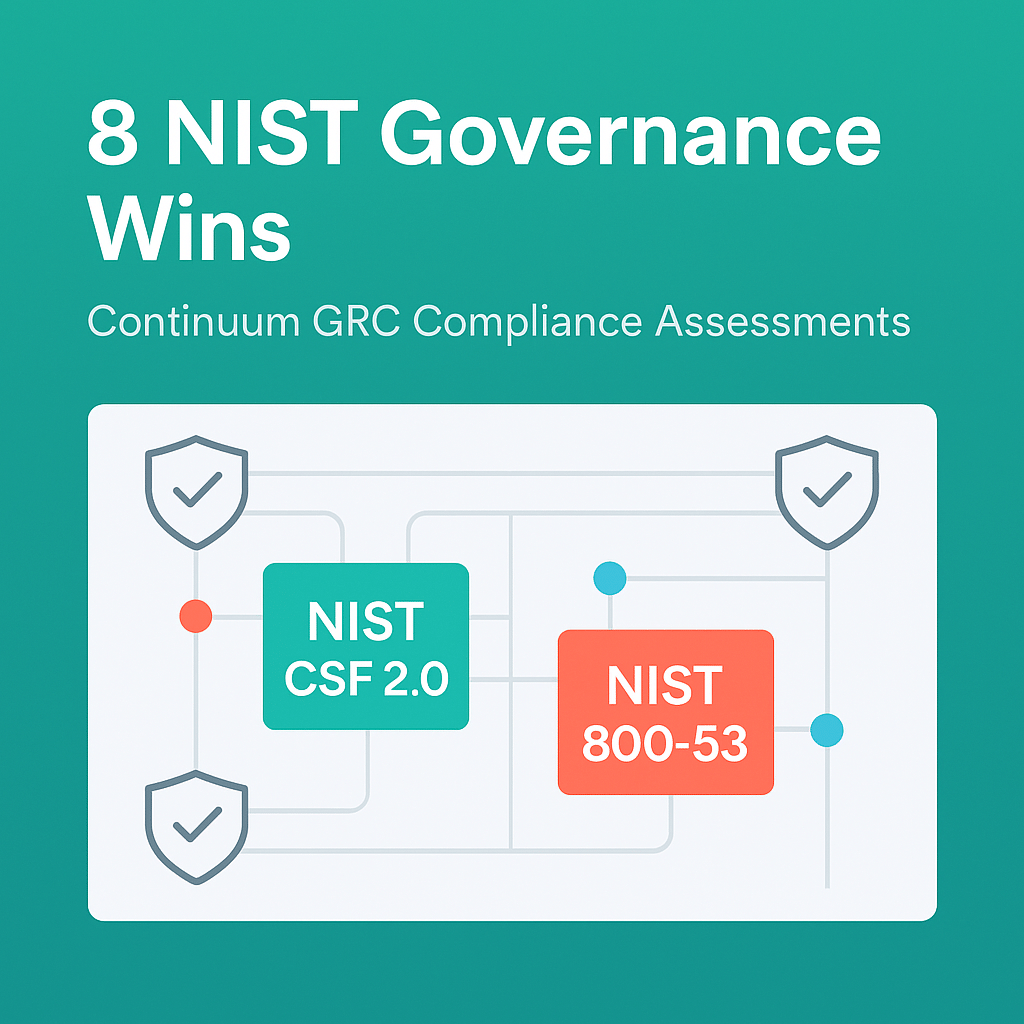
Continuum GRC discusses the practical value of NIST-centered governance for compliance assessments in Continuum GRC – NIST Governance Wins for Compliance Assessments.
2. Map Once, Test Many: Build Obligation-to-Control Traceability
Cross-framework control mapping should not be a spreadsheet of vague equivalencies. It should document the audit relationship between a framework requirement, a control objective, a control activity, test attributes, evidence artifacts, and responsible owners.
For CMMC and defense contracting, DoD CIO – Cybersecurity Maturity Model Certification explains CMMC program information, while NIST SP 800-171 Rev. 3 provides requirements for protecting controlled unclassified information in nonfederal systems and organizations. That relationship matters because a CMMC readiness effort cannot be treated as a brand-new audit if the organization already maintains strong NIST 800-171 evidence for access control, configuration management, incident response, risk assessment, security assessment, and system integrity.
A practical mapping record should include:
- Framework requirement, such as NIST 800-171 3.1.1 or PCI DSS v4.0.1 requirement area.
- Master control, such as NIST 800-53 AC-2, IA-2, IA-5, AU-6, CA-7, RA-3, or SI-2.
- Evidence artifact, such as an identity export, SIEM alert review, risk register, vulnerability scan, change ticket, or policy approval.
- Assessment procedure and sampling method.
- Evidence freshness rule, such as point-in-time, monthly, quarterly, annually, or continuous.
- Control owner, evidence owner, reviewer, and exception approver.
3. Convert Point-in-Time Artifacts into Reusable Evidence Packages
Many audit failures happen because evidence is technically present but context is missing. An auditor may receive a screenshot of a multi-factor authentication setting without knowing which tenant, application, user population, date, reviewer, or policy objective it supports.
A reusable evidence package should include the artifact, metadata, scope statement, control mapping, collection date, period covered, owner attestation, reviewer signoff, and exception notes. This is especially important for continuous monitoring. CISA states that cyber decoys can help organizations detect adversaries earlier, analyze intrusion information, allocate defensive resources more effectively, and reduce mean time to detection in CISA – New Guidance Helps Critical Infrastructure Detect, Observe and Impede Malicious Cyber Activity. Those monitoring outputs become stronger SOC 2, FedRAMP, and incident-response evidence when they are captured as complete packages rather than raw alerts.
4. Reuse Identity Evidence Across Cloud, SOC 2, FedRAMP, and HIPAA
Identity is one of the highest-value evidence reuse domains. CISA and NIST state that current cloud identity guidance supports risk-informed, threat-adaptive defenses across cloud environments and applies across commercial and government-operated cloud services in CISA – Guidelines to Protect Federal Cloud Identity Systems from Token Theft, Forgery, and Misuse. NIST IR 8587 addresses token management, key management, token verification, lifecycle controls, single sign-on, federation, API access, interoperability, continuous monitoring, and secure-by-design practices in NIST – Protecting Tokens and Assertions from Forgery, Theft, and Misuse.
Reusable identity evidence often includes user access listings, privileged access reviews, role-to-entitlement matrices, SSO configuration, MFA enforcement, service account inventories, token lifetime settings, API authorization rules, joiner-mover-leaver tickets, and emergency access logs.
5. Treat AI Governance Evidence as a New Reuse Layer
AI governance is becoming auditable. NIST’s AI work emphasizes measurable evaluation of trustworthy AI characteristics such as Safe, Secure and Resilient, Accountable and Transparent, Privacy-Enhanced, and Fair in NIST AI Risk Management Framework – Metric Submission Guidance. NIST NCCoE warns that autonomous AI agents can create risks including data leaks, compliance failures, prompt injection, and unpredictable autonomous behavior unless identity, authorization, and governance are properly managed in NIST NCCoE – Agentic AI Identity and Authorization. ISO is also developing a framework for describing AI systems as objects of conformity assessment in ISO – Framework for Describing AI Systems as Objects of Conformity Assessment.
Reusable AI evidence should include AI system inventories, model risk classifications, data lineage, human oversight decisions, vendor AI questionnaires, acceptable-use approvals, security testing of AI integrations, prompt-injection test results, privacy impact assessments, and board or committee oversight records. Continuum GRC addresses AI-focused audit automation in Continuum GRC – AI GRC Automation: 7 Cybersecurity Audit Wins Now.
6. Reuse Vulnerability and Patch Evidence Without Overclaiming Coverage
Vulnerability management evidence is frequently reusable, but it is also frequently overused. A monthly infrastructure scan may support NIST 800-53 SI-2, PCI DSS vulnerability management expectations, SOC 2 security monitoring, and ISO 27001 technical vulnerability management, but only for the assets included in scan scope.
PCI SSC provides PCI DSS v4.0.1 materials through its PCI Security Standards Council – Document Library, and PCI SSC states that its Secure Software Lifecycle Standard provides requirements and assessment procedures for software vendors to integrate security into development lifecycles in PCI Security Standards Council – Secure Software Lifecycle Standard. That means reusable vulnerability evidence must distinguish infrastructure scanning, application scanning, software supply-chain controls, remediation SLAs, risk acceptance, and production change validation.
7. Build Reuse Around Risk Treatment, Not Audit Requests
Evidence reuse should reduce cyber risk, not merely reduce auditor questions. CISA’s Critical Infrastructure Security and Resilience Month Toolkit emphasizes identifying critical systems, assessing risk, understanding dependencies, and using Cybersecurity Performance Goals to prioritize security investments in CISA – Critical Infrastructure Security and Resilience Month Toolkit. NIST’s draft operational technology guidance is structured around the NIST Cybersecurity Framework 2.0, including the Govern Function, and discusses use of the NIST Risk Management Framework in NIST CSRC – Draft Guide to OT Security.
In practice, this means every reusable evidence package should connect to a risk statement. For example: unmanaged service accounts increase unauthorized access risk; delayed patching increases exploitability risk; missing vendor SOC reports increase third-party assurance risk; incomplete logging reduces detection and investigation capability.
8. Use FedRAMP and GovRAMP-Style Discipline for Cloud Evidence
Cloud evidence benefits from authorization-style rigor. FedRAMP’s marketplace remains an authoritative route for identifying FedRAMP-certified cloud services, authorizing agencies, and FedRAMP-recognized assessors in FedRAMP – Fast Track to FedRAMP Certified Cloud Solutions. Even when an organization is not pursuing federal authorization, FedRAMP-style evidence discipline improves traceability for system boundaries, inherited controls, customer responsibilities, continuous monitoring, vulnerability management, incident response, and configuration baselines.
Continuum GRC discusses FedRAMP modernization and automation in Continuum GRC – FedRAMP 20x Automation.
9. Reuse Healthcare, Payment, and Privacy Evidence Carefully
HIPAA, PCI DSS, and GDPR evidence overlaps, but each framework has different scoping logic. HIPAA focuses on electronic protected health information and regulated entity obligations, PCI DSS focuses on cardholder data environments and payment security, and GDPR focuses on personal data processing, lawful bases, data subject rights, and controller-processor accountability under European Union – General Data Protection Regulation.
Reusable evidence may include risk analysis, encryption configuration, access reviews, logging, incident response, vendor contracts, privacy impact assessments, workforce training, and data retention procedures. Continuum GRC addresses combined PCI and HIPAA risk management in Continuum GRC – PCI HIPAA Audits: 9 Risk Moves with Continuum GRC.
10. Create an Evidence Reuse Operating Model
Tools matter, but operating discipline matters more. A mature evidence reuse model defines control ownership, evidence cadence, review workflows, authoritative systems of record, exception management, and executive reporting. It also defines when evidence cannot be reused because system scope, control design, operating effectiveness, time period, or audit criteria differ.
An anonymized scenario illustrates the point: a healthcare SaaS provider preparing for SOC 2, HIPAA, and PCI DSS had strong technical controls but failed initial readiness review because evidence owners submitted inconsistent screenshots from production, staging, and corporate identity tenants. The remediation was not more screenshots. The solution was a reusable evidence catalog tied to system boundaries, asset inventories, control mappings, and reviewer attestations. Within one assessment cycle, the organization reduced duplicate evidence collection, improved control-owner accountability, and strengthened executive visibility into unresolved exceptions.
Implementation Methodology: A 90-Day Evidence Reuse Roadmap
Days 1-30: Normalize Scope and Control Ownership
- Confirm systems, environments, business processes, data types, and third parties in scope.
- Create a master control library using NIST 800-53 as the backbone.
- Map SOC 1, SOC 2, ISO 27001, CMMC, FedRAMP, GovRAMP, PCI DSS, HIPAA, CJIS, C5, GDPR, and LADMF obligations to master controls where appropriate.
- Assign control owners, evidence owners, reviewers, and executive risk owners.
Days 31-60: Build Evidence Packages and Test Reuse
- Define evidence metadata requirements, including scope, period, owner, collection method, and review signoff.
- Prioritize high-reuse domains: identity, vulnerability management, logging, incident response, vendor risk, risk assessment, change management, and encryption.
- Run sample walkthroughs with audit, security operations, IT, privacy, legal, and procurement stakeholders.
- Document where evidence cannot be reused and why.
Days 61-90: Operationalize Continuous Evidence
- Automate evidence collection where systems of record are reliable.
- Schedule monthly or quarterly evidence refreshes based on control criticality and framework requirements.
- Report stale evidence, missing approvals, unresolved exceptions, and high-risk control gaps to governance committees.
- Prepare auditor-ready evidence indexes for each compliance assessment.
Common Pitfalls to Avoid
- Assuming mapped means equivalent. A control may appear similar across frameworks but require different testing depth, population, sampling, or evidence period.
- Ignoring system boundaries. Evidence from one cloud tenant, application, business unit, or geography may not support another.
- Collecting screenshots without metadata. A screenshot without source, date, scope, reviewer, and control mapping rarely stands alone.
- Overusing policies as operating evidence. A policy proves design intent; tickets, logs, approvals, reviews, and system settings prove operation.
- Failing to document exceptions. Auditors expect transparent risk acceptance, compensating controls, and remediation plans.
- Treating AI tools as out of scope. AI systems, AI vendors, model integrations, and autonomous agents can create security, privacy, and compliance obligations.
Frequently Asked Questions About Evidence Reuse
Can the same evidence support SOC 2 and ISO 27001?
Yes, when the evidence supports the relevant control objective, covers the correct scope, and meets the assessment period and testing criteria. However, ISO 27001 certification and SOC 2 reporting are different assurance models, so evidence reuse must preserve each assessor’s requirements.
Can CMMC evidence be reused from NIST 800-171 work?
Often yes. CMMC 2.0 alignment with protection of controlled unclassified information makes NIST 800-171 evidence highly relevant, but organizations still need assessment-ready documentation, scoping, system security plans, plans of action, and objective evidence tied to applicable requirements.
Does automation eliminate auditor questions?
No. Automation improves consistency, freshness, and traceability, but auditors still evaluate design, implementation, operating effectiveness, management review, exceptions, and scope.
Call to Action: Turn Audit Fatigue into Audit Leverage
If your organization is preparing for SOC 2, ISO 27001, FedRAMP, GovRAMP, CMMC, DFARS/NIST 800-171, HIPAA, PCI DSS, CJIS, C5, LADMF, GDPR, or multi-framework compliance assessments, Continuum GRC can help you replace fragmented evidence collection with reusable, mapped, auditor-ready GRC evidence. Contact Continuum GRC to evaluate your current control library, identify duplicate audit effort, and build an evidence reuse roadmap that supports stronger governance, risk management, and compliance assessment efficiency.
Sources and References
- NIST – SP 800-53 Rev. 5, Update 1
- HHS OCR – Ambry Genetics HIPAA Settlement
- Market Intelligence Tools – Cybersecurity Statistics
- Browsec – Data Breach Statistics, Costs and Causes
- Continuum GRC – NIST Governance Wins for Compliance Assessments
- DoD CIO – Cybersecurity Maturity Model Certification
- NIST – SP 800-171 Rev. 3
- CISA – New Guidance Helps Critical Infrastructure Detect, Observe and Impede Malicious Cyber Activity
- CISA – Guidelines to Protect Federal Cloud Identity Systems from Token Theft, Forgery, and Misuse
- NIST – Protecting Tokens and Assertions from Forgery, Theft, and Misuse
- NIST AI Risk Management Framework – Metric Submission Guidance
- NIST NCCoE – Agentic AI Identity and Authorization
- ISO – Framework for Describing AI Systems as Objects of Conformity Assessment
- Continuum GRC – AI GRC Automation: 7 Cybersecurity Audit Wins Now
- PCI Security Standards Council – Document Library
- PCI Security Standards Council – Secure Software Lifecycle Standard
- CISA – Critical Infrastructure Security and Resilience Month Toolkit
- NIST CSRC – Draft Guide to OT Security
- FedRAMP – Fast Track to FedRAMP Certified Cloud Solutions
- Continuum GRC – FedRAMP 20x Automation
- European Union – General Data Protection Regulation
- Continuum GRC – PCI HIPAA Audits: 9 Risk Moves with Continuum GRC
About Continuum GRC
We also provide risk management and compliance support for every major regulation and compliance framework on the market, including:
- FedRAMP
- GovRAMP
- GDPR
- NIST 800-53
- DFARS NIST 800-171, 800-172
- CMMC
- SOC 1, SOC 2
- HIPAA
- PCI DSS 4.0
- IRS 1075, 4812
- COSO SOX
- ISO 27000 Series
- ISO 9000 Series
- CJIS
- C5
- LADMF
- 100+ Frameworks
Continuum GRC is a proactive cybersecurity® and the only FedRAMP-authorized cybersecurity audit platform in the world. Call 1-888-896-6207 to discuss your organization’s cybersecurity needs and learn how we can help protect your systems and ensure compliance.
Related Posts